

Convergence Report, June 2026
The euro has already been introduced in 21 of the 27 EU Member States. This report examines five of the six Member States that have yet to adopt the single currency, namely the Czech Republic, Hungary, Poland, Romania and Sweden. These countries are committed under the Treaty on the Functioning of the European Union (hereinafter the “Treaty”) to adopt the euro, which implies that they must strive to fulfil all the convergence criteria.[1] The sixth Member State, Denmark has a special status and is therefore not covered in this report.[2]
In producing this report, the ECB fulfils its requirement under Article 140 of the Treaty. Article 140 states that at least once every two years, or at the request of an EU Member State with a derogation, the ECB and the European Commission must report to the EU Council “on the progress made by the Member States with a derogation in fulfilling their obligations regarding the achievement of economic and monetary union”. The five countries under review in this report have been examined as part of the regular two-year cycle. The European Commission has also prepared a report, and both reports are being submitted to the EU Council in parallel.
In this report, the ECB uses the framework applied in its previous Convergence Reports. For the five countries concerned, it examines whether a high degree of sustainable economic convergence has been achieved, whether the national legislation is compatible with the Treaties and the Protocol on the Statute of the European System of Central Banks and of the European Central Bank (hereinafter the “Statute of the ESCB”), and whether the statutory requirements are fulfilled for the relevant national central bank (NCB) to become an integral part of the Eurosystem.
The examination of the economic convergence process is highly dependent on the quality and integrity of the underlying statistics. The compilation and reporting of statistics must not be subject to political considerations or interference. EU Member States have been invited to consider the quality and integrity of their statistics as a matter of high priority, to ensure that a proper system of checks and balances is in place when these statistics are compiled, and to apply minimum standards in the domain of statistics. These standards are of the utmost importance in reinforcing the independence, integrity and accountability of the national statistical institutes and in supporting confidence in the quality of government finance statistics (see Chapter 6).
From 4 November 2014 it became mandatory for any EU Member State whose derogation is abrogated to join the Single Supervisory Mechanism (SSM) at the latest on the date on which it adopts the euro.[3] At that point, all SSM-related rights and obligations start to apply to that country. Therefore, it is of the utmost importance that the necessary preparations are made. In particular, the banking system of any Member State joining the euro area, and therefore the SSM, is subject to a comprehensive assessment.[4]
This report is structured as follows. Chapter 2 describes the framework used for the examination of economic and legal convergence. Chapter 3 provides a horizontal overview of the key aspects of economic convergence. Chapter 4 contains the country summaries, which provide the main results of the examination of economic and legal convergence. Chapter 5 examines in more detail the state of economic convergence in each of the five EU Member States under review. Chapter 6 provides an overview of the convergence indicators and the statistical methodology used to compile them. Finally, Chapter 7 examines the compatibility of the national legislation of the Member States under review, including the statutes of their NCBs, with Articles 130 and 131 of the Treaty.
2.1 Economic convergence
To examine the state of economic convergence in EU Member States seeking to adopt the euro, the ECB makes use of a common framework for analysis. This common framework, which has been applied in a consistent manner in all European Monetary Institute (EMI) and ECB Convergence Reports, is based, first, on the Treaty provisions and their application by the ECB with regard to developments in prices, fiscal balances and debt ratios, exchange rates and long‑term interest rates, as well as in other factors relevant to economic integration and convergence. Second, it is based on a range of additional backward and forward‑looking economic indicators considered to be useful for examining the sustainability of convergence in greater detail. Some elements of this framework have been enhanced over time. The examination of the Member State concerned based on all these factors also provides important information which helps to ensure that its integration into the euro area will proceed without major difficulties. Boxes 1 to 5 below outline the legal provisions and provide methodological details on the ECB’s application of these provisions.
This Convergence Report builds on principles set out in previous reports published by the ECB in order to ensure continuity and equal treatment. In particular, a number of guiding principles are used by the ECB (and prior to that by the EMI) in the application of the convergence criteria. First, the individual criteria are interpreted and applied in a strict manner. The rationale behind this principle is that the main purpose of the criteria is to ensure that only those Member States with economic conditions conducive to the maintenance of price stability and the coherence of the euro area can participate in it. Second, the convergence criteria constitute a coherent and integrated package, and they must all be satisfied. The Treaty lists the criteria on an equal footing and does not suggest a hierarchy. Third, the convergence criteria have to be met on the basis of actual data rather than forecasts. Fourth, the application of the convergence criteria should be consistent, transparent and simple. Moreover, when considering compliance with the convergence criteria, sustainability is an essential factor, as convergence must be achieved on a lasting basis and not just at a given point in time. For this reason, the country examination elaborates on the sustainability of convergence.
In this respect, economic developments in the country concerned are reviewed from a backward‑looking perspective covering, in principle, the past ten years. This helps to better determine the extent to which current achievements are the result of genuine structural adjustments, which in turn should lead to a better assessment of the sustainability of economic convergence.
In addition, and to the extent appropriate, a forward‑looking perspective is adopted. In this context, particular attention is paid to the fact that the sustainability of favourable economic developments hinges critically on appropriate and lasting policy responses to existing and future challenges. Strong governance, sound institutions and sustainable public finances are also essential for supporting price stability and sustainable output growth over the medium to long term. Overall, it is emphasised that ensuring the sustainability of economic convergence depends on the achievement of a strong starting position, the existence of sound institutions, resilience to shocks and the pursuit of appropriate policies after the adoption of the euro.
The cut‑off date for the statistics included in this Convergence Report was 17 June 2026. The statistical data used in the application of the convergence criteria were provided by the European Commission (see Chapter 6 as well as the statistical tables and charts), in cooperation with the ECB in the case of exchange rates and long‑term interest rates. In agreement with the Commission, the reference period for both the price stability criterion and the long-term interest rate criterion is from June 2025 to May 2026. For exchange rates, the reference period is from 18 June 2024 to 17 June 2026. Historical data on fiscal positions cover the period up to 2025. Account is also taken of forecasts from various sources and other information relevant to a forward‑looking examination of the sustainability of convergence. The report also takes into account the Commission’s Spring 2026 Economic Forecast and its Alert Mechanism Report 2026, which were released on 21 May 2026 and 25 November 2025 respectively. This report was adopted by the General Council of the ECB on 19 June 2026.
This Convergence Report also considers the impact of the war in the Middle East on the convergence assessment. Recent geopolitical tensions have contributed to increased uncertainty, including through potential effects on energy markets, trade routes and global financial conditions. While the initial impact has become visible in inflation developments and confidence indicators, the economic impact of the war will depend on the intensity and duration of the energy price shock and the scale of its indirect and second-round effects. Countries with a higher energy dependence and stronger trade links with the Middle East may be affected more than others. The impact will also depend on the macroeconomic environment and policy reactions in individual countries. The forward-looking part of the convergence assessment is therefore subject to greater uncertainty than usual.
With regard to price developments, the legal provisions and their application by the ECB are outlined in Box 1.
Box 1
Price developments
1. Treaty provisions
Article 140(1), first indent, of the Treaty requires the Convergence Report to examine the achievement of a high degree of sustainable convergence by reference to the fulfilment by each Member State of the following criterion:
“the achievement of a high degree of price stability; this will be apparent from a rate of inflation which is close to that of, at most, the three best performing Member States in terms of price stability”.
Article 1 of Protocol (No 13) on the convergence criteria stipulates that:
“The criterion on price stability referred to in the first indent of Article 140(1) of the Treaty on the Functioning of the European Union shall mean that a Member State has a price performance that is sustainable and an average rate of inflation, observed over a period of one year before the examination, that does not exceed by more than 1½ percentage points that of, at most, the three best performing Member States in terms of price stability. Inflation shall be measured by means of the consumer price index on a comparable basis taking into account differences in national definitions”.
2. Application of Treaty provisions
In the context of this report, the ECB applies the Treaty provisions as outlined below.
First, with regard to “an average rate of inflation, observed over a period of one year before the examination”, the inflation rate has been calculated using the change in the 12-month average of the HICP in the reference period from June 2025 to May 2026 compared with the previous 12-month average. Inflation has been measured on the basis of the HICP, which was developed for the purpose of assessing convergence in terms of price stability on a comparable basis (see Section 6.2). Second, the notion of “at most, the three best performing Member States in terms of price stability”, which is used for the definition of the reference value, has been applied by taking the unweighted arithmetic average of the rates of inflation of the three Member States with the lowest average inflation rates (excluding outliers).
It should be noted that the concept of “outlier” has been referred to in previous ECB Convergence Reports and in the Convergence Reports of the EMI. In line with those reports, a Member State is considered to be an outlier if two conditions are fulfilled: first, its 12-month average inflation rate is significantly below the euro area average; second, its price developments have been strongly affected by exceptional factors. The identification of outliers does not follow a mechanical approach. The outlier concept was introduced to deal appropriately with potential significant distortions in the inflation developments of individual countries that reduce the representativeness of the inflation rates in those countries as a benchmark for convergence. The ECB’s approach to identifying outliers in this report is in line with the approach followed in previous ECB Convergence Reports.
On this basis, for the purposes of this report, the three best performing Member States in terms of price stability are Cyprus (0.9%), France (1.2%) and Denmark (1.6%). Adding 1½ percentage points to the average of these three rates, the reference value for the price stability criterion is 2.7%. None of these three best performing Member States has been identified as a possible outlier for exclusion from the calculation of the reference value for price stability.
The average rate of HICP inflation over the 12‑month reference period from June 2025 to May 2026 is reviewed in light of the country’s economic performance over the last ten years in terms of price stability. This allows a more detailed examination of the sustainability of price developments in the country under review. Attention is paid to the orientation of monetary policy, in particular to whether the focus of the monetary authorities has been primarily on achieving and maintaining price stability, as well as to the contribution of other areas of economic policy to this objective. Moreover, the implications of the macroeconomic environment for the achievement of price stability are taken into account. Price developments are examined in light of supply and demand conditions, focusing on factors such as unit labour costs and import prices. Lastly, trends in other relevant price indices are considered. From a forward-looking perspective, a view is provided of prospective inflationary developments in the coming years, including forecasts by major international organisations and market participants. Moreover, institutional and structural aspects relevant to maintaining an environment conducive to price stability after adoption of the euro are discussed.
With regard to fiscal developments, the legal provisions and their application by the ECB, together with procedural issues, are outlined in Box 2.
Box 2
Fiscal developments
1. Treaty and other legal provisions
Article 140(1), second indent, of the Treaty requires the Convergence Report to examine the achievement of a high degree of sustainable convergence by reference to the fulfilment by each Member State of the following criterion:
“the sustainability of the government financial position; this will be apparent from having achieved a government budgetary position without a deficit that is excessive as determined in accordance with Article 126(6)”.
Article 2 of Protocol (No 13) on the convergence criteria stipulates that:
“The criterion on the government budgetary position referred to in the second indent of Article 140(1) of the said Treaty shall mean that at the time of the examination the Member State is not the subject of a Council decision under Article 126(6) of the said Treaty that an excessive deficit exists”.
Article 126 sets out the excessive deficit procedure (EDP). In accordance with Article 126(2) and (3), the European Commission prepares a report if a Member State does not fulfil the requirements for fiscal discipline, in particular if:
- the ratio of the planned or actual government deficit to GDP exceeds a reference value (defined in Protocol (No 12) on the excessive deficit procedure as 3% of GDP), unless either:
- the ratio has declined substantially and continuously and reached a level that comes close to the reference value; or, alternatively,
- the excess over the reference value is only exceptional and temporary and the ratio remains close to the reference value;
- the ratio of government debt to GDP exceeds a reference value (defined in Protocol (No 12) on the excessive deficit procedure as 60% of GDP), unless the ratio is sufficiently diminishing and approaching the reference value at a satisfactory pace.
In addition, the report prepared by the Commission must take into account whether the government deficit exceeds government investment expenditure and all other relevant factors, including the medium‑term economic and budgetary position of the Member State. The Commission may also prepare a report if, notwithstanding the fulfilment of the criteria, it is of the opinion that there is a risk of an excessive deficit in a Member State. The Economic and Financial Committee formulates an opinion on the Commission’s report. Lastly, in accordance with Article 126(6), the EU Council, on the basis of a recommendation from the Commission and having considered any observations which the Member State concerned may wish to make, decides, acting by qualified majority and excluding the Member State concerned, and following an overall assessment, whether an excessive deficit exists in a Member State.
The Treaty provisions under Article 126 are further clarified by Regulation (EC) No 1467/97[5], as amended by Regulations (EU) Nos 1177/2011[6] and 2024/1264[7], which, among other things:
- confirms the equal footing of the debt criterion with the deficit criterion by making the former operational;
- specifies the conditions under which a ratio of government debt to GDP which exceeds the reference value shall be considered sufficiently diminishing and approaching the reference value at a satisfactory pace in accordance with Article 126(2)(b) of the Treaty. The reformed EU fiscal framework modifies the conditions under which a ratio of government debt to GDP that exceeds the reference value shall be considered sufficiently diminishing and approaching the reference value at a satisfactory pace in accordance with Article 126(2)(b). Notably, Article 2(2) of the Regulation provides that the requirement shall be considered fulfilled if the Member State concerned respects its net expenditure path as set by the Council.[8] The Commission shall prepare a report in accordance with Article 126(3) of the Treaty when the ratio of government debt to GDP exceeds the reference value, the budgetary position is not close to balance or in surplus, and the deviations recorded in the control account of the Member State exceed either 0.3 percentage points of GDP annually or 0.6 percentage points of GDP cumulatively;
- details the relevant factors that the Commission shall take into account when preparing a report under Article 126(3) of the Treaty. Most importantly, it mentions a series of factors considered relevant in assessing developments in medium‑term economic, budgetary and government debt positions (see Article 2(3) of the Regulation).
2. Application of Treaty provisions
For the purpose of examining convergence, the ECB expresses its view on fiscal developments. With regard to sustainability, the ECB examines key indicators of fiscal developments from 2016 to 2025, the outlook and the challenges for general government finances, focusing on the links between deficit and debt developments. Regarding the impact of the COVID-19 pandemic and Russia’s war against Ukraine on general government finances, the ECB refers to the Stability and Growth Pact’s general escape clause, which was activated from 20 March 2020 until 31 December 2023 (i.e. before the reform of the Stability and Growth Pact in April 2024), as laid down in Articles 5(1) and 9(1) of Regulation (EC) No 1466/97[9] for the preventive arm and in Article 3(5) of Regulation (EC) No 1467/97 for the corrective arm. Regarding the impact of unlocking additional flexibility for higher defence expenditure, the ECB refers to the Stability and Growth Pact’s national escape clause, which was introduced in the reform of April 2024. Article 26 of Regulation (EU) 2024/1263 stipulates that “following a request from a Member State and on a recommendation by the Commission based on its analysis, the Council may within four weeks of the Commission recommendation adopt a recommendation allowing a Member State to deviate from its net expenditure path as set by the Council where exceptional circumstances outside the control of the Member State have a major impact on the public finances of the Member State concerned, provided that such deviation does not endanger fiscal sustainability over the medium term”. The ECB also provides an analysis with regard to the effectiveness of national budgetary frameworks, as referred to in Article 2(3)(d) of Regulation (EC) No 1467/97 and in Directive 2011/85/EU[10]. With regard to Article 126 of the Treaty, the ECB, in contrast to the Commission, has no formal role in the EDP. Therefore, the ECB report only states whether the country is subject to an EDP.
With regard to the Treaty provision that a debt ratio of above 60% of GDP should be “sufficiently diminishing and approaching the reference value at a satisfactory pace”, the ECB examines past and future trends in the debt ratio. For Member States in which the debt ratio exceeds the reference value, the ECB provides the Commission’s latest assessment as laid down in Article 2(3) of Regulation (EC) No 1467/97.
The examination of fiscal developments is based on data compiled on a national accounts basis, in compliance with the European System of Accounts 2010 (ESA 2010) (see Chapter 6). Most of the figures presented in this report were provided by the Commission in April and May 2026 and include government financial positions from 2016 to 2025 as well as Commission forecasts for the period 2026‑27.
With regard to the sustainability of public finances, the outcome in the reference year, 2025, is reviewed in light of the performance of the country under review over the past ten years. First, the development of the deficit ratio is investigated. It is useful to bear in mind that the change in a country’s annual deficit ratio is typically influenced by a variety of underlying forces. These influences can be divided into “cyclical effects” on the one hand, which reflect the reaction of deficits to changes in the economic cycle, and “non‑cyclical effects” on the other hand, which are often taken to reflect structural or permanent adjustments to fiscal policies. However, such non‑cyclical effects, as quantified in this report, cannot necessarily be seen as entirely reflecting a structural change to fiscal positions, because they include temporary effects on the budgetary balance stemming from the impact of both policy measures and special factors.
As a further step, the development of the government debt ratio in this period is considered, as well as the factors underlying it. These factors are the difference between nominal GDP growth and interest rates, the primary balance and the deficit‑debt adjustment. Such a perspective can offer further information on the extent to which the macroeconomic environment, in particular the combination of growth and interest rates, has affected the dynamics of debt. In addition, the structure of government debt is considered, focusing in particular on the shares of debt with a short‑term maturity and foreign currency debt, as well as their development. By comparing these shares with the current level of the debt ratio, the sensitivity of fiscal balances to changes in exchange rates and interest rates can be highlighted.
With the entry into force of the reformed Stability and Growth Pact in 2024 came new rules on the opening of a debt-based excessive deficit procedure (EDP). While the rules on opening a deficit-based EDP remain largely unchanged, the rules on opening a debt-based EDP have been amended as described in Box 2. However, given that net expenditure paths, as set by the EU Council, cover fiscal strategies only as of 2025, no debt-based EDPs were opened prior to 2026.
The general escape clause of the Stability and Growth Pact was activated for the period 2020-23, and in April 2025 the EU Council initiated a coordinated request for activation of the national escape clause. The activation of the general escape clause allowed Member States to depart from the budgetary requirements that would have normally applied in order to facilitate the necessary policy coordination measures in the context of the pandemic and Russia’s war against Ukraine within the framework of the Stability and Growth Pact. On 19 March 2025 the European Commission then proposed a coordinated activation of the national escape clause, allowing countries to deviate from their endorsed net expenditure path in order to unlock additional budgetary space for higher defence expenditure. In particular, the Commission stated that “Russia’s war of aggression against Ukraine and its threat to European security are exceptional circumstances outside the control of Member States, which have a major impact on Member States’ public finances through the related incurred and/or planned increase in defence expenditure”.[11] On 30 April 2025 the Council issued a statement on a coordinated request for activation of the national escape clause.[12] At the cut-off date for this report, the Council had activated the clause for 17 Member States, including three of the countries under review (the Czech Republic, Hungary and Poland). The clause covers a period of four years and a maximum of 1.5% of GDP in flexibility.
Turning to a forward‑looking perspective, recent forecasts by the European Commission for the period 2026‑27 and the assessment of long-term challenges to debt sustainability are considered. This includes, in particular, the outlook for budget balances and debt ratios on the basis of current fiscal policies. In addition, long‑term challenges to the sustainability of budgetary positions and broad areas for consolidation are emphasised, particularly those related to unfunded government pension systems in connection with demographic change and to contingent liabilities incurred by government. Under the new rules, countries’ medium-term budgetary plans are outlined in their national fiscal-structural plans, which they have published since autumn 2024. These plans present a net expenditure trajectory covering a period of at least four years and outline government fiscal strategies as of 2025.
With regard to exchange rate developments, the legal provisions and their application by the ECB are outlined in Box 3.
Box 3
Exchange rate developments
1. Treaty provisions
Article 140(1), third indent, of the Treaty requires the Convergence Report to examine the achievement of a high degree of sustainable convergence by reference to the fulfilment by each Member State of the following criterion:
“the observance of the normal fluctuation margins provided for by the exchange‑rate mechanism of the European Monetary System, for at least two years, without devaluing against the euro”.
Article 3 of Protocol (No 13) on the convergence criteria stipulates that:
“The criterion on participation in the Exchange Rate mechanism of the European Monetary System referred to in the third indent of Article 140(1) of the said Treaty shall mean that a Member State has respected the normal fluctuation margins provided for by the exchange‑rate mechanism on the European Monetary System without severe tensions for at least the last two years before the examination. In particular, the Member State shall not have devalued its currency’s bilateral central rate against the euro on its own initiative for the same period”.
2. Application of Treaty provisions
With regard to exchange rate stability, the ECB examines whether the country has participated in ERM II (which superseded the ERM as of January 1999) for a period of at least two years prior to the convergence examination without severe tensions, in particular without devaluing against the euro. In cases of shorter periods of participation, exchange rate developments are described over a two‑year reference period.
The examination of exchange rate stability against the euro focuses on the exchange rate being close to the ERM II central rate, while also taking into account factors that may have led to an appreciation, which is in line with the approach taken in the past. In this respect, the width of the fluctuation band within ERM II does not prejudice the examination of the exchange rate stability criterion.
Moreover, the issue of the absence of “severe tensions” is generally addressed by: (i) examining the degree of deviation of exchange rates from the ERM II central rates against the euro; (ii) using indicators such as exchange rate volatility vis‑à‑vis the euro and its trend, as well as short‑term interest rate differentials vis‑à‑vis the euro area and their development; (iii) considering the role played by foreign exchange interventions; and (iv) considering the role of international financial assistance programmes in stabilising the currency.
The reference period in this report is from 18 June 2024 to 17 June 2026. The bilateral exchange rates referred to are official ECB reference rates (see Chapter 6).
In addition to ERM II participation and nominal exchange rate developments against the euro over the period under review, evidence relevant to the sustainability of the current exchange rate is briefly reviewed. This is derived from the development of the real effective exchange rates and the current, capital and financial accounts of the balance of payments. The evolution of gross external debt and the net international investment position over longer periods is also examined. The section on exchange rate developments additionally considers measures of the degree of a country’s integration with the euro area. This is assessed in terms of both external trade integration (exports and imports) and financial integration. Lastly, the section on exchange rate developments reports, if applicable, whether the country under examination has benefited from central bank liquidity assistance or balance of payments support during the two-year reference period. Both actual and precautionary assistance are considered.
With regard to long‑term interest rate developments, the legal provisions and their application by the ECB are outlined in Box 4.
Box 4
Long‑term interest rate developments
1. Treaty provisions
Article 140(1), fourth indent, of the Treaty requires the Convergence Report to examine the achievement of a high degree of sustainable convergence by reference to the fulfilment by each Member State of the following criterion:
“the durability of convergence achieved by the Member State with a derogation and of its participation in the exchange‑rate mechanism being reflected in the long‑term interest‑rate levels”.
Article 4 of Protocol (No 13) on the convergence criteria stipulates that:
“The criterion on the convergence of interest rates referred to in the fourth indent of Article 140(1) of the said Treaty shall mean that, observed over a period of one year before the examination, a Member State has had an average nominal long‑term interest rate that does not exceed by more than two percentage points that of, at most, the three best performing Member States in terms of price stability. Interest rates shall be measured on the basis of long‑term government bonds or comparable securities, taking into account differences in national definitions”.
2. Application of Treaty provisions
In the context of this report, the ECB applies the Treaty provisions as outlined below.
First, with regard to “an average nominal long‑term interest rate” observed over “a period of one year before the examination”, the long‑term interest rate has been calculated as an arithmetic average over the latest 12 months for which HICP data were available. The reference period considered in this report is from June 2025 to May 2026, in line with the reference period for the price stability criterion.
Second, the notion of “at most, the three best performing Member States in terms of price stability”, which is used for the definition of the reference value, has been applied by using the unweighted arithmetic average of the long‑term interest rates of the same three Member States included in the calculation of the reference value for the criterion on price stability (see Box 1). Over the reference period considered in this report, the long‑term interest rates of the three Member States with the lowest inflation rate included in the calculation of the reference value for the price stability criterion were 2.6% (Denmark), 3.1% (Cyprus) and 3.5% (France). As a result, the average rate is 3.1% and, adding two percentage points, the reference value is 5.1%.[13]
As mentioned above, the Treaty makes explicit reference to the “durability of convergence” being reflected in the level of long‑term interest rates. Therefore, developments over the review period from June 2024 to May 2026 are reviewed against the background of the path of long‑term interest rates over the past ten years (or the period for which data are available) and the main factors underlying differentials vis‑à‑vis the average long‑term interest rate prevailing in the euro area. In theory, during the review period, the average euro area long‑term interest rate may have partly reflected high country‑specific risk premia in several euro area countries. Therefore, the euro area AAA long‑term government bond yield (i.e. the long‑term yield of the euro area AAA yield curve, which includes the euro area countries with an AAA rating) is also used for comparison purposes. As background to this analysis, this report also provides information about the size and development of the financial market. This is based on three different indicators (the outstanding amount of debt securities issued by financial and non‑financial corporations, stock market capitalisation and credit from monetary financial institutions to the domestic non-financial private sector), which together provide a measure of the size of financial markets.
Lastly, Article 140(1) of the Treaty requires this report to take account of several other relevant factors (see Box 5). In this respect, an enhanced economic governance framework in accordance with Article 121(6) of the Treaty entered into force in December 2011 with the aim of ensuring a closer coordination of economic policies and the sustained convergence of EU Member States’ economic performances. Box 5 below briefly outlines these legislative provisions and the way in which the above‑mentioned additional factors are addressed in the assessment of convergence conducted by the ECB.
Box 5
Other relevant factors
1. Treaty and other legal provisions
Article 140(1) of the Treaty requires that “the reports of the Commission and the European Central Bank shall also take account of the results of the integration of markets, the situation and development of the balances of payments on current account and an examination of the development of unit labour costs and other price indices”.
In this respect, the ECB takes into account the legislative package on EU economic governance which entered into force on 13 December 2011. Building on the Treaty provisions under Article 121(6), the European Parliament and the EU Council adopted detailed rules for the multilateral surveillance procedure referred to in Article 121(3) and (4) of the Treaty. These rules were adopted “in order to ensure closer coordination of economic policies and sustained convergence of the economic performances of the Member States” (Article 121(3)) in view of the “need to draw lessons from the first decade of functioning of the economic and monetary union and, in particular, for improved economic governance in the Union built on stronger national ownership”.[14] The legislative package includes an enhanced surveillance framework (the macroeconomic imbalance procedure or MIP) aimed at preventing excessive macroeconomic and macro‑financial imbalances by helping diverging EU Member States to establish corrective plans before divergence becomes entrenched.
2. Application of Treaty provisions
In line with past practice, the additional factors referred to in Article 140(1) of the Treaty are reviewed in Chapter 5 under the headings of the individual criteria described in Boxes 1 to 4. For completeness, in Chapter 3 the scoreboard indicators are presented for the countries covered in this report (including in relation to the alert thresholds), thereby ensuring the provision of all available information relevant to the detection of macroeconomic and macro‑financial imbalances that may be hampering the achievement of a high degree of sustainable convergence as stipulated in Article 140(1) of the Treaty. Notably, EU Member States with a derogation that are subject to an excessive imbalance procedure can hardly be considered as having achieved a high degree of sustainable convergence as stipulated in Article 140(1) of the Treaty.
2.2 Compatibility of national legislation with the Treaties
2.2.1 Introduction
Article 140(1) of the Treaty requires the ECB (and the European Commission) to report, at least once every two years or at the request of a Member State with a derogation, to the Council on the progress made by the Member States with a derogation in fulfilling their obligations regarding the achievement of economic and monetary union. These reports must include an examination of the compatibility of the national legislation of each Member State with a derogation, including the statutes of its NCB, with Articles 130 and 131 of the Treaty and the relevant Articles of the Statute of the ESCB. This Treaty obligation of Member States with a derogation is also referred to as “legal convergence”.
When assessing legal convergence, the ECB is not limited to making a formal assessment of the letter of national legislation but may also consider whether the implementation of the relevant provisions complies with the spirit of the Treaties and the Statute of the ESCB. The ECB is particularly concerned about any signs of pressure being put on the decision-making bodies of any Member State’s NCB which would be inconsistent with the spirit of the Treaty as regards central bank independence.
The ECB also sees the need for the smooth and continuous functioning of the NCBs’ decision-making bodies. In this respect, the relevant authorities of a Member State have, in particular, the duty to take the necessary measures to ensure the timely appointment of a successor if the position of a member of an NCB’s decision-making body becomes vacant.[15]
The ECB will closely monitor any developments prior to making a positive final assessment concluding that a Member State’s national legislation is compatible with the Treaty and the Statute of the ESCB.
2.2.1.1 Member States with a derogation and legal convergence
The Czech Republic, Hungary, Poland, Romania and Sweden, whose national legislation is examined in this report, each have the status of a Member State with a derogation, i.e. they have not yet adopted the euro. Sweden was given the status of a Member State with a derogation by a decision of the Council in May 1998.[16] As far as the Czech Republic, Hungary, Poland and Romania are concerned, Articles 4[17] and 5[18] of the Acts concerning the conditions of accession provide that each of these Member States is to participate in the Economic and Monetary Union from the date of accession as a Member State with a derogation within the meaning of Article 139 of the Treaty.
This report does not cover Denmark, which is a Member State with a special status and which has not yet adopted the euro. Protocol (No 16) on certain provisions relating to Denmark, annexed to the Treaties, provides that, in view of the notice given to the Council by the Danish Government on 3 November 1993, Denmark has an exemption and that the procedure for the abrogation of the derogation will only be initiated at the request of Denmark. As Article 130 of the Treaty applies to Denmark, Danmarks Nationalbank has to fulfil the requirements of central bank independence. The EMI’s Convergence Report of 1998 concluded that this requirement had been fulfilled. There has been no assessment of Danish convergence since 1998 due to Denmark’s special status. Until such time as Denmark notifies the Council that it intends to adopt the euro, Danmarks Nationalbank does not need to be legally integrated into the Eurosystem and no Danish legislation needs to be adapted.
The aim of assessing legal convergence is to facilitate the Council’s decisions as to which Member States fulfil “their obligations regarding the achievement of economic and monetary union” (Article 140(1) of the Treaty). In the legal domain, such conditions refer in particular to central bank independence and to the NCBs’ legal integration into the Eurosystem.
2.2.1.2 Structure of the legal assessment
The legal assessment broadly follows the framework of the previous reports of the ECB and the EMI on legal convergence.[19]
The compatibility of national legislation is considered in the light of legislation enacted before 25 March 2026.
2.2.2 Scope of adaptation
2.2.2.1 Areas of adaptation
For the purpose of identifying those areas where national legislation needs to be adapted, the following issues are examined:
- compatibility with provisions on the independence of NCBs, members of NCBs’ decision-making bodies and Governors in the Treaty (Article 130) and the Statute of the ESCB (Articles 7 and 14.2);
- compatibility with provisions on confidentiality (Article 37 of the Statute of the ESCB);
- compatibility with the prohibitions on monetary financing (Article 123 of the Treaty) and privileged access (Article 124 of the Treaty);
- compatibility with the single spelling of the euro required by EU law; and
- legal integration of the NCBs into the Eurosystem (in particular as regards Articles 12.1 and 14.3 of the Statute of the ESCB).
2.2.2.2 “Compatibility” versus “harmonisation”
Article 131 of the Treaty requires national legislation to be “compatible” with the Treaties and the Statute of the ESCB; any incompatibility must therefore be remedied. Neither the primacy of the Treaties and the Statute of the ESCB over national legislation nor the nature of the incompatibility affects the need to comply with this obligation.
The requirement for national legislation to be “compatible” does not mean that the Treaty requires “harmonisation” of the NCBs’ statutes, either with each other or with the Statute of the ESCB. National particularities may continue to exist to the extent that they do not infringe the competence in monetary matters that is irrevocably conferred on the EU. Indeed, Article 14.4 of the Statute of the ESCB permits NCBs to perform functions other than those specified in the Statute of the ESCB, to the extent that they do not interfere with the objectives and tasks of the ESCB.[20] Provisions authorising such additional functions in NCBs’ statutes are a clear example of circumstances in which differences may remain. Rather, the term “compatible” indicates that national legislation and the NCBs’ statutes need to be adjusted to eliminate inconsistencies with the Treaties and the Statute of the ESCB and to ensure the necessary degree of integration of the NCBs into the ESCB. In particular, any provisions that infringe an NCB’s independence, as defined in the Treaty, and its role as an integral part of the ESCB, should be adjusted. It is therefore insufficient to rely solely on the primacy of EU law over national legislation to achieve this.
The obligation in Article 131 of the Treaty only covers incompatibility with the Treaties and the Statute of the ESCB. However, national legislation that is incompatible with secondary EU legislation relevant for the areas of adaptation examined in this Convergence Report should be brought into line with such secondary legislation. The primacy of EU law does not affect the obligation to adapt national legislation. This general requirement derives not only from Article 131 of the Treaty but also from the case law of the Court of Justice of the European Union.[21]
The Treaties and the Statute of the ESCB do not prescribe the manner in which national legislation should be adapted. Compatibility may therefore be achieved by removing any national legislation which is incompatible with EU law or by referring to the Treaties and the Statute of the ESCB, or, exceptionally, by incorporating provisions thereof and referring to their provenance, subject to the following qualifications:
As a rule, a reproduction of relevant provisions of Union law directly applicable in the legal order of the Member State using the same language is to be avoided.[22] A reproduction may create uncertainty both as to the legal nature and origin of the applicable provisions and as to the date of their entry into force. This would not align with the principle of uniform application and interpretation of Union law throughout the Union.[23] Moreover, if a national provision uses wording that is different from that used in the relevant Union provision, it creates regulatory content of its own. In accordance with Article 2(1) of the Treaty, the Union’s exclusive competence in matters of monetary policy precludes Member States from adopting provisions which, in the light of their objective and content, establish legal rules governing the use of the euro as the single currency, unless Member States have been empowered to do so.[24] In this context, the concept of monetary policy is not limited to its operational implementation, which, under Article 127(2), first indent, of the Treaty is one of the basic tasks of the Eurosystem. It also has a regulatory dimension intended to guarantee the status of the euro as the single currency.[25]
In exceptional circumstances, a reproduction of relevant provisions of Union law directly applicable in the legal order of the Member State using the same language may be used for the sake of coherence and in order to make them comprehensible to the persons to whom they apply. Where such exceptional circumstances allowing for a reproduction of directly applicable provisions of Union law exist, provisions should be reproduced precisely, and the wording should not be modified.[26] Furthermore, provisions should be reproduced only to the extent warranted by the exceptional circumstances. However, such exceptional circumstances do not exist where the directly applicable provisions of Union law are sufficiently coherent and comprehensive, making it unnecessary to repeat or reflect them in national law.[27] Where directly applicable provisions of Union law are merely relevant in the context of the areas covered by the national law, the national law does not need to reference these provisions. To the extent that national law necessarily reproduces directly applicable provisions of Union law for the abovementioned reasons, it should do so in an explicit manner and clarify that its provisions are either “in accordance with” or “in compliance with” the relevant provisions of Union law, where the latter are merely reproduced to put the national law in the larger context, or “without prejudice to” the relevant provisions of Union law, where a national authority exercises residual competences that go beyond those exercised within the ESCB and the Eurosystem.[28]
Furthermore, as a tool for achieving and maintaining the compatibility of national legislation with the Treaties and the Statute of the ESCB, the ECB must be consulted by the EU institutions and by the Member States on draft legislative provisions in its fields of competence, pursuant to Articles 127(4) and 282(5) of the Treaty and Article 4 of the Statute of the ESCB. Council Decision 98/415/EC[29] expressly requires Member States to take the measures necessary to ensure compliance with this obligation.
2.2.3 Independence of NCBs
As far as central bank independence is concerned, national legislation in the Member States that joined the EU in 2004, 2007 or 2013 had to be adapted to comply with the relevant provisions of the Treaty and the Statute of the ESCB, and be in force on 1 May 2004, 1 January 2007 and 1 July 2013 respectively.[30] Sweden had to bring the necessary adaptations into force by the date of establishment of the ESCB on 1 June 1998.
2.2.3.1 Central bank independence
In November 1995, the EMI established a list of features of central bank independence (later described in detail in its 1998 Convergence Report) which were the basis for assessing the national legislation of the Member States at that time, in particular the NCBs’ statutes. The concept of central bank independence includes various types of independence that must be assessed separately, namely: functional, institutional, personal, and financial independence. Over the past few years there has been further refinement of the analysis of these aspects of central bank independence in the opinions adopted by the ECB. These aspects are the basis for assessing the level of convergence between the national legislation of the Member States with a derogation and the Treaties and the Statute of the ESCB.
2.2.3.2 Functional independence
Central bank independence is not an end in itself but is instrumental in achieving an objective that should be clearly defined and should prevail over any other objective. Functional independence requires each NCB’s primary objective to be stated in a clear and legally certain way and to be fully in line with the primary objective of price stability established by the Treaty. The pursuit of this objective is served by providing the NCBs with the necessary means and instruments for achieving this objective independently of any other authority. The Treaty’s requirement of central bank independence reflects the generally held view that the primary objective of price stability is best served by a fully independent institution with a precise definition of its mandate. Central bank independence is fully compatible with holding NCBs accountable for their decisions, which is an important aspect of enhancing confidence in their independent status. This entails transparency and dialogue with third parties.
As regards timing, the Treaty is not clear about when the NCBs of Member States with a derogation must comply with the primary objective of price stability set out in Articles 127(1) and 282(2) of the Treaty and Article 2 of the Statute of the ESCB. For those Member States that joined the EU after the date of the introduction of the euro in the EU, it is not clear whether this obligation should run from the date of accession or from the date of their adoption of the euro. While Article 127(1) of the Treaty does not apply to Member States with a derogation (see Article 139(2)(c) of the Treaty), Article 2 of the Statute of the ESCB does apply to such Member States (see Article 42.1 of the Statute of the ESCB). The ECB takes the view that the obligation of the NCBs to have price stability as their primary objective runs from 1 June 1998 in the case of Sweden, and from 1 May 2004, 1 January 2007 and 1 July 2013 for the Member States that joined the EU on those dates. This is based on the fact that one of the guiding principles of the EU, namely price stability (Article 119 of the Treaty), also applies to Member States with a derogation. It is also based on the Treaty objective that all Member States should strive for macroeconomic convergence, including price stability, which is the intention behind the regular reports of the ECB and the European Commission. This conclusion is also based on the underlying rationale of central bank independence, which is only justified if the overall objective of price stability has primacy.
The country assessments in this report are based on these conclusions as to the timing of the obligation of the NCBs of Member States with a derogation to have price stability as their primary objective.
2.2.3.3 Institutional independence
Institutional independence is reflected in Article 130 of the Treaty and Article 7 of the Statute of the ESCB. These two articles prohibit the NCBs and members of their decision-making bodies from seeking or taking instructions from EU institutions or bodies, from any government of a Member State or from any other body. In addition, they prohibit EU institutions, bodies, offices or agencies, and the governments of the Member States from seeking to influence those members of the NCBs’ decision-making bodies whose decisions may affect the fulfilment of the NCBs’ ESCB-related tasks. For national legislation to mirror Article 130 of the Treaty and Article 7 of the Statute of the ESCB, it should reflect both prohibitions and not narrow the scope of their application.[31] The recognition that central banks have such independence does not have the consequence of exempting them from every rule of law or of shielding them from any kind of legislation.[32]
Whether an NCB is organised as a state-owned body, a special public law body or simply a public limited company, there is a risk that influence may be exerted by the owner on its decision-making in relation to ESCB-related tasks by virtue of such ownership.[33] Such influence, whether exercised through shareholders’ rights or otherwise, may affect an NCB’s independence and should therefore be limited by law.
The legal framework for central banking needs to provide a stable and long-term basis for a central bank’s functioning. Frequent changes to the institutional set-up of an NCB, affecting its organisational or governance stability, could adversely affect that NCB’s institutional independence.[34]
Prohibition on giving instructions
Rights of third parties to give instructions to NCBs, their decision-making bodies or their members are incompatible with the Treaty and the Statute of the ESCB as far as ESCB-related tasks are concerned.
Any involvement of an NCB in the application of measures to strengthen financial stability must be compatible with the Treaty, i.e. NCBs’ functions must be performed in a manner that is fully compatible with their functional, institutional, and financial independence so as to safeguard the proper performance of their tasks under the Treaty and the Statute of the ESCB.[35] To the extent that national legislation provides for a role of an NCB that goes beyond advisory functions and requires it to assume additional tasks, it must be ensured that these tasks will not affect the NCB’s ability to carry out its ESCB-related tasks from an operational and financial point of view.[36] Additionally, the inclusion of NCB representatives in collegiate decision-making supervisory bodies or other authorities would need to give due consideration to safeguards for the personal independence of the members of the NCB’s decision-making bodies.[37]
Prohibition on approving, suspending, annulling or deferring decisions
Rights of third parties to approve, suspend, annul or defer an NCB’s decisions are incompatible with the Treaty and the Statute of the ESCB as far as ESCB-related tasks are concerned.[38]
Prohibition on censoring decisions on legal grounds
A right for bodies other than independent courts to censor, on legal grounds, decisions relating to the performance of ESCB-related tasks is incompatible with the Treaty and the Statute of the ESCB, since the performance of these tasks may not be reassessed at the political level. A right of an NCB Governor to suspend the implementation of a decision adopted by the ESCB or by an NCB decision-making body on legal grounds and subsequently to submit it to a political body for a final decision would be equivalent to seeking instructions from third parties.
Prohibition on participation in decision-making bodies of an NCB with a right to vote
Participation by representatives of third parties in an NCB’s decision-making body with a right to vote on matters concerning the performance by the NCB of ESCB-related tasks is incompatible with the Treaty and the Statute of the ESCB, even if such vote is not decisive.[39] Such participation even without the right to vote is incompatible with the Treaty and the Statute of the ESCB, if such participation interferes with the performance of ESCB-related tasks by that decision-making bodies or endangers compliance with the ESCB’s confidentiality regime.[40]
Prohibition on ex ante consultation relating to an NCB’s decision
An express statutory obligation for an NCB to consult third parties ex ante relating to an NCB’s decision provides third parties with a formal mechanism to influence the final decision and is therefore incompatible with the Treaty and the Statute of the ESCB.
However, dialogue between an NCB and third parties, even when based on statutory obligations to provide information and exchange views, is compatible with central bank independence provided that:
- this does not result in interference with the independence of the members of the NCB’s decision-making bodies;
- the special status of Governors in their capacity as members of the ECB’s decision-making bodies is fully respected; and
- confidentiality requirements resulting from the Statute of the ESCB are observed.[41]
Discharge provided for the duties of members of the NCB’s decision-making bodies
Statutory provisions regarding the discharge provided by third parties (e.g. governments) regarding the duties of members of the NCB’s decision-making bodies (e.g. in relation to accounts) should contain adequate safeguards, so that such a power does not impinge on the capacity of the individual NCB member independently to adopt decisions in respect of ESCB-related tasks (or implement decisions adopted at ESCB level). Inclusion of an express provision to this effect in NCB statutes is recommended.
Relationship between national legislation and the ethics framework established by the ECB
National legislation, including that which transposes EU legislation, is without prejudice to the ethics framework established by the ECB in order to ensure the independence of the ECB and the NCBs when exercising the powers and carrying out the tasks and duties conferred upon them by the Treaties and the Statute of the ESCB, as this framework has its own scope and legal basis.[42] To avoid doubt, the national legislator may wish to clarify this within the relevant national legislation.
2.2.3.4 Personal independence
Article 130 of the Treaty and Articles 7 and 14.2 of the Statute of the ESCB further safeguard central bank independence in relation to Governors and members of NCBs’ decision-making bodies. Governors are members of the General Council of the ECB and become members of the Governing Council upon adoption of the euro by their Member States. Governors cannot be regarded as representatives of a Member State when they perform their duties as members of the Governing Council or the General Council of the ECB.[43] Article 14.2 of the Statute of the ESCB provides that NCB statutes must, in particular, provide for a minimum term of office of five years for Governors. It also protects against Governors being arbitrarily relieved from their office by providing that they may only be relieved from office if they no longer fulfil the conditions required for performing their duties or if they have been found guilty of serious misconduct. In such cases, Article 14.2 of the Statute of the ESCB provides for the possibility of recourse to the Court of Justice of the European Union, which has the power to annul the national decision taken to relieve a Governor from office.[44] The suspension of a Governor may effectively amount to relieving a Governor from office for the purposes of Article 14.2 of the Statute of the ESCB.[45] NCB statutes must comply with this provision as set out below.
Article 130 of the Treaty prohibits national governments and any bodies from influencing the members of NCBs’ decision-making bodies in the performance of their tasks. In particular, Member States may not seek to influence the members of the NCB’s decision-making bodies by amending national legislation affecting their remuneration, which, as a matter of principle, should apply only for future appointments.[46] However, the independence requirements laid down in Article 130 of the Treaty are not breached by changes in the remuneration of the members of NCBs’ decision-making bodies which are decided by the NCB’s own decision-making bodies and are based on objective criteria, for example, by benchmarking salaries with the aim of ensuring proportionality between the different hierarchical positions at an NCB.[47]
Minimum term of office for Governors
In accordance with Article 14.2 of the Statute of the ESCB, NCB statutes must provide for a minimum term of office of five years for a Governor. This does not preclude longer terms of office, while an indefinite term of office does not require adaptation of the statutes provided the grounds for the relieving a Governor from office are in line with those of Article 14.2 of the Statute of the ESCB. Shorter periods cannot be justified even if only applied during a transitional period.[48] National legislation which provides for a compulsory retirement age should ensure that the retirement age does not interrupt the minimum term of office provided by Article 14.2 of the Statute of the ESCB, which prevails over any compulsory retirement age, if applicable to a Governor.[49] When NCB statutes are amended, the amending law should safeguard the security of tenure of the Governor and of other members of decision-making bodies who are involved in the performance of ESCB-related tasks.[50]
Grounds for relieving Governors from office
NCB statutes must ensure that Governors may not be dismissed for reasons other than those mentioned in Article 14.2 of the Statute of the ESCB. The purpose of the requirement under that Article is to prevent the authorities involved in the appointment of Governors, particularly the relevant government or parliament, from arbitrarily dismissing a Governor. NCB statutes should delete any incompatibility with the grounds for relieving from office laid down in Article 14.2 of the Statute of the ESCB or omit any mention of grounds for relieving from office (since Article 14.2 is directly applicable).[51] Once elected or appointed, Governors may not be relieved from office under conditions other than those mentioned in Article 14.2 of the Statute of the ESCB even if they have not yet taken up their duties. As the conditions under which a Governor may be relieved from office are autonomous concepts of Union law, their application and interpretation do not depend on national contexts.[52] Ultimately, it is for the Court of Justice of the European Union, in accordance with the powers conferred on it by Article 14.2, second subparagraph, of the Statute of the ESCB, to interpret these concepts.[53]
Security of tenure and grounds for relieving from office of members of NCBs’ decision-making bodies, other than Governors, who are involved in the performance of ESCB-related tasks
Applying the same rules for the security of tenure and grounds for relieving of Governors from office to other members of the decision-making bodies of NCBs involved in the performance of ESCB-related tasks will also safeguard the personal independence of those persons.[54] Article 130 of the Treaty and Article 7 of the Statute of the ESCB refer to “members of the decision-making bodies” of NCBs, rather than to Governors specifically. This applies in particular where a Governor is “first among equals” with colleagues with equivalent voting rights or where such other members are involved in the performance of ESCB-related tasks.
Right of judicial review
Governors as well as other members of the NCBs’ decision-making bodies must have the right to submit any decision to relieve them from their office to an independent court of law, in order to limit the potential for political discretion in evaluating the grounds for such a decision.
Article 14.2 of the Statute of the ESCB stipulates that Governors who have been dismissed from office may refer such a decision to the Court of Justice of the European Union. The Court of Justice of the European Union has the power to annul the national measure of dismissal if it is found to be contrary to Union law.
On the basis of Article 130 of the Treaty and Article 7 of the Statute of the ESCB, national legislation should provide for a right of review by the national courts of a decision to dismiss members of NCBs’ decision-making bodies (other than Governors) involved in the performance of ESCB-related tasks.[55] This right can either be a matter of general law or can it take the form of a specific provision. Even though this right may be available under the general law, for reasons of legal certainty it could be advisable to provide specifically for such a right of review.
Safeguards against conflicts of interest
Personal independence also entails ensuring that no conflict of interest arises between the duties of members of NCB decision-making bodies involved in the performance of ESCB-related tasks in relation to their respective NCBs (and of Governors also in relation to the ECB) and any other functions which such members of decision-making bodies may have and which may jeopardise their personal independence.[56] As a matter of principle, membership of a decision-making body involved in the performance of ESCB-related tasks is incompatible with the exercise of other functions that might create a conflict of interest. In particular, members of such decision-making bodies may not hold an office or have an interest that may influence their activities, whether through office in the executive or legislative branches of the state or in regional or local administrations, or through involvement in a business organisation. Particular care should be taken to prevent potential conflicts of interest on the part of non-executive members of decision-making bodies.
2.2.3.5 Financial independence
The overall independence of an NCB would be jeopardised if it could not autonomously avail itself of sufficient financial resources to fulfil its mandate, i.e. to perform the ESCB-related tasks required of it under the Treaty and the Statute of the ESCB.[57]
Member States may not put their NCBs in a position where they have insufficient financial resources and inadequate net equity[58] to carry out their ESCB or Eurosystem-related tasks, as applicable. This would be the case if, for example, an NCB was precluded from building up adequate financial resources in the form of reserves or buffers to offset losses, particularly those resulting from monetary policy operations, and the Member State concerned did not ensure in advance that the NCB had the necessary funds to bear the financial burden resulting from exercising a function outside the scope of the ESCB (such as the funds necessary to be able to pay the compensation resulting from the liability regime for that function), while retaining its ability to carry out its ESCB tasks effectively and independently.[59] It should be noted that Articles 28.1 and 30.4 of the Statute of the ESCB provide for the possibility of the ECB making further calls on the NCBs to contribute to the ECB’s capital and to make further transfers of foreign reserves.[60] Moreover, Article 33.2 of the Statute of the ESCB provides[61] that, in the event of a loss incurred by the ECB which cannot be fully offset against the general reserve fund, the ECB’s Governing Council may decide to offset the remaining loss against the monetary income of the relevant financial year in proportion to and up to the amounts allocated to the NCBs. The principle of financial independence means that compliance with these provisions requires an NCB to be able to perform its functions unimpaired.
For all the reasons mentioned above, financial independence also implies that an NCB should always be sufficiently capitalised. In particular, any situation should be avoided whereby for a prolonged period of time an NCB’s net equity is below the level of its statutory capital or is even negative, including where losses beyond the level of capital and the reserves are carried over.[62] Any such situation may negatively impact on the NCB’s ability to perform its ESCB-related tasks. Moreover, such a situation may affect the credibility of the Eurosystem’s monetary policy. Therefore, the event of an NCB’s net equity becoming less than its statutory capital or even negative would require that the respective Member State provides the NCB with an appropriate amount of capital at least up to the level of the statutory capital within a reasonable period of time so as to comply with the principle of financial independence. As concerns the ECB, the relevance of this issue has already been recognised by the Council by adopting Council Regulation (EC) No 1009/2000.[63] It enabled the Governing Council of the ECB to decide on an actual increase of the ECB’s capital to sustain the adequacy of the capital base to support the operations of the ECB;[64] NCBs should be financially able to respond to such ECB decision.
The concept of financial independence should be assessed from the perspective of whether any third party is able to exercise either direct or indirect influence not only over an NCB’s ESCB-related tasks but also over its ability to fulfil its mandate financially in terms of appropriate financial resources. The aspects of financial independence set out below are particularly relevant in this respect.[65] These are the features of financial independence where NCBs are most vulnerable to outside influence.
Determination of budget
If a third party has the power to determine or influence an NCB’s budget, this is incompatible with financial independence unless the law provides a safeguard clause so that such a power is without prejudice to the financial means necessary for carrying out the NCB’s ESCB-related tasks.[66]
The accounting rules
The accounts should be drawn up either in accordance with general accounting rules or in accordance with rules specified by an NCB’s decision-making bodies. If, instead, such rules are specified by third parties, the rules must at least take into account what has been proposed by the NCB’s decision-making bodies.
The annual accounts should be adopted by the NCB’s decision-making bodies, assisted by independent accountants, and may be subject to ex post approval by third parties (e.g. the government or parliament). The NCB’s decision-making bodies should be able to decide on the calculation of the profits independently and professionally.
Where an NCB’s operations are subject to the control of a state audit office or similar body charged with controlling the use of public finances, the scope of the control should be clearly defined by the legal framework,[67] should be without prejudice to the activities of the NCB’s independent external auditors[68] and further, in line with the principle of institutional independence, it should comply with the prohibition on giving instructions to an NCB and its decision-making bodies and should not interfere with the NCB’s ESCB-related tasks.[69] The state audit should be done on a non-political, independent and purely professional basis.[70]
Distribution of profits, NCBs’ capital and financial provisions
With regard to profit allocation, an NCB’s statutes may prescribe how its profits are to be allocated. In the absence of such provisions, decisions on the allocation of profits should be taken by the NCB’s decision-making bodies on professional grounds, and should not be subject to the discretion of third parties unless there is an express safeguard clause stating that this is without prejudice to the financial means necessary for carrying out the NCB’s ESCB-related tasks.[71]
Profits may be distributed to the State budget only after any accumulated losses from previous years have been covered and financial provisions deemed necessary to safeguard the real value of the NCB’s capital and assets have been created.[72] Temporary or ad hoc legislative measures amounting to instructions to the NCBs in relation to the distribution of their profits are not permissible.[73]
Any income accruing to the NCB as a result of the management of official foreign reserves can only be distributed to the State through the process for the distribution of profits as set out in the relevant legislative and statutory provisions.[74] Similarly, a tax on an NCB’s unrealised capital gains would also impair the principle of financial independence.[75]
A Member State may not impose reductions of capital on an NCB without the ex-ante agreement of the NCB’s decision-making bodies, which must aim to ensure that it retains sufficient financial means to fulfil its mandate under Article 127(2) of the Treaty and the Statute of the ESCB as a member of the ESCB. For the same reason, any amendment to the profit distribution rules of an NCB should only be initiated and decided in close cooperation with the NCB, which is best placed to assess its required level of reserve capital.[76] As regards financial provisions or buffers, NCBs must be free to independently create financial provisions to safeguard the real value of their capital and assets. Member States may also not hamper NCBs from building up their reserve capital to a level which is necessary for a member of the ESCB to fulfil its tasks.[77]
Financial liability for supervisory authorities
Most Member States place their financial supervisory authorities within their NCB. This is unproblematic if such authorities are subject to the NCB’s independent decision-making. However, if the law provides for separate decision-making by such supervisory authorities, it is important to ensure that decisions adopted by them do not endanger the finances of the NCB as a whole. In such cases, national legislation should enable the NCB to have ultimate control over any decision by the supervisory authorities that could affect an NCB’s independence, in particular its financial independence.[78]
Autonomy in staff matters
Member States may not impair an NCB’s ability to employ and retain the qualified staff necessary for the NCB to perform independently the tasks conferred on it by the Treaty and the Statute of the ESCB.[79] Also, an NCB may not be put into a position where it has limited control or no control over its staff, or where the government of a Member State can influence its policy on staff matters.[80] Any amendment to the legislative provisions on the remuneration for members of an NCB’s decision-making bodies and its employees should be decided in close and effective cooperation with the NCB,[81] taking due account of its views, to ensure the ongoing ability of the NCB to independently carry out its tasks.[82] Autonomy in staff matters extends to issues relating to staff pensions. Further, amendments that lead to reductions in the remuneration for an NCB’s staff should not interfere with that NCB’s powers to administer its own financial resources, including the funds resulting from any reduction in salaries that it pays.[83]
Ownership and property rights
Rights of third parties to intervene or to issue instructions to an NCB in relation to the property held by an NCB are incompatible with the principle of financial independence.
2.2.4 Confidentiality
The obligation of professional secrecy for ECB and NCB staff as well as for the members of the ECB and NCB governing bodies under Article 37 of the Statute of the ESCB may give rise to similar provisions in NCBs’ statutes or in the Member States’ legislation. The primacy of Union law and rules adopted thereunder also means that national laws on access by third parties to documents should comply with relevant Union law provisions, including Article 37 of the Statute of the ESCB, and may not lead to infringements of the ESCB’s confidentiality regime.[84] The access of a state audit office or similar body to an NCB’s confidential information and documents must be limited to what is necessary for the performance of the statutory tasks of the body that receives the information and must be without prejudice to the ESCB’s independence and the ESCB’s confidentiality regime to which the members of NCBs’ decision-making bodies and staff are subject.[85] NCBs should ensure that such bodies protect the confidentiality of information and documents disclosed at a level corresponding to that applied by the NCBs.
2.2.5 Prohibition on monetary financing and privileged access
On the monetary financing prohibition and the prohibition on privileged access, the national legislation of the Member States that joined the EU in 2004, 2007 or 2013 had to be adapted to comply with the relevant provisions of the Treaty and the Statute of the ESCB and be in force on 1 May 2004, 1 January 2007 and 1 July 2013 respectively. Sweden had to bring the necessary adaptations into force by 1 January 1995.
2.2.5.1 Prohibition on monetary financing
Article 123(1) of the Treaty prohibits overdraft facilities or any other type of credit facility with the ECB or with the NCBs in favour of EU institutions, bodies, offices or agencies, central governments, regional, local, or other public authorities, other bodies governed by public law, or public undertakings of Member States.
It also prohibits the purchase directly from these public sector entities by the ECB or NCBs of debt instruments. The Treaty contains one exemption from this monetary financing prohibition: it does not apply to publicly owned credit institutions which, in the context of the supply of reserves by central banks, must be given the same treatment as private credit institutions (Article 123(2) of the Treaty). The precise scope of application of the monetary financing prohibition is further clarified by Council Regulation (EC) No 3603/93,[86] according to which the prohibition includes any financing of the public sector’s obligations vis-à-vis third parties.
The monetary financing prohibition aims to encourage the Member States to follow a sound budgetary policy, not allowing monetary financing of public deficits (or privileged access by public authorities to the financial markets) to lead to excessively high levels of debt or excessive Member State deficits.[87] Therefore the prohibition must be interpreted extensively in order to ensure its strict application, subject only to the limited exemptions contained in Article 123(2) of the Treaty and Regulation (EC) No 3603/93. Thus, even if Article 123(1) of the Treaty refers specifically to “credit facilities”, i.e. with the obligation to repay the funds, the prohibition applies a fortiori to other forms of funding, i.e. without the obligation to repay.
The ECB’s general stance on the compatibility of national legislation with the prohibition has primarily been developed within the framework of consultations of the ECB by Member States on draft national legislation under Articles 127(4) and 282(5) of the Treaty.[88]
National legislation relating to the scope of application of the monetary financing prohibition
National legislation may not narrow the scope of application of the monetary financing prohibition or extend the exemptions available under EU law. For example, national legislation providing for the financing by the NCB of a Member State’s financial commitments to international financial institutions or to third countries is, in principle, incompatible with the monetary financing prohibition. As an exemption, Regulation (EC) No 3603/93 allows for the financing by the NCBs of obligations falling upon the public sector vis-à-vis the IMF provided that it results in foreign claims which have all the characteristics of reserve assets.[89] The relevant characteristics that determine the reserve asset quality of the claims concern their availability on demand to meet balance of payments financing needs and other related purposes, which implies that the credit quality and liquidity of the claims must be ensured.[90]
National legislation conferring tasks upon NCBs
National legislation assigning tasks to NCBs may not lead to any financing of the public sector’s obligations vis-à vis third parties. In accordance with Article 14.4 of the Statute of the ESCB, NCBs may perform functions other than those specified in the Statute of the ESCB unless the Governing Council finds that these functions interfere with the objectives and tasks of the ESCB. Where a Member State assigns such a function to its NCB, that NCB is responsible and liable for the performance of that function. Nevertheless, when defining the responsibility and liability of an NCB in relation to that function, Member States are required to comply with their obligations deriving from Union law and, in particular, Article 123(1) of the Treaty.[91]
Article 1(1), point (b), of Council Regulation (EC) No 3603/93 defines the term “other type of credit facility” for the purposes of Article 123 of the Treaty as, inter alia, any financing of the public sector’s obligations vis-à-vis third parties. Accordingly, the NCB concerned must not assume obligations vis-a-vis third parties that could potentially be incumbent on the public sector. Consequently, the NCB concerned must not finance pre-existing obligations vis-à-vis third parties that are incumbent on other public authorities or bodies and the effective financing of the obligations vis-à-vis third parties by the NCB concerned must not result directly from the measures adopted or the policy choices made by other public authorities or bodies.[92]
Advanced distribution of central bank profits
National legislation may not require the distribution of central bank profits which have not been fully realised, accounted for and audited. To comply with the monetary financing prohibition, the amount distributed to the State budget pursuant to the applicable profit distribution rules cannot be paid, even partially, from the NCB’s reserve capital. Therefore, profit distribution rules should leave unaffected the NCB’s reserve capital. Moreover, when NCB assets are transferred to the State, they must be remunerated at market value and the transfer should take place at the same time as the remuneration.[93]
Similarly, intervention in the performance of other Eurosystem tasks, such as the management of foreign reserves, by introducing taxation of theoretical and unrealised capital gains is not permitted since this would result in a form of central bank credit to the public sector through the advanced distribution of future and uncertain profits.[94] Similarly, a transfer of the foreign reserves (including the gold reserves) off the NCB’s balance sheet to the State would circumvent the prohibition of monetary financing, which prohibits central bank financing of the public sector.[95] Any income accruing to the NCB as a result of the management of such official foreign reserves can only be distributed to the State through the process for the distribution of profits as set out in the relevant legislative and statutory provisions.[96]
Assumption of public sector liabilities
National legislation which requires an NCB to take over the liabilities of a previously independent public body, as a result of a national reorganisation of certain tasks and duties (for example, in the context of a transfer to the NCB of certain supervisory tasks previously carried out by the state or independent public authorities or bodies), without fully insulating the NCB from all financial obligations resulting from the prior activities of such a body, would be incompatible with the monetary financing prohibition.[97]
National legislation holding an NCB liable on account of the exercise of a task assigned to it under national law would entail the assumption of a pre-existing obligation vis-à-vis third parties and be incompatible with the monetary financing prohibition if the third parties who have suffered harm were not compensated as a result of the NCB’s actions, i.e. the infringement by the NCB of the rules imposed on it in that context.[98] In addition, in case of tasks that require implementation of highly complex and urgent measures, such as those relating to the reorganisation or resolution of banks or central counterparties, national legislation holding an NCB liable on account of the exercise of such tasks would amount to the effective financing of the obligations vis-à-vis third parties if the NCB’s liability was not limited to infringements of a serious nature of the rules imposed on it in that context.[99]
The Court of Justice has not yet elaborated on what the limitations to infringements of a serious nature of the rules imposed on an NCB exactly consist of. In view of the different traditions for the liability of NCBs in the Member States’ national legal orders, such limitations may take different forms provided that they exclude the effective financing of the obligations of the public sector vis-à-vis third parties. This is the case if national law, addressing liability criteria for fault, limits the liability of the NCB concerned to gross negligence in view of the urgency and complexity of the case at hand.[100] The effective financing of the obligations of the public sector vis-à-vis third parties is also excluded if national law, addressing liability criteria for unlawful conduct instead of fault, limits judicial review of relevant measures by granting a large margin of discretion to the NCB concerned in view of the urgency and complexity of the case at hand.[101]
Financial support for credit and/or financial institutions
National legislation which provides for financing by an NCB, even if granted independently and at their full discretion, of insolvent credit and/or other financial institutions would be incompatible with the monetary financing prohibition.
The same would apply to the Eurosystem financing of a credit institution which has been recapitalised to restore its solvency by way of a direct placement of state-issued debt instruments where no alternative market-based funding sources exist (hereinafter “recapitalisation bonds”), and where such bonds are to be used as collateral. In such case of a state recapitalisation of a credit institution by way of direct placement of recapitalisation bonds, the subsequent use of the recapitalisation bonds as collateral in central bank liquidity operations raises monetary financing concerns.[102] Emergency liquidity assistance, granted by an NCB independently and at its full discretion to a solvent credit institution on the basis of collateral security in the form of a State guarantee, has to meet the following criteria: (a) it must be ensured that the credit provided by the NCB is as short term as possible; (b) there must be systemic stability aspects at stake; (c) there must be no doubts as to the legal validity and enforceability of the State guarantee under applicable national law; and (iv) there must be no doubts as to the economic adequacy of the State guarantee, which should cover both principal and interest on the loans.[103]
Financial support for resolution funds or financial arrangements and deposit insurance or investor compensation schemes
The financing by an NCB of a resolution fund or a deposit guarantee fund that qualifies as a “body governed by public law” within the meaning of Article 123(1) of the Treaty is not compatible with the monetary financing prohibition. A body is “governed by public law” if it has all of the following characteristics: (a) it is established for the specific purpose of meeting needs in the general interest, not having an industrial or commercial character; (b) it has legal personality; and (c) it is closely dependent on the public sector entities referred to in Article 123(1) of the Treaty. A close dependence on those public sector entities is presumed when a body is financed, for the most part, by them; or is subject to management supervision by them; or has an administrative, managerial or supervisory board, more than half of whose members are appointed by them.[104]
Even if the financing is not provided to a “body governed by public law”, the financing of any resolution fund or financial arrangement is not in line with the monetary financing prohibition.[105] Where an NCB acts as resolution authority, it should not, under any circumstances, assume or finance any obligation of either a bridge institution or an asset management vehicle.[106] To this end, national legislation should clarify that the NCB will not assume or finance any of these entities’ obligations.[107]
The Deposit Guarantee Schemes Directive[108] and the Investor Compensation Schemes Directive[109] provide that the costs of financing deposit guarantee schemes and investor compensation schemes must be borne, respectively, by credit institutions and investment firms themselves. With the exception of financing a “body governed by public law”, national legislation which provides for the financing by an NCB of a national deposit insurance scheme for credit institutions or a national investor compensation scheme for investment firms would be compatible with the monetary financing prohibition only if it were short term, addressed urgent situations, systemic stability aspects were at stake, and decisions were at the NCB’s discretion.[110] In particular, central bank support for deposit guarantee schemes should not amount to a systematic pre-funding operation.[111]
Fiscal agency function
Article 21.2 of the Statute of the ESCB establishes that the “ECB and the national central banks may act as fiscal agents” for “Union institutions, bodies, offices or agencies, central governments, regional local or other public authorities, other bodies governed by public law, or public undertakings of Member States”. The purpose of Article 21.2 of the Statute of the ESCB is, following transfer of the monetary policy competence to the Eurosystem, to clarify that NCBs may continue to provide the fiscal agent service traditionally provided to governments and other public entities without infringing the monetary financing prohibition. In addition, Regulation (EC) No 3603/93 establishes a number of explicit and narrowly drafted exemptions from the monetary financing prohibition relating to the fiscal agency function, as follows: (a) intra-day credits to the public sector are permitted provided that they remain limited to the day and that no extension is possible;[112] (b) crediting the public sector’s account with cheques issued by third parties before the drawee bank has been debited is permitted if a fixed period of time corresponding to the normal period for the collection of cheques by the NCB concerned has elapsed since receipt of the cheque, provided that any float which may arise is exceptional, is of a small amount and averages out in the short term;[113] and (c) the holding of coins issued by and credited to the public sector is permitted where the amount of such assets remains at less than 10 % of coins in circulation.[114]
National legislation on the fiscal agency function should be compatible with EU law in general, and with the monetary financing prohibition in particular.[115] Taking into account the express recognition in Article 21.2 of the Statute of the ESCB of the provision of fiscal agency services, which is a legitimate function traditionally performed by NCBs, the provision by central banks of fiscal agency services complies with the monetary financing prohibition, provided that such services remain within the field of the fiscal agency function and do not constitute central bank financing of public sector obligations vis-à-vis third parties or central bank crediting of the public sector outside the narrowly defined exceptions specified in Regulation (EC) No 3603/93.[116] National legislation that enables an NCB to hold government deposits and to service government accounts does not raise concerns about compliance with the monetary financing prohibition as long as such provisions do not enable the extension of credit, including overnight overdrafts. However, there would be a concern about compliance with the monetary financing prohibition if, for example, national legislation were to enable the remuneration of deposits or current account balances above, rather than at or below, market rates. Remuneration that is above market rates constitutes a de facto credit, contrary to the objective of the prohibition on monetary financing, and might therefore undermine that objective. It is essential for any remuneration of an account to reflect market parameters and it is particularly important to correlate the remuneration rate of the deposits with their maturity.[117] Moreover, the provision without remuneration by an NCB of fiscal agent services does not raise monetary financing concerns, provided they are core fiscal agent services.[118]
2.2.5.2 Prohibition on privileged access
Article 124 of the Treaty provides that “[a]ny measure, not based on prudential considerations, establishing privileged access by Union institutions, bodies, offices or agencies, central governments, regional, local or other public authorities, other bodies governed by public law, or public undertakings of Member States to financial institutions, shall be prohibited”. As with the monetary financing prohibition, the prohibition of privileged access aims to encourage the Member States to follow a sound budgetary policy, not allowing (monetary financing of public deficits or) privileged access by public authorities to the financial markets to lead to excessively high levels of debt or excessive Member State deficits.[119]
Under Article 1(1) of Council Regulation (EC) No 3604/93,[120] privileged access is understood as any law, regulation or other binding legal instrument adopted in the exercise of public authority which: (a) obliges financial institutions to acquire or to hold liabilities of EU institutions or bodies, central governments, regional, local or other public authorities, other bodies governed by public law or public undertakings of Member States, or (b) confers tax advantages that only benefit financial institutions or financial advantages that do not comply with the principles of a market economy, in order to encourage those institutions to acquire or hold such liabilities.
As public authorities, NCBs may not take measures granting privileged access to financial institutions by the public sector if such measures are not based on prudential considerations. Furthermore, the rules on the mobilisation or pledging of debt instruments enacted by the NCBs must not be used as a means of circumventing the prohibition on privileged access.[121] Member States’ legislation in this area may not establish such privileged access.
Article 2 of Regulation (EC) No 3604/93 defines “prudential considerations” as those which underlie national laws, regulations or administrative actions based on, or consistent with, EU law and designed to promote the soundness of financial institutions so as to strengthen the stability of the financial system as a whole and the protection of the customers of those institutions. Prudential considerations seek to ensure that banks remain solvent with regard to their depositors.[122] In the area of prudential supervision, EU secondary legislation has established a number of requirements to ensure the soundness of credit institutions.[123] A “credit institution” has been defined as an undertaking whose business is to receive deposits or other repayable funds from the public and to grant credits for its own account.[124] Additionally, credit institutions, commonly referred to as “banks”, require an authorisation by a competent Member State authority to provide services.[125]
Although minimum reserves might be seen as a part of prudential requirements, they are part of an NCB’s operational framework and used as a monetary policy tool in most economies, including in the euro area.[126] In this respect, paragraph 2 of Annex I to Guideline (EU) 2015/510 of the European Central Bank (ECB/2014/60)[127] states that the Eurosystem’s minimum reserve system primarily pursues the aims of stabilising the money market interest rates and creating (or enlarging) a structural liquidity shortage.[128] The ECB requires credit institutions established in the euro area to hold the required minimum reserves (in the form of deposits) on account with their NCB.[129]
This report focuses on the compatibility both of national legislation or rules adopted by NCBs and of the NCBs’ statutes with the Treaty prohibition on privileged access. However, this report is without prejudice to an assessment of whether laws, regulations, rules or administrative acts in Member States are used under the cover of prudential considerations as a means of circumventing the prohibition on privileged access. Such an assessment is beyond the scope of this report.
2.2.6 Single spelling of the euro
Article 3(4) of the Treaty on European Union lays down that the “Union shall establish an economic and monetary union whose currency is the euro”. In the texts of the Treaties in all the authentic languages written using the Roman alphabet, the euro is consistently identified in the nominative singular case as “euro”. In the Greek alphabet text, the euro is spelled “ευρώ” and in the Cyrillic alphabet text the euro is spelled “евро”.[130] Consistent with this, Regulation (EC) No 974/98 makes it clear that the name of the single currency must be the same in all the official languages of the EU, taking into account the existence of different alphabets. The Treaties thus require a single spelling of the word “euro” in the nominative singular case in all EU and national legislative provisions, taking into account the existence of different alphabets.
In view of the exclusive competence of the EU to determine the name of the single currency, any deviations from this rule are incompatible with the Treaties and should be eliminated.[131] While this principle applies to all national legislation, the assessment in the country chapters focuses on the NCBs’ statutes and the euro changeover laws.
2.2.7 Legal integration of NCBs into the Eurosystem
Provisions in national legislation (in particular an NCB’s statutes, but also other legislation) which would prevent the performance of Eurosystem-related tasks or compliance with the ECB’s decisions are incompatible with the effective operation of the Eurosystem once the Member State concerned has adopted the euro. National legislation therefore has to be adapted to ensure compatibility with the Treaty and the Statute of the ESCB in respect of Eurosystem-related tasks. To comply with Article 131 of the Treaty, national legislation had to be adjusted to ensure its compatibility by the date of establishment of the ESCB (as regards Sweden) and by 1 May 2004, 1 January 2007 and 1 July 2013 (as regards the Member States that joined the EU on these dates). Nevertheless, statutory requirements relating to the full legal integration of an NCB into the Eurosystem need only enter into force at the moment that full integration becomes effective, i.e. the date on which the Member State with a derogation adopts the euro.
The main areas examined in this report are those in which statutory provisions may hinder NCBs’ compliance with the Eurosystem’s requirements. These include provisions (a) that could prevent NCBs from taking part in implementing the single monetary policy, as defined by the ECB’s decision-making bodies, or (b) that could hinder a Governor from fulfilling their duties as a member of the ECB’s Governing Council, or (c) that do not respect the ECB’s prerogatives, or (d) that do not recognise that the exclusive competence for ESCB-related tasks in Member States whose currency is the euro is irrevocably conferred on the Union,[132] or (e) under which NCBs in the performance of their ESCB-related tasks are bound by decisions of national authorities that conflict with legal acts of the ECB. Distinctions are made between economic policy objectives, tasks, financial provisions, exchange rate policy and international cooperation. Finally, other areas where NCBs’ statutes may need to be adapted are mentioned.
2.2.7.1 Economic policy objectives
The full integration of an NCB into the Eurosystem requires its statutory objectives to be compatible with the ESCB’s objectives, as laid down in Article 2 of the Statute of the ESCB. Among other things, this means that statutory objectives with a “national flavour” – for example, where statutory provisions refer to an obligation to conduct monetary policy within the framework of the general economic policy of the Member State concerned – need to be adapted. Furthermore, an NCB’s secondary objectives must be consistent and not interfere with its obligation to support the general economic policies in the EU with a view to contributing to the achievement of the objectives of the EU as laid down in Article 3 of the Treaty on European Union, which is itself an objective expressed to be without prejudice to maintaining price stability.[133]
2.2.7.2 Tasks
The tasks of an NCB of a Member State whose currency is the euro are predominantly determined by the Treaty and the Statute of the ESCB, given that NCB’s status as an integral part of the Eurosystem. In order to comply with Article 131 of the Treaty, provisions on tasks in an NCB’s statutes therefore need to be compared with the relevant provisions of the Treaty and the Statute of the ESCB, and any incompatibility must be removed.[134] This applies to any provision that, after adoption of the euro and integration into the Eurosystem, constitutes an impediment to carrying out ESCB-related tasks and in particular to provisions which do not respect the ESCB’s powers under Chapter IV of the Statute of the ESCB.
Any national legislative provisions relating to monetary policy must recognise that the EU’s monetary policy is to be carried out through the Eurosystem.[135] An NCB’s statutes may contain provisions on monetary policy instruments. Such provisions should be compatible with those in the Treaty and the Statute of the ESCB, and any incompatibility must be removed in order to comply with Article 131 of the Treaty.
Monitoring fiscal developments is a task that an NCB carries out on a regular basis to assess properly the stance to be taken in monetary policy. NCBs may also present their views on relevant fiscal developments on the basis of their monitoring activity and the independence of their advice, with a view to contributing to the proper functioning of the European Monetary Union. The monitoring of fiscal developments by an NCB for monetary policy purposes should be based on the full access to all relevant public finance data. Accordingly, the NCBs should be granted unconditional, timely and automatic access to all relevant public finance statistics. However, an NCB’s role should not go beyond monitoring activities that result from or are linked – directly or indirectly – to the discharge of their monetary policy mandate.[136] A formal mandate for an NCB to assess forecasts and fiscal developments implies a function for the NCB in (and a corresponding responsibility for) fiscal policymaking which may risk undermining the discharge of the Eurosystem’s monetary policy mandate and the NCB’s independence.[137]
In the context of the national legislative initiatives to address the turmoil in the financial markets, the ECB has emphasised that any distortion in the national segments of the euro area money market should be avoided, as this may impair the implementation of the single monetary policy. In particular, this applies to the extension of State guarantees to cover interbank deposits.[138]
Member States must ensure that national legislative measures addressing liquidity problems of businesses or professionals, for example their debts to financial institutions, do not have a negative impact on market liquidity. In particular, such measures may not be inconsistent with the principle of an open market economy, as reflected in Article 3 of the Treaty on European Union, as this could hinder the flow of credit, materially influence the stability of financial institutions and markets and therefore affect the performance of Eurosystem tasks.[139]
National legislative provisions assigning the exclusive right to issue banknotes to the NCB must recognise that, once the euro is adopted, the ECB’s Governing Council has the exclusive right to authorise the issue of euro banknotes, pursuant to Article 128(1) of the Treaty and Article 16 of the Statute of the ESCB,[140] while the right to issue euro banknotes belongs to the ECB and the NCBs. Once the euro is adopted, national legislative provisions enabling the government to influence issues such as the denominations, production, volume or withdrawal of banknotes must also either be repealed or recognition must be given to the ECB’s powers with regard to euro banknotes, as set out in the provisions of the Treaty and the Statute of the ESCB. Irrespective of the division of responsibilities in relation to coins between governments and NCBs, the relevant provisions must recognise the ECB’s power to approve the volume of issue of euro coins once the euro is adopted. A Member State may not consider currency in circulation as its NCB’s debt to the government of that Member State, as this would defeat the concept of a single currency and be incompatible with the requirements of Eurosystem legal integration.[141]
With regard to foreign reserve management,[142] any Member State that has adopted the euro and which does not transfer its official foreign reserves[143] to its NCB is in breach of the Treaty. The ESCB task of holding and managing foreign reserves includes all actions necessary for its effective performance of the Eurosystem’s mandate. For instance, for reserve assets to accomplish their function in foreign reserve management operations, the aspect of full effective control by the central bank is essential. This implies the ability of NCBs to take decisions, in complete autonomy, relating to the holding, retention, disposal, negotiation and daily, as well as long-term, management of the foreign reserves, including by buying and selling gold outright, spot and forward and under repurchase agreements.[144] In addition, any right of a third party – for example, the government or parliament – to influence an NCB’s decisions with regard to the management of the official foreign reserves would be inconsistent with Article 127(2), third indent, of the Treaty. Furthermore, NCBs have to provide the ECB with foreign reserve assets in proportion to their shares in the ECB’s subscribed capital. This means that there must be no legal obstacles to NCBs transferring foreign reserve assets to the ECB.
With regard to statistics, although regulations adopted under Article 34.1 of the Statute of the ESCB in the field of statistics do not confer any rights or impose any obligations on Member States that have not adopted the euro, Article 5 of the Statute of the ESCB, which concerns the collection of statistical information, applies to all Member States, regardless of whether they have adopted the euro. Accordingly, Member States whose currency is not the euro are under an obligation to design and implement, at national level, all measures they consider appropriate to collect the statistical information needed to fulfil the ECB’s statistical reporting requirements[145] and to make timely preparations in the field of statistics in order for them to become Member States whose currency is the euro.[146] National legislation laying down the framework for cooperation between the NCBs and national statistical offices should guarantee the NCBs’ independence in the performance of their tasks within the ESCB’s statistical framework.[147]
2.2.7.3 Financial provisions
The financial provisions in the Statute of the ESCB comprise rules on financial accounts,[148] auditing,[149] capital subscription,[150] the transfer of foreign reserve assets[151] and the allocation of monetary income.[152] NCBs must be able to comply with their obligations under these provisions and therefore any incompatible national provisions must be repealed.[153]
2.2.7.4 Exchange rate policy
A Member State with a derogation may retain national legislation which provides that the government is responsible for the exchange rate policy of that Member State, with a consultative and/or executive role being granted to the NCB. However, by the time that a Member State adopts the euro, such legislation must reflect the fact that responsibility for the euro area’s exchange rate policy has been transferred to the EU level in accordance with Articles 138 and 219 of the Treaty.
2.2.7.5 International cooperation
For the adoption of the euro, national legislation must be compatible with Article 6.1 of the Statute of the ESCB, which provides that in the field of international cooperation involving the tasks entrusted to the Eurosystem, the ECB decides how the ESCB is represented. National legislation allowing an NCB to participate in international monetary institutions must make such participation subject to the ECB’s approval (Article 6.2 of the Statute of the ESCB).
2.2.7.6 Miscellaneous
In addition to the above issues, for certain Member States there are other areas where national provisions need to be adapted (for example in the area of clearing and payment systems and the exchange of information).
This chapter provides a horizontal overview. Some factors relevant for the overall assessment are not covered here, but in Chapters 4 and 5.
Progress towards compliance with the convergence criteria has been held back by external shocks since the ECB’s 2024 Convergence Report. In three of the five countries examined, HICP inflation remains above the reference value, and in one of those countries it is considerably above that threshold (Table 3.1). Public finances have deteriorated in most countries since the 2024 Convergence Report, with debt-to-GDP ratios in some cases rising significantly. Since the 2024 Convergence Report, the number of countries subject to an excessive deficit procedure (EDP) has increased from one to three, and none of those countries is projected to reduce its deficit to below the 3% of GDP reference value by the end of 2027. The currencies of all the countries examined in this report remain outside the exchange rate mechanism (ERM II), and some have experienced sizeable fluctuations against the euro over the last few years. Since June 2024 the long-term interest rate differential vis-à-vis the euro area has increased slightly in two countries and declined in three countries. As of May 2026, in three countries the 12-month average of long-term interest rates is above the reference value, while in the other two it is below. A key factor holding back economic convergence is the economic impact of external shocks, including Russia’s war against Ukraine, global trade tensions and the outbreak of the war in the Middle East.
Table 3.1
Overview table of economic indicators of convergence
Price stability |
Government budgetary development and projections |
Exchange rate |
|||||
|---|---|---|---|---|---|---|---|
HICP inflation1) |
Country in excessive deficit2) 3) |
General government surplus (+)/ deficit (-)4) |
General government debt4) |
Currency participating in ERM II3) |
Exchange rates |
Long-term interest |
|
Czech Republic |
|
|
|
|
|
|
|
2024 |
2.7 |
No |
-2.0 |
43.3 |
No |
-4.6 |
4.0 |
2025 |
2.3 |
No |
-2.1 |
44.3 |
No |
1.7 |
4.3 |
2026 |
1.9 |
No |
-2.8 |
45.8 |
No |
1.5 |
4.5 |
Hungary |
|
|
|
|
|
|
|
2024 |
3.7 |
Yes |
-5.1 |
73.5 |
No |
-3.5 |
6.5 |
2025 |
4.4 |
Yes |
-4.7 |
74.6 |
No |
-0.6 |
6.9 |
2026 |
3.3 |
Yes |
-6.2 |
75.1 |
No |
6.1 |
6.7 |
Poland |
|
|
|
|
|
|
|
2024 |
3.7 |
Yes |
-6.4 |
54.8 |
No |
5.2 |
5.5 |
2025 |
3.3 |
Yes |
-7.3 |
59.7 |
No |
1.5 |
5.5 |
2026 |
2.9 |
Yes |
-6.5 |
64.5 |
No |
0.0 |
5.4 |
Romania |
|
|
|
|
|
|
|
2024 |
5.8 |
Yes |
-9.3 |
54.8 |
No |
-0.6 |
6.3 |
2025 |
6.8 |
Yes |
-7.9 |
59.3 |
No |
-1.4 |
6.9 |
2026 |
8.4 |
Yes |
-6.2 |
61.6 |
No |
-1.8 |
6.7 |
Sweden |
|
|
|
|
|
|
|
2024 |
2.0 |
No |
-1.5 |
34.2 |
No |
0.4 |
2.2 |
2025 |
2.6 |
No |
-1.3 |
35.1 |
No |
3.2 |
2.5 |
2026 |
2.2 |
No |
-2.8 |
36.6 |
No |
2.7 |
2.6 |
Reference value7) |
2.7 |
-3.0 |
60.0 |
5.1 |
|||
Sources: European Commission (Eurostat, Directorate-General for Economic and Financial Affairs) and European System of Central Banks.
1) Average annual percentage change. Data for 2026 refer to the period from June 2025 to May 2026.
2) Refers to whether a country was subject to an EU Council decision on the existence of an excessive deficit for at least part of the year.
3) The information for 2026 refers to the period up to the cut-off date for statistics (17 June 2026).
4) As a percentage of GDP. Data for 2026 are taken from the European Commission’s Spring 2026 Economic Forecast.
5) Annual percentage change. A positive (negative) number denotes an appreciation (depreciation) vis-à-vis the euro. Data for 2026 refer to the period from 1 January 2026 to 17 June 2026.
6) Average annual interest rate. Data for 2026 refer to the period from June 2025 to May 2026.
7) The reference values for HICP inflation and long-term interest rates refer to the period from June 2025 to May 2026; for the general government balance and debt, the reference values are defined in Article 126(2) of the Treaty on the Functioning of the European Union and the related Protocol (No 12) on the excessive deficit procedure.
Over the past two years, the economies of the countries under review have remained exposed to elevated geopolitical tensions and increasing global trade uncertainty and fragmentation. The wars in Ukraine and the Middle East, alongside heightened geopolitical tensions more generally, have weighed on economic activity through increased uncertainty, trade and supply chain disruptions, and weaker business and consumer confidence. In addition, renewed trade tensions and tariff measures at the global level have added to external headwinds. Although the direct trade exposures to the United States of the countries under review are relatively limited, indirect effects transmitted through global value chains can amplify trade shocks, reverberating to upstream manufacturing sectors and related services. More recently, the war in the Middle East has affected inflation convergence in particular, as some of the countries under review are more sensitive to energy price shocks than the euro area. The war has added to global uncertainty and led to sharp increases in energy prices, including spikes in oil and gas prices and heightened risks to key global shipping routes. This has interrupted a steady decline in inflation in most of the countries under review. While sensitivity and direct exposure to energy shocks have been decreasing over time and are currently lower than in 2022, the medium-term implications will depend on the intensity and duration of the conflict and on how energy prices feed through to consumer prices and economic activity in individual countries.
Despite these external challenges, so far economic activity in the countries under review has shown resilience. As inflationary pressures eased in most of the countries during 2024 and 2025, supported by tighter monetary policies and the earlier normalisation of energy prices, real disposable incomes gradually recovered, underpinning domestic demand. Nevertheless, growth dynamics have remained uneven across countries. Economic activity in Hungary and Romania was weak in 2024 and 2025. In Hungary, subdued net exports and investment weighed on growth amid weak external demand in the country’s most important export-oriented sectors and uncertainty related to the absorption of EU funds and the business environment. In Romania, net exports and investment contributed negatively to growth in 2024. In 2025 fiscal consolidation measures dampened private consumption in Romania, while investment expanded and the negative contribution of net exports diminished. The stronger inflationary pressures in these two countries have limited real income gains and contributed to tighter financing conditions. By contrast, output growth in Poland outpaced that in most other EU countries, supported by strong domestic demand and buoyant investment, although this was accompanied by a widening fiscal deficit.
The economic outlook for the countries under review is clouded by heightened geopolitical tensions. While domestic demand is expected to remain the main driver of growth in 2026 and 2027, supported by still resilient labour markets, the war in the Middle East has contributed to greater volatility in global energy markets and rising energy costs, with already visible effects on inflation and economic sentiment, which may weigh on economic activity. In the current environment, growth prospects remain subject to significant uncertainty and downside risks. Further geopolitical and trade tensions could intensify fragmentation trends, particularly given the high degree of openness and integration of these economies in global value chains, potentially disrupting trade and investment flows and increasing risk premia. The outlook is further clouded by earlier losses in price competitiveness in several of the countries and uncertainty surrounding the pace and composition of fiscal consolidation in some cases.
The central and eastern European countries under review have made clear progress in terms of real convergence towards the euro area average over the past few decades, but structural headwinds have increased in recent years. Since 1999 these countries have significantly narrowed their gaps relative to the euro area average in terms of real GDP per capita (Chart 3.1). However, since 2019 the pace of real convergence has slowed in most of the countries, reflecting the lingering effects of successive shocks and structural constraints on productivity and labour supply. At the same time, macroeconomic and financial vulnerabilities persist, albeit to differing degrees across countries. If not adequately addressed, such vulnerabilities may amplify the impact of external shocks and weigh both on growth potential and on the sustainability of convergence over the longer term. Key challenges to sustained real convergence currently include: (i) heightened global uncertainty, including geopolitical tensions, increasing trade fragmentation and shifts in global value chains, which may alter trade and investment patterns, intensify competitive pressures in European industries and increase vulnerabilities related to dependencies on critical inputs; (ii) ongoing adjustments in industrial structures, notably in the context of the green and digital transitions, which pose particular challenges for countries moving from middle to high income levels, especially in those with a relatively high reliance on carbon-intensive energy sources; (iii) persistent labour shortages, skill mismatches and unfavourable demographic developments, which constrain potential growth; (iv) limited progress in improving governance, institutional capacity and the business environment, which are key to strengthening long-term productivity growth and bolstering resilience to future shocks; and (v) fiscal vulnerabilities, including strong spending pressures to address, inter alia, the consequences of geopolitical tensions, ageing populations, climate risks and the green transition, as well as rising levels of public debt.
Chart 3.1
Real GDP per capita
a) Relative to euro area average |
b) Change relative to euro area average since 1999 |
|---|---|
(index: euro area = 100) |
(index: euro area = 100; x-axis: level in 1999; y-axis: change in level, percentage points, 1999-2025) |
 |
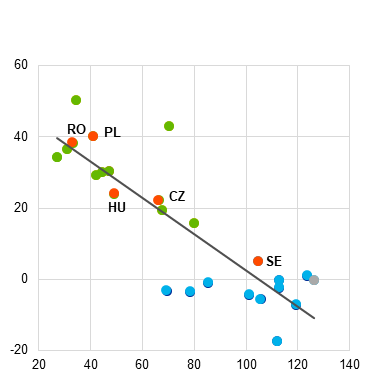 |
Sources: European Commission (Directorate-General for Economic and Financial Affairs) and ECB calculations.
Notes: Based on real GDP per capita in terms of purchasing power standard. In panel b), the red dots indicate the countries under review (labelled); the green dots indicate countries that have joined the euro area since 2003 (unlabelled); the light blue dots indicate countries that joined the euro area before 2003 (unlabelled); and the grey dot indicates Denmark (which has an opt-out). Ireland is excluded because GDP figures are significantly affected by multinational activities, which can distort the measurement of domestic economic activity. Luxembourg is excluded because GDP per capita computations are distorted by the high number of cross-border workers. The grey line shows the fitted linear relationship.
When assessing compliance with the convergence criteria, the sustainability of convergence remains essential. Convergence must be durable and grounded in sound economic fundamentals, rather than achieved only at a single point in time. Experience since the launch of Economic and Monetary Union has shown that weak fundamentals, an excessively loose macroeconomic stance, insufficient institutional and statistical capacity, and overly optimistic expectations regarding real income convergence can create vulnerabilities – not only for the countries concerned but also for the smooth functioning of the euro area as a whole. Previous crises, including the sovereign debt crisis, the COVID-19 pandemic and the 2022-23 energy shock, have further demonstrated that large macroeconomic imbalances, limited reform capacity and weak resilience to adverse shocks can make the convergence process protracted and costly. In the current environment of heightened geopolitical tensions and increased economic fragmentation, resilience and policy credibility have become even more important. Compliance with the numerical convergence criteria at a single point in time is therefore not, in itself, a guarantee of smooth participation in the euro area. Countries seeking to adopt the euro should demonstrate that convergence is sustainable, that their macroeconomic policies are consistent with stability-oriented participation in the monetary union, and that their institutions are sufficiently robust to cope with future shocks. This is primarily in each country’s own interest, but it is also essential for the effective transmission of monetary policy and the stability of the euro area as a whole, given that it remains a monetary union without a centralised fiscal capacity and with limited permanent risk-sharing mechanisms.
Achieving sustainable convergence requires lasting policy adjustments and structural convergence. Key prerequisites include macroeconomic stability, sound and credible fiscal policies in line with the EU’s economic governance framework, and a supportive business environment underpinned by efficient economic structures and strong public institutions. A high degree of flexibility in product and labour markets is essential to facilitate structural adjustment and to absorb macroeconomic shocks. A stability-oriented policy framework and well-anchored inflation expectations are crucial for maintaining price stability and supporting durable nominal convergence. The effective functioning of an open market economy with free competition promotes the efficient allocation of capital and labour, thereby fostering productivity and long-term growth. A high degree of economic integration with the euro area supports business cycle synchronisation and smooth participation in the monetary union. At the same time, greater alignment of economic structures is important to ensure that economies respond in a broadly similar manner to common shocks, including those related to differences in energy dependence and production structures, thereby supporting the smooth functioning of the monetary union. Appropriate macroprudential and supervisory frameworks are also needed to prevent the build-up of macroeconomic and financial imbalances, including excessive asset price increases and socially costly boom-bust credit cycles. Where macroeconomic imbalances have been identified under the European Commission’s macroeconomic imbalance procedure (MIP), decisive policy action remains essential. The effective absorption and implementation of EU funds, including the remaining resources under the Next Generation EU programme, can support convergence, provided that investment and reform commitments are executed in a timely and efficient manner. Ultimately, the strength of the institutional framework and the capacity to implement sound policies remain central to sustainable economic integration.
3.1 The price stability criterion
Over the past ten years, inflation developments in the countries under review have reflected a sequence of large and partly overlapping shocks. Following a period of low inflation in the preceding years, the outbreak of the pandemic in 2020 led to a sharp contraction in economic activity. While inflation initially slowed in some countries, it remained relatively persistent in others, partly owing to rising food and services prices and continued labour market tightness. From 2021 onwards, inflation increased markedly in all the countries under review, driven by sharp rises in energy prices and supply and demand imbalances (Chart 3.2). From early 2022, Russia’s war against Ukraine further intensified these pressures. Inflation in central and eastern Europe rose more strongly than in the euro area, reflecting a higher energy intensity of production, a larger weight of energy and food in consumption baskets, an initial dependence on Russian energy supplies, and deep integration in global value chains, which amplified the transmission of external shocks. Persistent labour market tightness and robust wage growth also contributed to domestic price pressures (Chart 3.3, panel a) (see also Section 3.5). To counter the surge in inflation, most central banks began raising policy rates in 2021, while governments introduced temporary fiscal measures, mainly in 2022 and 2023, largely in the form of energy-related subsidies and, to a lesser extent, reductions in indirect taxes. After peaking around the end of 2022/beginning of 2023, inflation declined markedly, supported by tighter monetary policy, falling global energy prices, the gradual easing of supply bottlenecks and base effects. Nevertheless, over the past ten years, inflation in most of the countries under review has, on average, been higher and more volatile than in the euro area.
Chart 3.2
Long-term HICP inflation developments and outlook
(annual percentage changes)
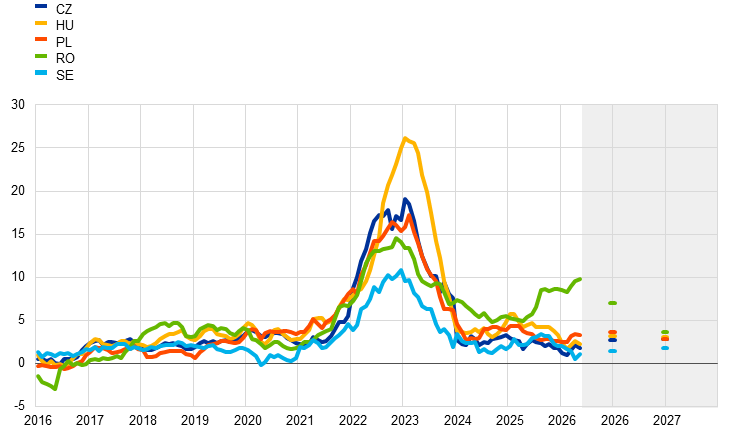
Sources: European Commission (Eurostat, Directorate-General for Economic and Financial Affairs) and ECB.
Notes: Solid lines depict annual percentage changes in the monthly HICP. In the shaded area, projections of annual HICP inflation from the European Commission’s Spring 2026 Economic Forecast are shown.
Chart 3.3
Cumulative growth in the HICP, nominal unit labour costs (ULC) and harmonised competitiveness indicators (HCIs) between 2016 and 2025
a) HICP and nominal ULC |
b) HCIs based on ULC and GDP deflator |
|---|---|
(percentage points; x-axis: cumulative HICP growth; y-axis: cumulative ULC growth) |
(percentage points; x-axis: cumulative HCI growth based on GDP deflator; y-axis: cumulative HCI growth based on ULC) |
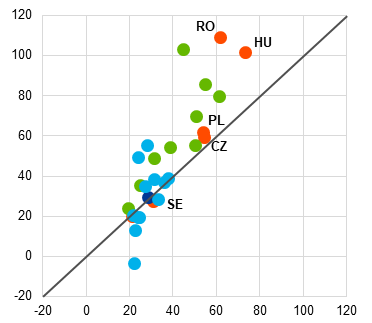 |
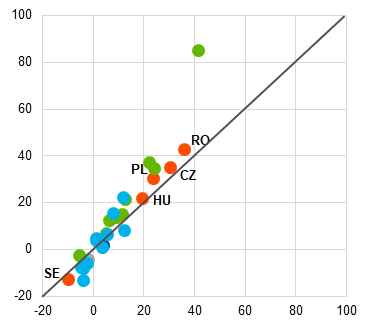 |
Sources: Eurostat and ECB.
Notes: Panel a) shows cumulative HICP growth on the x-axis and cumulative ULC growth on the y-axis. Panel b) shows cumulative increase in HCIs based on the GDP deflator on the x-axis and cumulative increase in HCIs based on total ULC on the y-axis. The solid lines in each panel represent the bisector. HICP growth is computed from monthly data aggregated to average annual data. HCIs based on the GDP deflator for euro area countries are calculated relative to the 21 euro area countries and the EER-40 group of trading partners; HCIs based on total ULC for euro area countries are calculated relative to the 21 euro area countries and the EER-17 group of trading partners. For non-euro area countries, HCIs based on the GDP deflator and total ULC are calculated relative to the EER-40 and EER-17 groups of trading partners respectively. The red dots indicate the countries under review (labelled); the green dots indicate countries that joined the euro area from 2003 onwards (unlabelled); the light blue dots indicate countries that joined the euro area before 2003 (unlabelled); the grey dot indicates Denmark; the dark blue dot indicates the euro area aggregate.
In May 2026 three of the five countries under review recorded a 12-month average inflation rate above the reference value of 2.7% for the price stability criterion. Following the sharp surge in inflation in 2022, inflation began to decline markedly in 2023 in all countries under review and moderated further during 2024. However, disinflation patterns were heterogeneous across the countries. In Romania, inflation was more elevated than elsewhere and has increased significantly since mid-2025, reflecting indirect tax measures introduced in the context of fiscal consolidation, driving inflation well above the central bank’s target. In Hungary, inflation returned to within the central bank’s tolerance band towards the end of 2025. In Poland, inflation fell back towards target in the first half of 2024 and – after a temporary uptick – has remained within target since mid-2025. Inflationary pressures in all countries in 2025 were supported by higher food prices, which on average rose more strongly in central and eastern Europe than in the euro area, reflecting weather-related supply disruptions, faster-growing input costs – including wages, energy and fertilisers – and the higher weight of food in consumption baskets in central and eastern Europe. Persistent, albeit easing, labour market tightness also exerted upward pressure on wage growth in most of these countries. In the first months of 2026, rising energy costs, stemming from the escalation of geopolitical tensions in the Middle East, added to upward pressures on inflation in the countries under review. In response, the authorities in all the countries under review introduced measures aimed at mitigating the impact of higher energy prices, such as fuel price caps, reductions in excise duties, profit margin caps and subsidies to households and firms, which are expected to cushion the inflationary pressures. In May 2026 Romania recorded inflation considerably above the reference value, while rates in Hungary and Poland were also above the threshold, albeit to a lesser extent (Chart 3.4). By contrast, inflation remained below the reference value in the Czech Republic and Sweden. In the 2024 Convergence Report, all countries under review recorded inflation rates above the reference value applicable at that time (3.3%). This indicates some progress in inflation convergence, although it remains uneven across countries.
Chart 3.4
HICP inflation
(average annual percentage changes)
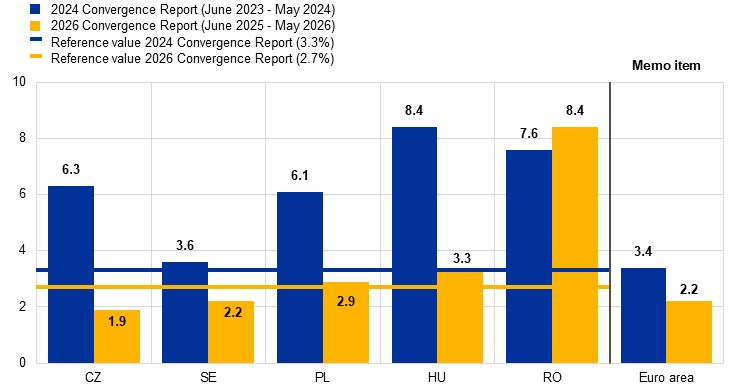
Sources: Eurostat and ECB calculations.
Reflecting heterogeneous disinflationary dynamics, the easing of monetary policy following the inflationary shock of 2022-23 was uneven across countries. Following the earlier tightening cycle, which in the countries under review began before that of the euro area, policy stances were gradually eased as inflation moderated (Chart 3.5, panel a). The central banks of the Czech Republic and Poland initiated monetary policy easing in 2023, while Sweden started reducing policy rates in 2024. Poland adopted a more cautious approach and resumed easing only in 2025. In Hungary and Romania, monetary policy rates remained comparatively high, reflecting more persistent inflationary pressures and elevated domestic and global uncertainty. Despite the sharp increases in inflation in recent years, longer-term inflation expectations have generally remained broadly stable across the countries under review, staying close to their respective target rates (Chart 3.5, panel b). In an environment of heightened uncertainty and elevated inflation, the anchoring of longer-term expectations points to the continued credibility of monetary policy frameworks.
Chart 3.5
Key policy interest rates and long-term inflation expectations
a) Key policy interest rates |
b) Long-term inflation expectations |
|---|---|
(percentages per annum) |
(annual percentage changes) |
 |
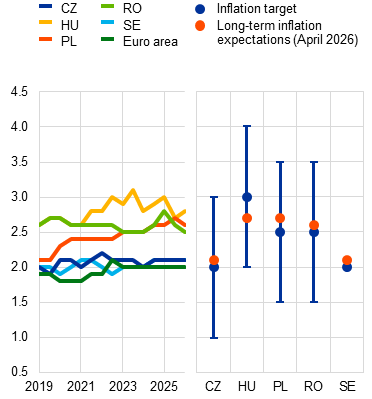 |
Sources: Bloomberg, Consensus Economics and ECB.
Notes: Panel a) shows developments in key monetary policy rates; the latest observations are for 17 June 2026. Panel b) shows long-term inflation forecasts (six to ten years ahead) based on April 2026 Consensus Economics survey data. The whiskers around the inflation target represent the central bank’s target band.
In some of the countries under review, risks to the sustainability of inflation convergence remain pronounced. According to the European Commission’s Spring 2026 Economic Forecast, inflation is expected to increase in 2026 in most of the countries examined (Chart 3.2), mainly reflecting upward pressures from higher energy prices associated with renewed geopolitical tensions. At the same time, weaker economic activity could help to lower inflation in the countries under review. These projections are subject to considerable uncertainty, given the sensitivity of inflation in the countries examined to external shocks, including renewed volatility in global energy markets in the current geopolitical environment, as well as the magnitude of indirect and second-round effects stemming from a stronger and more persistent energy shock. Persistent labour market tightness, particularly in some central and eastern European countries, could also exert further upward pressure on wages. Over the medium term, structural factors, such as demographic developments and the economic implications of climate change, including the costs associated with the green transition, may exert additional pressures on inflation dynamics. Looking further ahead, as GDP per capita and price levels remain below the euro area average in the central and eastern European countries (Chart 3.6), the ongoing catching-up process may give rise to positive inflation differentials vis-à-vis the euro area, unless this is offset by an appreciation of nominal exchange rates.
Chart 3.6
Price and labour compensation levels relative to the euro area
a) Comparative price level |
b) Compensation per employee |
|---|---|
(index: euro area = 100) |
(index: euro area = 100) |
 |
 |
Sources: Eurostat and ECB calculations.
Notes: Panel a): comparative price level for household final consumption expenditure based on purchasing power parities. Panel b): compensation per employee in the total economy, calculated as compensation of employees at current prices divided by the number of employees. The latest observations are for 2025.
An environment conducive to sustainable price stability in the countries covered in this report requires stability-oriented macroeconomic policies, continued structural reforms and effective safeguards for financial stability. In the current context of heightened geopolitical and trade uncertainty and ongoing fiscal adjustment in several countries, maintaining policy credibility and economic resilience is particularly important. The functioning of labour markets remains central to sustaining price stability. Looking ahead, a key factor will be the extent to which wage developments reflect labour productivity growth, labour market conditions and developments in price and cost competitiveness vis-à-vis trading partners (Chart 3.3). Persistently tight labour markets and demographic constraints underscore the importance of policies that enhance labour supply and productivity. Continued efforts to strengthen product market competition, improve institutional quality and reinforce governance frameworks are essential to support potential growth and limit inflationary pressures over the medium term. In an environment where monetary policy space may be constrained and external shocks remain frequent, other policy areas must support macroeconomic stability and prevent the build-up of macroeconomic and financial imbalances.
3.2 The government budgetary position criterion
At the time of publication of this report, Hungary, Poland and Romania are the subject of EU Council decisions on the existence of an excessive deficit. In Romania, the deficit exceeded the 3% of GDP reference value in 2019, and an EDP was opened in April 2020. The deadline for correction of the excessive deficit has since been extended to 2030. In Hungary and Poland, EDPs were opened in July 2024 based on the deficits exceeding the 3% of GDP reference value in 2023. The deadlines for correction of the excessive deficit were set at 2026 for Hungary and 2028 for Poland. The fiscal deficit-to-GDP ratios of these three countries continued to exceed the reference value in 2025, while the other two countries under review recorded deficits below the reference value (Chart 3.7). The deficits were well above the reference value in Hungary, at 4.7% of GDP, and significantly above the reference value in Poland, at 7.3% of GDP, and Romania, at 7.9% of GDP. In the Czech Republic the deficit remained below the reference value, at 2.1% of GDP, and in Sweden it remained well below the reference value, at 1.3% of GDP.
Chart 3.7
General government surplus (+) or deficit (-)
(percentages of GDP)
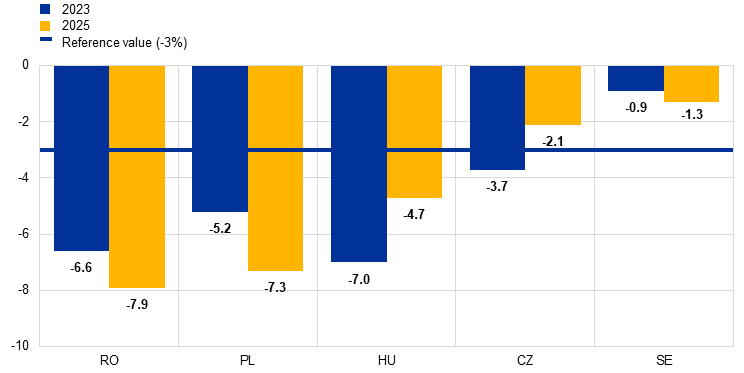
Source: Eurostat.
Note: Data for 2023 have been revised slightly since the 2024 Convergence Report.
The fiscal deficit in 2025 was above its 2023 level in three of the countries covered in this report. In 2023 fiscal deficits had increased in most of the countries under review, with all except Sweden recording deficits above 3% of GDP, owing to the economic impact of Russia’s war against Ukraine, fiscal policy measures taken in response to the resulting high energy prices and the weakening of economic activity. Since then, budget balances have evolved heterogeneously, as the positive effects of the withdrawal of energy measures and stronger economic activity were unevenly counteracted by increased defence spending in response to Russia’s ongoing aggression in Ukraine, as well as higher interest spending. Overall, between 2023 and 2025, the budget balance deteriorated in Poland, Romania and Sweden (although it remained well below the reference value in Sweden), while it improved in the other two countries under review. In the Czech Republic, the deficit ratio fell below the 3% of GDP reference value in 2024 and remained below it in 2025.
For 2026 the European Commission forecasts that the deficit-to-GDP ratio will remain significantly above the 3% reference value in Hungary, Poland and Romania. In 2026 the government balance is projected to deteriorate in three of the countries under review. It is projected to remain significantly above the reference value in Hungary, Poland and Romania. At the same time, it is expected to remain below the 3% reference value in the other two countries under review. While all of the countries under review implemented fiscal energy measures in response to the energy price shock following the outbreak of the war in the Middle East, the associated budgetary impact is expected to remain limited. In 2027 the budget balance is expected to improve in four of the countries, but it is expected to still exceed the reference value in Hungary, Poland and Romania.
In 2025 the debt-to-GDP ratio was above 60% of GDP in Hungary, while in the other countries under review debt levels were below or well below this threshold (Table 3.1 and Chart 3.8). The government debt-to-GDP ratio was above its 2023 level in all of the countries under review in 2025, mostly on account of their persistent fiscal deficits. The debt ratio increased strongly in Poland, by 10.2 percentage points of GDP, and significantly in Romania, by 10.0 percentage points of GDP. It increased notably in Sweden, by 2.9 percentage points of GDP, and the Czech Republic, by 2.1 percentage points of GDP, and slightly in Hungary, by 1.3 percentage points of GDP. Taking a longer perspective, between 2016 and 2025 the government debt-to-GDP ratio increased strongly in Romania, by 21.5 percentage points of GDP, and significantly in the Czech Republic, by 8.1 percentage points of GDP, and Poland, by 5.6 percentage points of GDP, while it stayed constant or declined in the other two countries under review.
Chart 3.8
General government gross debt
(percentages of GDP)

Source: Eurostat.
Note: Data for 2023 have been revised slightly since the 2024 Convergence Report.
For 2026 the European Commission projects an increase in debt-to-GDP ratios in all of the countries under review. The debt ratio is expected to increase notably in Poland and Romania and moderately in the other three countries. The Commission’s projections indicate that in 2026 the debt ratio will remain above the 60% reference value in Hungary and rise above it in Poland and Romania.
In June 2026 the European Commission decided to hold the EDPs for Hungary, Poland and Romania in abeyance. On 3 June 2026, the Commission published its assessment of compliance with the EDP recommendations on the basis of its Spring 2026 Economic Forecast. All three countries were assessed as having taken effective action, and as a result, their EDPs were held in abeyance. While Poland and Romania were also projected to be compliant in 2026, the Commission found that there is a clear risk that Hungary will not correct its excessive deficit by 2026, which is the final year of its corrective path.
Looking ahead, it is essential for the countries examined in this report to achieve and/or maintain sound and sustainable fiscal positions. Hungary, Poland and Romania, which are all subject to EDPs, should ensure compliance with the rules of the Stability and Growth Pact and correct their excessive deficits in line with the recommendations of the EU Council. Moreover, they should ensure that their public debt-to-GDP ratios, which are currently projected to exceed the reference value in 2026 and 2027, are declining sufficiently to ensure that fiscal buffers are available for any future downturn. In all the countries under review, the deficits in 2025 clearly exceeded those from before the pandemic. Member States should, in a growth-friendly way, reduce their budget deficits to below the 3% reference value as soon as possible, or keep it below that level, and they should build up the buffers needed to allow automatic stabilisers to work and increase their resilience to adverse shocks. All countries need to ensure compliance with the recommendations under the revised Stability and Growth Pact. Fiscal prudence is necessary to deal with the budgetary challenges related to higher spending needs for defence, the green transition and adverse demographic developments. Strong national fiscal frameworks that are fully in line with EU rules should be implemented effectively to support fiscal consolidation and limit slippages in public expenditure while helping to prevent a re-emergence of macroeconomic imbalances. Overall, fiscal strategies should prioritise sustainable public finances, strategic investment and growth-enhancing structural reforms.
3.3 The exchange rate criterion
At the time of publication, none of the currencies of the countries examined in this report was participating in ERM II. Four of the currencies traded under flexible exchange rate regimes, while the Romanian leu traded under a managed floating exchange rate regime. Most of the currencies exhibited relatively high exchange rate volatility, largely on account of swings in investor sentiment in foreign exchange markets in a rapidly evolving geopolitical landscape and country-specific factors that partially exacerbated the external factors. The Romanian leu exhibited comparatively low volatility thanks to its managed floating exchange rate regime and despite significant depreciation in both May 2025 and May 2026. The Hungarian forint appreciated strongly following parliamentary elections in mid-April 2026. As a result, at the time of publication of this report, only the Romanian leu was trading below its June 2024 level, which is used as a benchmark for illustrative purposes in the absence of an ERM II central rate, while the other currencies had all appreciated vis-à-vis the euro since June 2024 (Chart 3.9).[154]
Chart 3.9
Bilateral exchange rates vis-à-vis the euro
(index: average of June 2024 = 100; daily data; 1 June 2024 – 17 June 2026)

Source: ECB.
Note: An upward (downward) movement indicates appreciation (depreciation) of the currency.
3.4 The long-term interest rate criterion
Over the reference period from June 2025 to May 2026, three of the five countries under review recorded average long-term interest rates that were above the 5.1% reference value (Chart 3.10). The country with the lowest 12-month average long-term interest rate was Sweden, at 2.6%. The Czech Republic also recorded an average long-term interest rate below the reference value, at 4.5%, while Poland remained above, at 5.4%. The highest average long-term interest rate, at 6.7%, was recorded in both Hungary and Romania. Across the five countries, the 12-month averages of long-term interest rates experienced very limited fluctuations over the review period, which started with the publication of the 2024 Convergence Report. At the same time, monthly long-term interest rates increased in three of the five countries, influenced by global developments as well as domestic factors like higher inflation and, in some cases, high growth and a looser fiscal policy. In Poland, they were stable during a period in which inflation was more muted, economic growth remained resilient and fiscal policy eased, while in Hungary they recorded a sharp fall of 1.2 percentage points, which took place almost entirely after the April 2026 parliamentary elections.
Chart 3.10
Long-term interest rates
(percentages, annual averages)

Sources: Eurostat and ECB.
The dynamics of long-term interest rate spreads vis-à-vis the euro area average since the 2024 Convergence Report have been quite heterogeneous across the countries under review. This heterogeneity in long-term interest rate differentials reflects differences in both the cyclical positions of countries and the assessment of financial markets of their external and internal vulnerabilities, including developments in budgetary performance and the prospects for sustainable convergence. In Hungary, following the elections in mid-April 2026, the domestic long-term interest rate fell by 0.5 percentage points in two days and continued to decline, albeit more gradually thereafter. As of May 2026, its differential vis-à-vis the euro area average rate had fallen by a total of 1.2 percentage points over the review period. In Poland and Romania, the interest rate differential also declined over the review period, by 0.3 and 0.2 percentage points respectively. Lastly, in the Czech Republic and Sweden, the interest rate differential increased, by 0.3 and a marginal 0.1 percentage points respectively. Since the outbreak of the war in the Middle East at the end of February 2026, only the Czech Republic and Poland have seen an increase in the long-term interest rate differential, by 0.2 and 0.4 percentage points respectively. In Hungary it has declined by 1.2 percentage points, while in Romania and Sweden it has fallen by much less (‑0.1 and ‑0.2 percentage points respectively).
3.5 Other relevant factors
According to the European Commission, concerns related to cost competitiveness pressures remain. In its Alert Mechanism Report 2026, the Commission highlighted continued competitiveness pressures in the central and eastern European countries under review, reflecting still elevated nominal ULC growth rates, sizeable cumulative inflation differentials and tight labour market conditions. The Commission concluded that in-depth reviews were warranted for Hungary, Romania and Sweden. As regards Hungary, the Commission pointed to elevated ULC growth, high core inflation, significant fiscal vulnerabilities, including high government deficits and debt-related risks, and renewed upward pressures in the housing market. For Romania, the Commission highlighted substantial external sustainability risks and persistent competitiveness concerns in the context of very high ULC growth, large current account deficits and sizeable fiscal imbalances. In the case of Sweden, the Commission identified continued vulnerabilities related to elevated house prices and high levels of household and corporate debt. Although the Commission classified the other countries under review in this report as having no imbalances, those countries also face economic challenges as discussed in the relevant country sections. In its 2026 European Semester Spring Package, the Commission confirmed that Hungary continues to experience imbalances. It also found Romania to be experiencing excessive imbalances, as vulnerabilities related to fiscal and current account deficits remain very significant despite some recent improvement, while cost competitiveness has continued to deteriorate.
The external positions of most of the countries under review have improved in recent years, although the recent energy price shock and associated volatility may lead to a renewed deterioration. The MIP scoreboard indicates that three-year average current account balances strengthened in most of the central and eastern European countries in 2025 (Table 3.2), reflecting improving terms of trade and moderating domestic demand. However, in 2025 the three-year average current account deficit remained beyond the indicative threshold of ‑4.0% of GDP in Romania, where large fiscal deficits have contributed to sizeable external imbalances in recent years. All countries under review are net energy importers, albeit to varying degrees and with varying geographical diversification of their energy imports, which makes their external positions particularly vulnerable to the recent energy price shock and associated volatility.
In most of the countries under review, negative net international investment positions (NIIPs) as a share of GDP have improved in recent years but remain sizeable. In 2025 the NIIP remained beyond the indicative threshold of ‑35% of GDP in Romania. Net external liabilities were lower in Hungary (32.4% of GDP), Poland (29.5% of GDP) and the Czech Republic (9.8% of GDP), while Sweden continued to record a positive NIIP (54.7% of GDP). In the four central and eastern European countries, net external liabilities are predominantly composed of foreign direct investment (FDI), which is generally considered a more stable form of financing than portfolio or debt flows. However, in several of the countries under review, FDI inflows have moderated in recent years compared with levels prior to Russia’s full-scale invasion of Ukraine. Against the current geopolitical backdrop and heightened uncertainty in global financial markets, sizeable external liabilities continue to represent a source of vulnerability in the event of adverse shocks affecting investor confidence or external financing conditions.
Price and cost competitiveness concerns persist in most of the countries under review. HICP-deflated real effective exchange rates have appreciated to varying degrees in most of the countries under review over the past three years, exceeding the 10% indicative threshold in Hungary, Poland and Romania. In all the countries, the three-year growth rate of nominal ULC increased over the same period and, except in Sweden, exceeded the indicative threshold of 12% in 2025. ULC growth remained particularly elevated in Hungary, Poland and Romania, where cumulative increases were more than twice the threshold. These developments largely reflect strong nominal wage growth in recent years combined with more moderate productivity growth. Despite the deterioration in cost competitiveness indicators, export performance vis-à-vis advanced economies remained broadly resilient over a three-year horizon in 2025, supported in part by the expansion of export production capacity and structural shifts in trade patterns. Looking ahead, renewed increases in energy prices and broader cost pressures in the current geopolitical environment could weigh further on competitiveness if they were to translate into sustained inflation differentials vis-à-vis trading partners.
The economies of the countries under review remain closely integrated with the euro area through trade and financial linkages. The euro area continues to be the main trading and financial partner for all the countries examined (Chart 3.11). In 2025 exports of goods to the euro area ranged from around 41% of total exports in Sweden to 63.4% in the Czech Republic, while imports from the euro area ranged from 50.6% of total imports in Romania to 56.5% in the Czech Republic. Financial linkages with the euro area are also substantial. The share of the euro area in the stock of inward direct investment exceeded 70% in the Czech Republic, Romania and Poland, while the euro area accounted for more than 60% of the stock of portfolio investment liabilities in the Czech Republic. For both direct and portfolio investment, the share of foreign assets invested in the euro area was highest for Romania, followed by the Czech Republic. Beyond trade and financial shares, these economies are also deeply embedded in euro area value chains, with a high degree of participation in cross-border production networks, particularly in manufacturing. This strengthens the transmission of demand and supply shocks between the euro area and the countries concerned. Moreover, banks owned by euro area financial institutions continue to play a significant role in the banking systems of several of the central and eastern European countries, notably the Czech Republic and Romania. Meanwhile, Swedish banks play a key role in some euro area countries. The depth of these economic linkages supports the alignment of the business cycles of the countries under review with that of the euro area.
Chart 3.11
Trade and financial linkages with the euro area
a) Share of trade in goods with the euro area |
b) Investment position with the euro area |
|---|---|
(percentages of total) |
(percentages of total) |
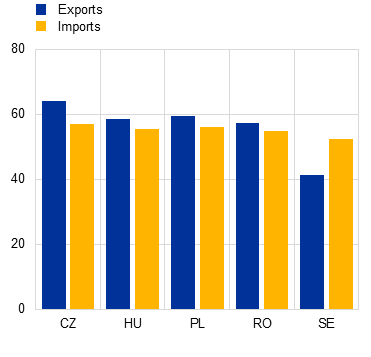 |
 |
Sources: Eurostat and ECB.
Note: Data refer to 2025.
Real estate-related risks have increased in several countries, amid renewed house price and credit growth. Following the correction observed in 2022-23, residential property markets have strengthened again in most of the countries under review. Since 2024 house prices have increased markedly in Hungary and the Czech Republic, with annual growth rates reaching double digits (Chart 3.12, panel a) and standard valuation metrics pointing to overvaluation relative to fundamentals. House price growth has also accelerated in Romania, albeit to a lesser extent, with standard valuation metrics suggesting that prices remain below estimated equilibrium levels. In all the countries under review, credit growth to households has picked up in recent years. Despite this, household indebtedness in the central and eastern European countries remains comparatively low relative to the euro area average (Chart 3.12, panel b), which mitigates systemic risks. By contrast, vulnerabilities remain more pronounced in Sweden, where private debt levels remain elevated, albeit having declined somewhat in recent years, and the banking sector has substantial exposure to the real estate sector. Looking ahead, continued rapid price and credit growth in some of the countries under review warrants close monitoring, particularly in the event of a tightening of financing conditions or a deterioration in labour market prospects.
Chart 3.12
Housing market developments and private sector indebtedness
a) Residential property prices and loans to households |
b) Private sector indebtedness |
|---|---|
(annual percentage changes) |
(percentages of GDP) |
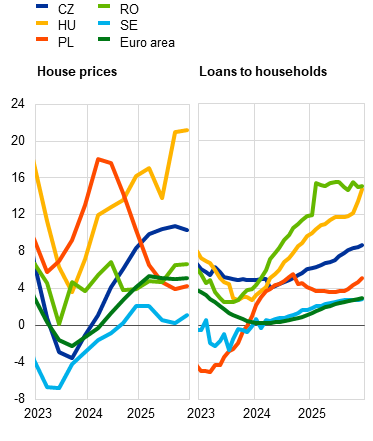 |
 |
Sources: Eurostat, ECB and ECB calculations.
Notes: Panel a): residential property prices in nominal terms and loans to households reported by monetary financial institutions (based on adjusted notional stocks). Panel b): household and non-financial corporate debt; data refer to the fourth quarter of 2025; quarterly non-consolidated data.
Sovereign exposures of domestic banking sectors have increased over the past years, although banking sectors maintain strong capital buffers. Sovereign exposures have risen in all central and eastern European countries under review in recent years and remain significantly higher than in the euro area (Chart 3.13, panel a). This could amplify vulnerabilities in the event of fiscal stress or a reassessment of sovereign risk, potentially affecting the balance sheets, funding conditions and credit supply of banks. While foreign exchange exposures remain elevated in some countries, associated risks appear contained, as corporate foreign currency borrowing is largely concentrated in export-oriented sectors with natural hedges through euro-denominated revenues, and household euroisation remains limited. Notwithstanding vulnerabilities related to real estate market developments and rising sovereign exposures, banking sectors in the countries under review continue to display sound capital positions and liquidity buffers, stable access to funding and adequate profitability. Non-performing loan ratios have declined further or remained close to historical lows (Chart 3.13, panel b), although in most cases they remain above the euro area average.
Chart 3.13
Sovereign exposures and non-performing loans in the banking sector
a) Bank holdings of government bonds |
b) Non-performing loans |
|---|---|
(percentages of total assets) |
(percentages of total loans) |
 |
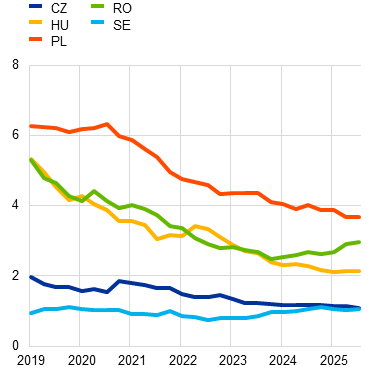 |
Sources: ECB and ECB calculations.
Notes: Panel a): share of holdings of debt securities issued by the general government in total bank assets. Panel b): ratio of gross non-performing loans to total gross loans (non-performing loan ratio).
Financial sector policies should safeguard financial stability, thereby contributing to sustainable economic growth and the maintenance of price stability. Maintaining prudent supervisory and macroprudential frameworks remains essential to mitigate vulnerabilities related to high household or corporate indebtedness, sovereign exposures and real estate market developments. To further support confidence in the financial system, national competent authorities should continue to strengthen supervisory practices, including by implementing relevant recommendations of international and European bodies and by cooperating closely with other EU supervisors within supervisory colleges.
Labour market conditions have remained tight in most of the countries under review. Although unemployment rates have edged up somewhat in recent years, they remain close to historical lows and below the euro area average in all the countries except Sweden (Chart 3.14, panel a). Labour shortages persist in several segments of the labour market, continuing to exert upward pressure on wages. At the same time, labour supply constraints have been partly alleviated by rising net migration inflows, including the arrival of non-EU workers and Ukrainian refugees. Nevertheless, adverse demographic trends remain a structural challenge, as working age populations are continuing to decline in several of the central and eastern European countries, reflecting population ageing and past migration outflows (Chart 3.14, panel b). Other structural challenges include relatively low labour market participation in some countries and persistent skill mismatches. Over the medium term, demographic headwinds and structural labour market constraints represent a key challenge to further real convergence with the euro area.
Chart 3.14
Labour market indicators
a) Unemployment rate |
b) Working age population |
|---|---|
(percentages of the labour force) |
(percentage changes) |
 |
 |
Sources: Eurostat and ECB calculations.
Note: Panel b): percentage changes between the first quarter of 2014 and the fourth quarter of 2025 (blue bars); percentage changes between the first quarter of 2022 and the fourth quarter of 2025 (yellow bars).
The strength of the institutional environment is an important factor in assessing the sustainability of economic integration and convergence. Stronger governance and institutional quality are associated with improvements in the business environment, more efficient public administration, better transparency and accountability, a stronger rule of law, and enhanced digital and administrative capacity. In most of the countries under review, further improvements in institutional quality would help remove rigidities and obstacles to the efficient allocation of production factors, thereby strengthening potential growth. By enhancing productivity and potential output, a stronger institutional framework may also support debt sustainability and facilitate the effective implementation of policy measures.
Stronger institutional quality and governance could bring important economic benefits, particularly in Hungary and Romania. Strengthening these areas can enhance economic resilience and support the sustainability of convergence. While challenges remain in areas such as the rule of law, regulatory quality and the control of corruption, some countries have made steady progress over time (Chart 3.15).[155] Romania and Hungary can address their institutional challenges by focusing on the effective implementation of the reforms and milestones set out in their recovery and resilience plans. These efforts are key to bolstering governance frameworks and promoting the rule of law.
Chart 3.15
Overview of EU countries in terms of institutional quality
a) Worldwide Governance Indicators |
b) Corruption Perceptions Index |
|---|---|
(index: x-axis: level in 2000; y-axis: level in 2024) |
(index: x-axis: level in 1999; y-axis: level in 2025) |
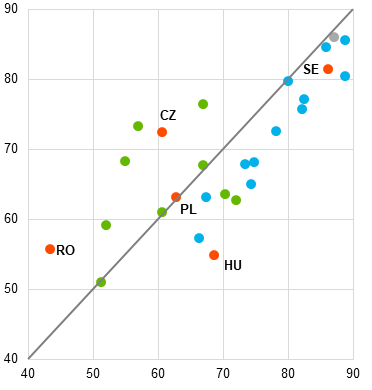 |
 |
Sources: Worldwide Governance Indicators 2024 (World Bank), Transparency International and ECB calculations.
Notes: Panel a): The index is computed as the average of the percentile scores (relative to the scale) of the following World Governance Indicators: voice and accountability, political stability and absence of violence/terrorism, government effectiveness, regulatory quality, rule of law, and control of corruption. Panel b): The Corruption Perceptions Index ranks countries by their perceived levels of public sector corruption on a scale of 0 (highly corrupt) to 100 (very clean). For the Corruption Perceptions Index, the reference years for Cyprus and Malta are 2003 and 2004 respectively. The red dots indicate the countries under review (labelled); the green dots indicate countries that joined the euro area from 2003 onwards (unlabelled); the light blue dots indicate countries that joined the euro area before 2003 (unlabelled); the grey dot indicates Denmark.
Wide-ranging structural reforms would support the convergence process by strengthening potential growth and competitiveness. Enhancing institutional quality, improving governance and reinforcing the business environment, together with more effective implementation of EU-funded investment and reform programmes, would support productivity growth. In this respect, strengthening the governance and efficiency of state-owned enterprises and increasing competition in regulated and network sectors – including energy and transport – would help lower barriers to entry, improve resource allocation and foster private investment, thereby supporting sustainable convergence.
Table 3.2
Scoreboard for the surveillance of macroeconomic imbalances
Table 3.2a – External imbalances and competitiveness indicators
Current account balance1) |
Net international investment |
Real effective exchange rate3) |
Export performance against |
Nominal unit labour cost index5) |
|
|---|---|---|---|---|---|
Czech Republic |
|
|
|
|
|
2022 |
-1.7 |
-20.2 |
13.7 |
-4.7 |
17.0 |
2023 |
-2.3 |
-14.4 |
24.2 |
0.5 |
18.4 |
2024 |
-1.0 |
-7.4 |
14.4 |
1.7 |
20.3 |
2025 |
0.8 |
-9.8 |
7.2 |
8.4 |
19.8 |
Hungary |
|
|
|
|
|
2022 |
-4.8 |
-44.7 |
-7.9 |
-3.5 |
25.4 |
2023 |
-4.4 |
-38.9 |
10.3 |
1.7 |
37.2 |
2024 |
-2.4 |
-33.3 |
7.3 |
1.3 |
48.4 |
2025 |
1.2 |
-32.4 |
14.4 |
2.5 |
41.0 |
Poland |
|
|
|
|
|
2022 |
-0.4 |
-34.6 |
-0.1 |
11.9 |
17.3 |
2023 |
-0.7 |
-31.8 |
9.3 |
7.7 |
25.1 |
2024 |
-0.1 |
-28.2 |
17.5 |
5.6 |
33.6 |
2025 |
0.3 |
-29.5 |
21.6 |
8.3 |
28.8 |
Romania |
|
|
|
|
|
2022 |
-7.3 |
-42.6 |
2.6 |
3.5 |
19.1 |
2023 |
-7.8 |
-41.6 |
6.8 |
6.8 |
30.2 |
2024 |
-8.1 |
-41.3 |
9.7 |
1.8 |
51.0 |
2025 |
-7.6 |
-45.1 |
11.7 |
7.6 |
42.6 |
Sweden |
|
|
|
|
|
2022 |
5.3 |
38.5 |
-1.3 |
-1.3 |
8.0 |
2023 |
5.5 |
40.5 |
-7.5 |
-3.8 |
11.8 |
2024 |
5.7 |
67.1 |
-9.7 |
-4.1 |
13.6 |
2025 |
6.3 |
54.7 |
1.7 |
4.5 |
8.9 |
Threshold |
-4.0/+6.0 |
-35.0 |
+/-10.0 |
-3.0 |
+12.0 |
Table 3.2b – Internal imbalances and employment indicators
Internal imbalances |
Employment indicators |
|||||||
|---|---|---|---|---|---|---|---|---|
General government gross |
Household debt2) 6) 7) |
Non-financial corporations |
Household credit |
Non-financial |
House price |
Unemploy- |
Labour force participation |
|
Czech Republic |
|
|
|
|
|
|
|
|
2022 |
42.5 |
31.4 |
44.9 |
4.9 |
11.3 |
16.9 |
2.2 |
0.5 |
2023 |
42.2 |
30.5 |
43.6 |
5.2 |
5.3 |
-1.7 |
2.6 |
0.8 |
2024 |
43.3 |
30.7 |
44.7 |
6.0 |
4.9 |
5.0 |
2.6 |
0.9 |
2025 |
44.3 |
31.4 |
45.9 |
8.5 |
7.3 |
10.4 |
2.8 |
0.7 |
Hungary |
|
|
|
|
|
|
|
|
2022 |
74.1 |
18.7 |
62.9 |
5.9 |
14.4 |
22.3 |
3.6 |
2.4 |
2023 |
73.3 |
16.9 |
55.7 |
3.9 |
7.4 |
7.1 |
4.1 |
2.9 |
2024 |
73.5 |
17.2 |
56.6 |
10.1 |
3.3 |
13.7 |
4.5 |
2.3 |
2025 |
74.6 |
18.3 |
52.5 |
14.2 |
5.0 |
18.3 |
4.4 |
1.3 |
Poland |
|
|
|
|
|
|
|
|
2022 |
48.8 |
26.2 |
35.5 |
-3.4 |
10.3 |
11.8 |
2.9 |
3.5 |
2023 |
49.5 |
23.6 |
32.3 |
-0.2 |
3.1 |
8.8 |
2.8 |
4.3 |
2024 |
54.8 |
22.6 |
31.1 |
3.3 |
5.9 |
15.0 |
2.9 |
1.8 |
2025 |
59.7 |
22.0 |
30.8 |
4.5 |
10.2 |
4.9 |
3.1 |
1.5 |
Romania |
|
|
|
|
|
|
|
|
2022 |
48.1 |
14.1 |
30.0 |
6.3 |
14.4 |
7.2 |
5.6 |
3.5 |
2023 |
49.3 |
12.7 |
28.4 |
4.3 |
11.6 |
3.3 |
5.6 |
2.7 |
2024 |
54.8 |
12.5 |
27.7 |
10.9 |
10.1 |
5.0 |
5.4 |
1.8 |
2025 |
59.3 |
12.3 |
27.5 |
10.6 |
10.4 |
5.7 |
6.1 |
0.3 |
Sweden |
|
|
|
|
|
|
|
|
2022 |
34.4 |
89.9 |
123.0 |
3.8 |
7.1 |
3.6 |
7.5 |
0.7 |
2023 |
32.2 |
85.5 |
117.8 |
0.6 |
-0.1 |
-5.2 |
7.7 |
1.8 |
2024 |
34.2 |
82.7 |
116.8 |
1.6 |
-1.0 |
0.0 |
8.4 |
1.2 |
2025 |
35.1 |
82.3 |
110.5 |
2.9 |
2.6 |
1.0 |
8.8 |
0.7 |
Threshold |
60.0 |
55.0 |
85.0 |
14.0 |
13.0 |
9.0 |
10.0 |
-0.2 |
Sources: European Commission (Eurostat, Directorate-General for Economic and Financial Affairs) and European System of Central Banks.
Note: This table includes data available as at 17 June 2026, i.e. the cut-off date for this report, and therefore differs from the scoreboard published in the Alert Mechanism Report 2026.
1) As a percentage of GDP, three-year average.
2) As a percentage of GDP.
3) HICP/CPI-deflated. Three-year percentage change relative to 41 other industrial countries. A positive value indicates a loss of competitiveness.
4) Three-year percentage change. Advanced economies are the OECD countries plus the non-OECD EU countries.
5) Per hour worked (2020 = 100), three-year percentage change.
6) Consolidated debt.
7) Includes non-profit institutions serving households (NPISH).
8) As the percentage of the previous year’s stock of debt.
9) Excludes foreign direct investment (FDI).
10) Nominal house prices. One-year percentage change.
11) As a percentage of labour force aged 15-74.
12) As a percentage of population aged 15-64, three-year change.
4.1 Czech Republic
In May 2026 the 12‑month average rate of HICP inflation in the Czech Republic stood at 1.9%, i.e. well below the 2.7% reference value for the criterion on price stability. This rate is expected to increase gradually over the coming months, driven mainly by higher commodity prices and broadening inflationary pressures related to the war in the Middle East. At the same time, labour market conditions remain tight despite signs of a softening, with robust wage growth contributing to underlying inflationary pressures. GDP per capita and price levels, while relatively high compared with other central and eastern European countries under review, remain below the euro area average. Unless offset by an appreciation of the nominal exchange rate, the catching-up process in terms of GDP per capita and price levels may result in positive inflation differentials vis‑à‑vis the euro area, especially if it were to be accompanied by unsustainable developments in credit and asset prices.
The Czech Republic is currently not subject to a Council Decision on the existence of an excessive deficit. The Czech Republic’s general government budget deficit was 2.1% of GDP in 2025, i.e. below the 3% reference value, and its debt-to-GDP ratio was 44.3%, i.e. below the 60% reference value.
In the two-year reference period from 18 June 2024 to 17 June 2026, the Czech koruna did not participate in ERM II but traded under a flexible exchange rate regime. The exchange rate of the Czech koruna against the euro exhibited, on average, a relatively high degree of volatility over the reference period. On 17 June 2026 the exchange rate stood at 24.147 korunas per euro, i.e. the koruna was 2.5% stronger than its average level in June 2024.
Over the reference period from June 2025 to May 2026, long‑term interest rates in the Czech Republic stood at 4.5% on average and were therefore below the 5.1% reference value for the interest rate convergence criterion. The differential between long‑term interest rates in the Czech Republic and the euro area (GDP‑weighted) interest rate increased slightly, standing at 1.4 percentage points at the end of the reference period. Capital markets in the Czech Republic are smaller and much less developed than those in the euro area.
Czech law does not comply with all the requirements for central bank independence, the monetary financing prohibition and legal integration into the Eurosystem. The Czech Republic is an EU Member State with a derogation and must therefore comply with all adaptation requirements under Article 131 of the Treaty.
4.2 Hungary
In May 2026 the 12‑month average rate of HICP inflation in Hungary was 3.3%, i.e. well above the reference value of 2.7% for the criterion on price stability. This rate is expected to increase gradually over the coming months, driven mainly by higher commodity prices and broadening inflationary pressures related to the war in the Middle East. At the same time, labour market conditions remain tight despite signs of a softening, with robust wage growth driven partly by increases in public sector wages and the minimum wages. There are concerns about the sustainability of inflation convergence in Hungary over the longer term. Unless offset by an appreciation of the nominal exchange rate, the catching-up process in terms of GDP per capita and price levels may result in positive inflation differentials vis‑à‑vis the euro area, especially if it were to be accompanied by unsustainable developments in credit and asset prices.
Hungary has been subject to an excessive deficit procedure since 2024. Hungary’s general government budget deficit was 4.7% of GDP in 2025, i.e. well above the 3% reference value, and its debt-to-GDP ratio was 74.6%, i.e. above the 60% reference value. Hungary should put an end to its excessive deficit by 2026. In June 2026, the European Commission held Hungary’s excessive deficit procedure in abeyance.
In the two-year reference period from 18 June 2024 to 17 June 2026, the Hungarian forint did not participate in ERM II but traded under a flexible exchange rate regime. The exchange rate of the Hungarian forint against the euro exhibited, on average, a relatively high degree of volatility over the reference period. On 17 June 2026 the exchange rate stood at 349.68 forints per euro, i.e. the forint was trading 11.4% stronger than its average level in June 2024. The Magyar Nemzeti Bank entered a repo line arrangement with the ECB in June 2020, under which it could borrow up to €4 billion against high-quality euro-denominated collateral to provide euro liquidity to Hungarian financial institutions. This agreement remained in place over the reference period as it was extended again in January 2025 for a period of two years.
Over the reference period from June 2025 to May 2026, long‑term interest rates in Hungary stood at 6.7% on average and were thus above the 5.1% reference value for the interest rate convergence criterion. The differential between long‑term interest rates in Hungary and the euro area (GDP‑weighted) interest rate declined significantly to stand at 2.2 percentage points at the end of the reference period. Capital markets in Hungary are smaller and much less developed than those in the euro area.
Hungarian law does not comply with all the requirements for central bank independence, the prohibition of monetary financing, the requirements for the single spelling of the euro and legal integration into the Eurosystem. Hungary is an EU Member State with a derogation and must therefore comply with all adaptation requirements under Article 131 of the Treaty.
4.3 Poland
In May 2026 the 12‑month average rate of HICP inflation in Poland was 2.9%, i.e. above the reference value of 2.7% for the criterion on price stability. This rate is expected to increase gradually over the coming months, driven mainly by higher commodity prices and broadening inflationary pressures related to the war in the Middle East. At the same time, tight, albeit softening, labour market conditions will continue to exert upward pressure on inflation. Unless offset by an appreciation of the nominal exchange rate, the further catching-up process in terms of GDP per capita and price levels may result in positive inflation differentials vis‑à‑vis the euro area, especially if it were to be accompanied by unsustainable developments in credit and asset prices.
Poland has been subject to an excessive deficit procedure since 2024. Poland’s general government budget deficit was 7.3% of GDP in 2025, i.e. significantly above the 3% reference value, while its debt-to-GDP ratio was 59.7%, i.e. below the 60% reference value. Poland should correct its excessive deficit by 2028. In June 2026, the European Commission held Poland’s excessive deficit procedure in abeyance.
In the two-year reference period from 18 June 2024 to 17 June 2026, the Polish zloty did not participate in ERM II but traded under a flexible exchange rate regime. The exchange rate of the Polish zloty against the euro exhibited, on average, a relatively high degree of volatility over the reference period. On 17 June 2026 the exchange rate stood at 4.241 zlotys per euro, i.e. the zloty was 1.9% stronger than its average level in June 2024.
Over the reference period from June 2025 to May 2026, long‑term interest rates in Poland stood at 5.4% on average and were therefore above the reference value of 5.1% for the interest rate convergence criterion. The differential between long‑term interest rates in Poland and the euro area (GDP‑weighted) interest rate declined, stood at 2.3 percentage points at the end of the reference period. Capital markets in Poland are smaller and much less developed than those in the euro area.
Polish law does not comply with all the requirements for central bank independence, confidentiality, the monetary financing prohibition and legal integration into the Eurosystem. Poland is an EU Member State with a derogation and must therefore comply with all adaptation requirements under Article 131 of the Treaty.
4.4 Romania
In May 2026 the 12‑month average rate of HICP inflation in Romania was 8.4%, i.e. considerably above the reference value of 2.7% for the criterion on price stability. This rate is expected to remain elevated over the coming months, owing partly to higher commodity prices and broadening inflationary pressures related to the war in the Middle East. At the same time, favourable base effects due to the 2025 increase in indirect taxes and in domestic electricity prices amid weak private consumption are likely to exert a downward impact on inflation in the near term. There are concerns about the sustainability of inflation convergence in Romania over the longer term. Unless offset by an appreciation of the nominal exchange rate, the catching-up process in terms of GDP per capita and price levels may result in positive inflation differentials vis‑à‑vis the euro area, especially if it were to be accompanied by unsustainable developments in credit and asset prices.
Romania has been subject to an excessive deficit procedure since 2020. Romania’s general government budget deficit was 7.9% in 2025, i.e. significantly above the 3% reference value, while its debt-to-GDP ratio was 59.3%, i.e. below the 60% reference value. Romania should bring its excessive deficit to an end by 2030. In June 2026, the European Commission held Romania’s excessive deficit procedure in abeyance.
Over the reference period from 18 June 2024 to 17 June 2026, the Romanian leu did not participate in ERM II but traded under a flexible exchange rate regime involving a managed float of the currency’s exchange rate. The exchange rate of the Romanian leu against the euro exhibited, on average, a low degree of volatility over the reference period. On 17 June 2026 it stood at 5.232 lei per euro, i.e. the leu was 5.1% weaker than its average level in June 2024. Banca Naţională a României entered a repo line arrangement with the ECB in June 2020, under which it could borrow up to €4.5 billion against high-quality euro-denominated collateral to provide euro liquidity to Romanian financial institutions. This agreement remained in place over the reference period as it was extended again in January 2025 for a period of two years.
Over the reference period from June 2025 to May 2026, long‑term interest rates in Romania stood at 6.7% on average and were therefore above the 5.1% reference value for the interest rate convergence criterion. The differential between long‑term interest rates in Romania and the euro area (GDP‑weighted) interest rate declined marginally to stand at 2.7 percentage points at the end of the reference period. Capital markets in Romania are much smaller than those in the euro area and are still underdeveloped.
Romanian law does not comply with all the requirements for central bank independence, the monetary financing prohibition and legal integration into the Eurosystem. Romania is an EU Member State with a derogation and must therefore comply with all adaptation requirements under Article 131 of the Treaty.
4.5 Sweden
In May 2026 the 12‑month average rate of HICP inflation in Sweden was 2.2%, i.e. below the reference value of 2.7% for the criterion on price stability. This rate is expected to decrease gradually over the coming months, mainly reflecting lower value added tax on food and the pass-through of the exchange rate appreciation in 2025. However, this decline is likely to be partly offset by higher commodity prices and broadening inflationary pressures related to the war in the Middle East. Inflation in Sweden is expected to remain below Sveriges Riksbank’s target in 2026 and 2027. Looking ahead, Sweden’s monetary policy and its stability‑oriented institutional framework should continue to support the achievement of price stability.
Sweden is currently not subject to a Council Decision on the existence of an excessive deficit. Sweden’s general government budget deficit was 1.3% of GDP in 2025, i.e. well below the 3% reference value, and its debt-to-GDP ratio was 35.1%, i.e. well below the 60% reference value.
In the two-year reference period from 18 June 2024 to 17 June 2026, the Swedish krona did not participate in ERM II but traded under a flexible exchange rate regime. The exchange rate of the Swedish krona against the euro exhibited, on average, a high degree of volatility over the two-year period. On 17 June 2026 the exchange rate stood at 10.891 kronor per euro, i.e. the krona was 3.5% stronger than its average level in June 2024. Over the reference period, Sveriges Riksbank maintained a swap agreement with the ECB for borrowing up to €10 billion in exchange for Swedish kronor, which has been in place since 20 December 2007.
Over the reference period from June 2025 to May 2026, long‑term interest rates in Sweden stood at 2.6% on average and therefore remained well below the 5.1% reference value for the interest rate convergence criterion. The differential between long‑term interest rates in Sweden and the euro area average interest rate recorded a very small increase, standing at ‑0.7 percentage points at the end of the reference period. Capital markets in Sweden are highly developed compared with those in the euro area.
Swedish law does not comply with all the requirements for central bank independence, the monetary financing prohibition and legal integration into the Eurosystem. Sweden is an EU Member State with a derogation and must therefore comply with all adaptation requirements under Article 131 of the Treaty. Pursuant to the Treaty, Sweden has been under the obligation to adopt national legislation with a view to integration into the Eurosystem since 1 June 1998.
5.1 Czech Republic
5.1.1 Price developments
In May 2026 the 12-month average rate of HICP inflation in the Czech Republic was 1.9%, i.e. well below the reference value of 2.7% for the criterion on price stability (Chart 5.1.1). This rate is expected to increase gradually over the coming months, driven mainly by higher commodity prices and broadening inflationary pressures related to the war in the Middle East.
Over the past ten years the 12-month average rate of HICP inflation has fluctuated within a very wide range, from 0.3% to 16.8%. During the second half of the 2010s, inflation dynamics were marked by solid economic growth and by labour productivity growth being outpaced by growth in compensation per employee. The outbreak of the COVID-19 pandemic in 2020 sparked a contraction in economic activity and initially dampened inflationary pressures. To counteract the economic impact of the pandemic, Česká národní banka reduced its main policy rate significantly over that year, down to 0.25%. In 2021 large increases in energy and commodity prices, together with global supply bottlenecks, exerted significant upward pressure on inflation. These inflationary pressures were exacerbated in the wake of Russia’s invasion of Ukraine in 2022, with inflation averaging 14.8% over the year (Table 5.1.1). This led Česká národní banka to significantly tighten its monetary policy, raising its main policy rate by a cumulative 675 basis points, up to 7% in June 2022, and to intervene in foreign exchange markets to limit exchange rate volatility. At the same time, the Czech Government introduced measures to mitigate the impact of rising energy prices, mainly in the form of transfers to households and firms. From 2023 inflation decreased markedly, supported by the tight monetary policy stance, lower global energy prices, the unwinding of supply bottlenecks and the government’s energy relief measures. In response to this decline, Česká národní banka gradually eased its monetary policy stance, reducing its main policy rate by a cumulative 350 basis points between December 2023 and May 2025.
In May 2026 the annual rate of HICP inflation stood at 1.8%. The downward trend in inflation observed in 2025 – reflecting waning external inflationary pressures, cautious monetary policy easing and an exchange rate appreciation – continued in the first two months of 2026, with inflation hovering around 1%. However, in March inflationary pressures started to increase again, largely on the back of a rebound in energy prices amid the heightened geopolitical tensions related to the war in the Middle East. In response, the authorities introduced measures aimed at mitigating the impact of higher energy prices. These measures, which include a reduction in the excise duty on diesel, regulation of retail fuel margins and the release of state oil reserves, are expected to cushion the inflationary pressures. As with the other central and eastern European countries under review, the Czech Republic is particularly vulnerable to global energy shocks, owing to the relatively high energy intensity of its economy and the relatively large share of energy in the consumption basket.
The orientation of monetary policy towards price stability has played a pivotal role in shaping inflation dynamics in the Czech Republic over the past decade. Since 2001 Česká národní banka’s inflation target has been defined in terms of the national consumer price index, initially as a continuously declining band and then as a flat point target from 2006. The target was set at 3% (±1 percentage point) in 2006 and lowered to 2% (±1 percentage point) in 2010 to bring it more into line with the euro area price stability standards. In November 2013 Česká národní banka intervened to weaken the domestic currency and introduced an exchange rate floor to fulfil its mandate to maintain price stability. This commitment to a minimum exchange rate vis‑à‑vis the euro was then abandoned in 2017, and the exit from the regime proceeded smoothly, with a gradual appreciation of the exchange rate. This marked the first step towards normalising domestic monetary conditions and was followed by several interest rate adjustments, in both directions, aimed at safeguarding price stability in a changing macroeconomic environment.
Inflation in the Czech Republic is expected to remain above the central target of 2% over the forecast horizon. According to the European Commission’s Spring 2026 Economic Forecast, HICP inflation is expected to rise to 2.7% in 2026 and 2.8% in 2027. The near-term inflation outlook mainly reflects upward pressures stemming from higher energy prices due to the war in the Middle East. In addition, labour market conditions remain tight despite signs of a softening, with robust wage growth contributing to underlying inflationary pressures. These forecasts are subject to considerable uncertainty in terms of the evolution of energy prices, their pass-through to other price components and the geopolitical situation, especially in view of the sensitivity of the Czech economy to external shocks. Risks to the inflation outlook are tilted to the upside, as further volatility in global commodity prices and renewed global supply bottlenecks could lead to more broad-based inflationary pressures. This includes through the emergence of indirect and second-round effects, particularly given that the Czech Republic has a high energy intensity of production and that its economy is deeply rooted in regional and global supply chains. Looking further ahead, unless offset by an appreciation of the nominal exchange rate, the ongoing catching‑up process may result in positive inflation differentials vis‑à‑vis the euro area. GDP per capita and price levels in the Czech Republic remain below the euro area average, despite being relatively high compared with those in other central and eastern European countries under review. While equilibrium inflation differentials associated with the catching-up process tend not to be very large, they may become a concern if they are accompanied by potentially unsustainable developments in credit and asset prices. To prevent the build‑up of excessive price pressures and macroeconomic imbalances, the catching‑up process needs to be underpinned by appropriate macroeconomic and structural policies.
Achieving an environment that is conducive to sustainable convergence in the Czech Republic requires targeted structural reforms to strengthen competitiveness and support potential growth. Reducing administrative burdens, stepping up the digital transition and improving the business environment would help boost productivity and strengthen the Czech Republic’s participation in the Single Market. While the country is gradually shifting from an economy led by manufacturing towards a more diversified economic structure, with ICT and financial services gaining prominence, further progress in this regard and support for innovation-driven sectors would be beneficial. In view of adverse demographic trends, it would also be beneficial to address labour shortages, including by increasing labour force participation, particularly among young people and women with children. In the energy sector, recent policy initiatives are expected to strengthen energy security over the longer term. Nevertheless, the economy remains exposed to volatility in imported energy prices in the short to medium term. With regard to macroeconomic imbalances, the European Commission did not select the Czech Republic for an in-depth review in its Alert Mechanism Report 2026.
Financial sector policies should be aimed at safeguarding financial stability and ensuring that the financial sector contributes to sustainable economic growth. The resilience of the Czech Republic’s banking sector is underpinned by the relatively large capital and liquidity buffers held by banks. Furthermore, banks have remained profitable, and non-performing loan ratios are still low. Risks in the financial sector currently appear to be contained, with vulnerabilities concentrated mainly in the real estate sector. Rapid property price growth alongside strong mortgage lending to households, rising institutional investor activity and greater use of investment mortgages have contributed to more widespread financial risks, including in terms of possible spillovers to corporate lending. In addition, the recent spike in inflation, heightened uncertainty and the still elevated level of interest rates mean that liquidity-constrained households may face increased debt servicing difficulties, particularly in the mortgage segment. To mitigate this risk, Česká národní banka issued a recommendation that lenders apply stricter loan‑to‑value and debt‑to‑income limits for investment mortgages from 1 April 2026. It is also maintaining a cautious, data‑driven macroprudential stance, with a readiness to take further preventive measures if risks intensify. In order to bolster confidence in the financial system, the national competent authorities can further improve their supervisory practices by, among other things, following the applicable recommendations from the relevant international and European bodies, and by collaborating closely with other national supervisors of EU Member States within the supervisory colleges.
5.1.2 Fiscal developments
The Czech Republic’s general government budget deficit stood below the 3% reference value in 2025 and its debt was below the 60% reference value. In the reference year 2025, the general government budget balance recorded a deficit of 2.1% of GDP, i.e. below the 3% deficit reference value. The general government gross debt-to-GDP ratio stood at 44.3%, i.e. below the 60% reference value (Table 5.1.2). Compared with the previous year, the government deficit-to-GDP ratio increased by 0.1 percentage points, whereas the debt-to-GDP ratio increased slightly by 1.0 percentage points. With regard to other fiscal factors, the deficit ratio did not exceed the ratio of public investment to GDP in 2025.
The Czech Republic is currently not subject to a Council Decision on the existence of an excessive deficit. The Czech Republic is subject to the preventive arm of the Stability and Growth Pact. In June 2026, the European Commission found that the Czech Republic’s annual net expenditure growth in 2025 and its projected annual net expenditure growth in 2026 were above the ceilings recommended by the Council, while the 2025 cumulative growth rate was below the ceiling. The projected cumulated deviation for 2026 was within the flexibility provided for by the national escape clause for defence expenditure. The Council activated this national escape clause on 8 July 2025, which allows the Czech Republic to deviate from the net expenditure path if this is due to higher defence expenditure. This clause covers a period of four years and a maximum of 1.5% of GDP in flexibility. Therefore, the Czech Republic was assessed as being compliant with the recommended maximum growth rate of net expenditure in 2025 and was projected to be compliant in 2026. Previously, the Czech Republic was subject to the preventive arm of the Stability and Growth Pact from 2014 to 2019, during which time its medium-term objective of a structural deficit of no more than 1% of GDP was consistently met. The deficit reference value was breached between 2020 and 2023 without triggering the initiation of the excessive deficit procedure. For the years 2020-22, in which the general escape clause under the Stability and Growth Pact applied, the Commission considered that, given the high uncertainty surrounding the macroeconomic outlook, decisions on whether to place a Member State under the excessive deficit procedure should not be taken. In 2023 the breach of the reference value was assessed as being significant and not exceptional but temporary, as the European Commission had not projected the deficit to exceed 3% of GDP in 2024 and 2025. Taking into account mitigating relevant factors, the Commission concluded that the Czech Republic fulfilled the deficit criterion of the Stability and Growth Pact.
Following the pandemic, the structural deficit declined as of 2022 but remained large historically and cyclical factors still contributed negatively to the government balance. Prior to the pandemic, the budget balance recorded an average surplus of 0.8% of GDP between 2016 and 2019 (Chart 5.1.2). With the pandemic shock in 2020, the deficit widened to 5.6% of GDP on account of fiscal measures in response to the pandemic and cyclical factors, thereby reflecting the deterioration in the general economic situation. The budget balance improved by 2.6 percentage points in the period 2021-22 as a result of cyclical factors reflecting the economic recovery in 2021 and consolidation efforts implemented in 2022. Further improvements in the deficit ratio up to 2025 mostly stemmed from the phasing-out of energy-related measures taken in response to Russia’s invasion of Ukraine and the implementation of further consolidation. However, these gains were partly offset by negative cyclical factors. As a result, the deficit in 2025 was 2.4 percentage points higher than the level seen in 2019, the year before the outbreak of the pandemic.
The debt-to-GDP ratio has increased over recent years but has remained below the 60% reference value. Over the four years prior to the pandemic, the debt ratio decreased by 6.7 percentage points, from 36.2% of GDP in 2016 to 29.6% of GDP in 2019. This reduction was mostly driven by primary surpluses and favourable interest-growth differentials. The pandemic triggered an 11.1 percentage point increase in the debt ratio between 2019 and 2021. This was mainly on account of large primary deficits, as expenditure increased strongly to finance measures to mitigate the adverse impact of external shocks on households and firms. Since 2021, the debt-to-GDP ratio has continued to increase, reaching a new peak of 44.3% of GDP in 2025, almost 15 percentage points higher than in 2019.
The level and structure of government debt protect the Czech Republic from any sudden changes in market conditions, with the bulk of debt at long-term maturities and most denominated in local currency. The share of government debt with a short-term maturity is low (5.6% in 2025 – Table 5.1.2). Taking into account the share of debt with a variable interest rate and the overall level of the debt ratio, fiscal balances are relatively insensitive to changes in interest rates. The proportion of foreign currency-denominated government debt is low (6.3% in 2025) and predominantly denominated in euro, and since 2019 it has remained below the 2016-20 average (12.8%). Considering the size of the debt ratio, fiscal balances are relatively insensitive to changes in exchange rates.
The European Commission’s Spring 2026 Economic Forecast predicts a deterioration in the budget balance and a slight increase in the public debt ratio. According to the European Commission’s Spring 2026 Economic Forecast, the headline balance is expected to deteriorate to a deficit of 2.8% of GDP in 2026, still below the 3% reference value. The increase in the general government deficit also stems from the increase in public salaries on account of higher nominal wages, while social spending is expected to remain contained owing to a reduced indexation of pensions. In response to the energy price shock following the outbreak of the war in the Middle East, the Czech Republic implemented limited fiscal energy measures, including the regulation of retail fuel margins and a reduction of excise duty on diesel fuel. These measures are temporary, with the option of extension if warranted. The deficit is projected to increase further in 2027 to 2.9% of GDP, mainly on account of reduced capital revenues resulting in a contractionary fiscal stance. The debt ratio is projected to continue increasing moderately to 45.8% of GDP in 2026 and 47.2% of GDP in 2027.
The Czech Republic’s fiscal governance framework is being applied effectively, but further progress is warranted. Recently adopted changes in the national fiscal rules are consistent with reforms to EU fiscal rules. Based on the new legislation, the determination of consolidated expenditure frameworks for the state budget and state funds is consistent with new European legislation on the net expenditure rule. National legislation implementing the EU Directive on requirements for budgetary frameworks was adopted in 2017. Since then, the Fiscal Council has become operational and has issued reports on long-term sustainability and on compliance with the budgetary rules. However, its mandate remains relatively narrow, as it excludes the production of macroeconomic and budgetary forecasts or any analysis or impact assessment of fiscal policies except in the area of pension insurance. Furthermore, access to information could also be improved.
The Czech Republic faces medium risks to fiscal sustainability over the medium and long term. The European Commission’s 2025 Debt Sustainability Monitor shows that the Czech Republic faces medium fiscal sustainability risks over the medium term, mainly on account of rising ageing costs and a projected initial budgetary position with a 0.5% of GDP structural primary deficit in 2026, which appears ambitious compared with its historical average. With regard to long-term risks, the Czech Republic was found to face medium fiscal sustainability risks, mainly on account of projected increases in ageing costs. This assessment is unchanged compared with the 2023 Debt Sustainability Monitor despite the 2024 pension reform, which increased the retirement age to 67 and adjusted the pension benefit calculation. According to the 2024 Ageing Report, prepared by the Ageing Working Group (AWG) of the EU’s Economic Policy Committee, the Czech Republic would record a notable rise in age-related public expenditure (3.7 percentage points of GDP by 2070) under the baseline projection, from a level of 20.6% of GDP in 2022. Under the AWG’s risk scenario, the increase was projected to be 6.2 percentage points of GDP. It is estimated that the pension reform adopted in 2024 will reduce pension costs by 1.4 percentage points by 2070, but health and long-term care spending continue to weigh on the long-term sustainability of public finances.[156] There is also additional pressure from defence spending.
Looking ahead, a prudent fiscal policy will be needed to safeguard the sustainability of public finances and compliance with the requirements of the Stability and Growth Pact. Notwithstanding the current moderate debt-to-GDP ratio, a consistent and prudent fiscal policy is required to build a sufficient fiscal buffer to alleviate adverse shocks while ensuring compliance with the reformed EU governance framework. Further consolidation as of 2026 will be needed to ensure that net expenditure growth remains within the ceilings set in the Council recommendation while addressing rising spending pressure.
5.1.3 Exchange rate developments
In the two-year reference period from 18 June 2024 to 17 June 2026, the Czech koruna did not participate in ERM II but traded under a flexible exchange rate regime. Over the reference period the Czech koruna was mostly close to its June 2024 average exchange rate against the euro of 24.779 korunas per euro, which is used as a benchmark for illustrative purposes in the absence of an ERM II central rate (Chart 5.1.3). The maximum upward deviation from this benchmark was 2.6%, whereas the maximum downward deviation amounted to 2.7%. On 17 June 2026 the exchange rate stood at 24.147 korunas per euro, i.e. the koruna was 2.5% stronger than its average level in June 2024. Over the past ten years the Czech koruna has appreciated by 10.8% against the euro.
The exchange rate of the Czech koruna against the euro exhibited, on average, a relatively high degree of volatility over the two-year reference period. The koruna was broadly stable against the euro from June 2024 until spring 2025. It then strengthened in the course of 2025 and stabilised again at the beginning of 2026. The strengthening reflected the widening of positive interest rate differentials vis-à-vis the euro area and capital inflows, mainly owing to an improvement in the country’s foreign trade performance, in spite of high trade uncertainty and the imposition of new tariffs by the United States. Short-term interest rate differentials against the three‑month EURIBOR were relatively wide over the reference period and stood at 1.4 percentage points in the three-month period ending in May 2026.
Over the past ten years the Czech koruna has appreciated in HICP-based real effective terms (Chart 5.1.4). Overall, this appreciation in real terms mainly reflected developments in the nominal effective exchange rate. However, the relatively high level of inflation following the two episodes of sharp rises in energy prices in 2022 and in the spring of 2026, following Russia’s invasion of Ukraine and the start of the war in the Middle East respectively, have also contributed to the upward pressure on the real effective exchange rate. Looking ahead, this indicator should be interpreted with caution, as the Czech Republic has been subject to a process of economic convergence in terms of GDP per capita and price levels over the past few decades, which complicates any long-term assessment of real exchange rate developments.
The combined current and capital account balance has recorded a modest surplus over the past ten years, while net foreign liabilities have declined (Table 5.1.3). The combined current and capital account surplus rose from 1.0% of GDP in 2023 to 3.3% in 2024 and 2.2% in 2025, reflecting an improvement in the trade balance. The primary income deficit was largely stable at 4.4% of GDP in 2024 and 4.6% of GDP in 2025. On the financing side, the Czech Republic recorded positive net inflows of portfolio investment that counterbalanced net outflows of direct investment and other investment on average from 2021 to 2025. After reaching a low of 62.8% in 2023, gross external debt increased again and stood at 66.4% in 2025. At the same time, the net international investment position improved further, rising from -22.3% of GDP on average in the period 2016-20 to -13.3% in the period 2021-25. Fiscal and structural policies continue to be important for supporting external sustainability and the competitiveness of the economy, especially in a more volatile environment characterised by protracted geopolitical tensions and recurring commodity price shocks.
The Czech economy is well integrated with the euro area through trade and investment linkages. In 2025 exports of goods and services to the euro area constituted 60.8% of total Czech exports, whereas imports of goods and services from the euro area were stable at 50.2% of total imports. In the same year the share of the euro area in the stock of inward direct investment stood at 76.4% and its share in the country’s stock of portfolio investment liabilities was 63.6%. The share of the Czech Republic’s stock of foreign assets invested in the euro area amounted to 65.7% in the case of direct investment and 72.5% for portfolio investment in 2025.
5.1.4 Long‑term interest rate developments
Over the reference period from June 2025 to May 2026, long-term interest rates in the Czech Republic stood at 4.5% on average and were therefore below the 5.1% reference value for the interest rate convergence criterion (Chart 5.1.5).
Long‑term interest rates in the Czech Republic stood at 4.9% at the end of the reference period, having been less than 1% at the start of 2016. In 2016 long-term interest rates in the Czech Republic stood at very low levels as Česká národní banka implemented an accommodative monetary policy stance in a context of gradual economic recovery combined with moderate inflationary pressures. A pick-up in the global and domestic economic cycle led Česká národní banka to gradually tighten monetary policy as of mid-2017, but the upswing proved to be short-lived. After reaching levels above 2% in 2018, long-term interest rates fell to new lows – around 1% – in the summer of 2020, reflecting mounting global geopolitical tensions, the uncertainty about the outcome and implications of the Brexit process and, most notably, the surge in the pandemic. Against this background, by mid-2020 the central bank had reduced the two-week repo rate – the main policy rate – to its lowest level since August 2017. From summer 2020 until the end of 2022 long-term interest rates rose sharply – initially due to the ensuing recovery in the domestic cycle and later amid risks of higher and persistent inflation as a result of the Russian invasion of Ukraine. The moderation of the domestic and global cycle that followed in 2023 was accompanied by a gradual decline in long-term interest rates, which stabilised at around 4% in 2024 and remained close to that level until mid-2025. Between 2023 and May 2025, the central bank successively cut the two-week repo rate until it reached 3.5% (down from 7.0% in June 2022). From April 2025 onwards long-term interest rates steadily increased to reach 4.9% at the end of the review period in a context of economic recovery, a tight labour market and loose fiscal policy. Credit default swap spreads for Czech government debt were stable over the review period, at around 50 basis points, remaining the lowest among the group of countries in the region. The government debt of the Czech Republic issued in domestic (foreign) currency is rated high investment grade by all three main rating agencies (Moody’s: Aa3 (Aa3); S&P: AA (AA‑); Fitch: AA‑ (AA‑)).
The long-term interest rate differential of the Czech Republic vis-à-vis the euro area average has increased marginally over the review period. The long-term interest rate differential increased steadily from 2016 until June 2022, when it reached a historical high of 2.9 percentage points (3.6 percentage points vis-à-vis the euro area AAA yield; Chart 5.1.6). Subsequently, the increase in yields on euro area government debt led to the gradual compression of the spread to less than one percentage point in February 2024. After a period of virtual stability, the differential increased slightly in April 2025, possibly pricing in a small risk of an increase in both inflation and the cost of public spending relative to the euro area. As a result, the interest rate differential stood at 1.4 percentage points in May 2026 (and 1.8 percentage points vis-à-vis the euro area AAA yield). The outbreak of the war in the Middle East did not have a significant impact on the long-term interest rate differential.
Capital markets in the Czech Republic are smaller and much less developed than those in the euro area (Table 5.1.4). Stock market capitalisation in the Czech Republic stood at 13.3% of GDP in 2025, which is above the average value recorded over the period 2016-25. The volume of outstanding debt securities issued by non‑financial institutions, a measure of market‑based indebtedness, has increased in recent years to reach 5.3% of GDP in 2025. This is in line with the average of 5.5% for the period 2016-25. Debt securities issued by financial institutions have also decreased over the past three years to stand at 13.0% of GDP in 2025, which is slightly lower than the average value of 13.8% observed during the period 2016-25. Financial intermediation, as measured by MFI credit to the non-government sector, remained in line with its average value for the period 2016-25 and stood at 52.8% of GDP in 2025, slightly over half the euro area average. In 2025 the Czech Republic’s banking sector increased the funding it obtains from euro area banks compared with the previous year, with claims of euro area MFIs on resident MFIs standing at 17.3% of total liabilities of resident MFIs. The development of the capital markets in terms of size and intermediation capacity remains limited but is comparable with that of other non‑euro area EU Member States in central and eastern Europe.
5.1.5 Statistical tables and charts
5.1.5.1 Czech Republic – Price developments
Chart 5.1.1
HICP inflation and reference value1)
(annual percentage changes)
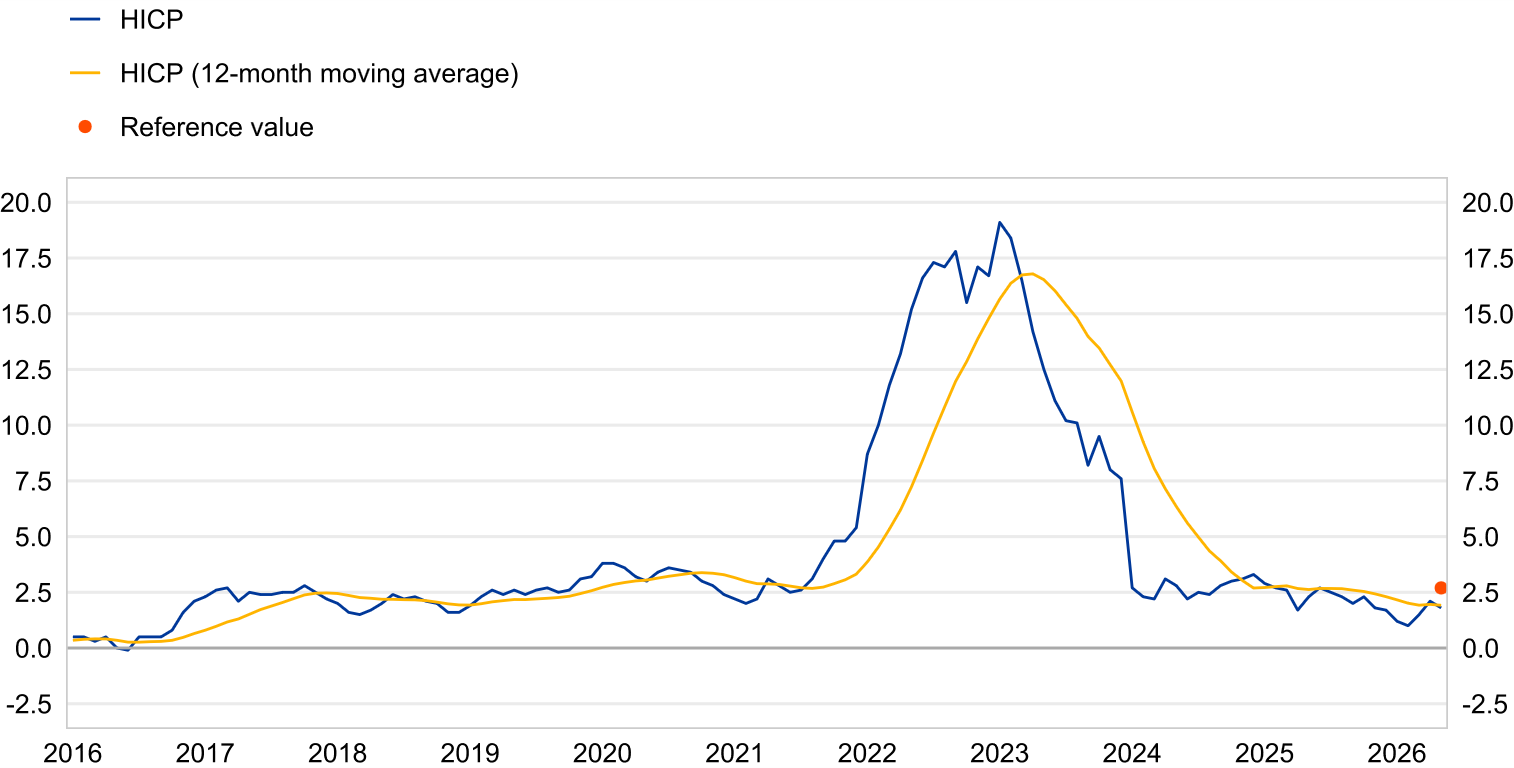
Sources: European Commission (Eurostat) and ECB calculations.
1) The basis of the calculation of the reference value for the period from June 2025 to May 2026 is the unweighted arithmetic average of the annual percentage changes in the HICP for Cyprus, France and Denmark plus 1.5 percentage points. The reference value is 2.7%.
Table 5.1.1
Measures of inflation and related indicators
(annual percentage changes, unless otherwise indicated)
2016- |
2016- |
2021- |
2021 |
2022 |
2023 |
2024 |
2025 |
20262) |
20272) |
|
|---|---|---|---|---|---|---|---|---|---|---|
Measures of inflation |
||||||||||
HICP |
4.5 |
2.2 |
6.9 |
3.3 |
14.8 |
12.0 |
2.7 |
2.3 |
2.7 |
2.8 |
HICP excluding unprocessed food and energy |
4.3 |
2.3 |
6.4 |
3.9 |
12.4 |
9.4 |
3.2 |
3.3 |
2.8 |
2.5 |
HICP at constant tax rates3) |
4.4 |
2.1 |
6.7 |
3.4 |
14.3 |
12.0 |
2.3 |
2.0 |
. |
. |
CPI |
4.5 |
2.2 |
6.8 |
3.9 |
15.1 |
10.7 |
2.4 |
2.5 |
2.3 |
2.2 |
Private consumption deflator |
4.5 |
2.6 |
6.5 |
4.2 |
14.3 |
8.6 |
3.1 |
3.0 |
3.7 |
2.6 |
GDP deflator |
4.3 |
2.9 |
5.7 |
4.0 |
8.7 |
8.6 |
3.9 |
3.5 |
2.7 |
3.1 |
Producer prices4) |
3.7 |
0.6 |
6.9 |
7.1 |
24.3 |
5.0 |
0.8 |
-0.8 |
. |
. |
Related indicators |
||||||||||
Real GDP growth |
1.9 |
1.7 |
2.1 |
4.0 |
2.8 |
0.0 |
1.3 |
2.6 |
1.8 |
2.4 |
GDP per capita in PPS5) (euro area = 100) |
87.5 |
87.7 |
87.3 |
87.8 |
85.7 |
87.0 |
86.8 |
88.9 |
. |
. |
Comparative price levels (euro area = 100) |
75.8 |
69.0 |
84.3 |
79.0 |
85.3 |
87.8 |
84.9 |
. |
. |
. |
Output gap6) |
0.1 |
0.8 |
-0.7 |
-0.6 |
0.8 |
-1.4 |
-1.5 |
-0.5 |
-0.4 |
0.5 |
Unemployment rate (%)7) |
2.7 |
2.7 |
2.6 |
2.8 |
2.2 |
2.6 |
2.6 |
2.8 |
3.1 |
3.2 |
Unit labour costs, whole economy |
5.2 |
4.8 |
5.5 |
3.6 |
5.4 |
8.4 |
5.3 |
4.9 |
3.6 |
2.4 |
Compensation per employee, whole economy |
6.1 |
7.4 |
4.8 |
3.7 |
3.8 |
6.6 |
4.7 |
5.4 |
5.4 |
4.9 |
Labour productivity, whole economy |
0.9 |
2.4 |
-0.7 |
0.1 |
-1.5 |
-1.7 |
-0.6 |
0.5 |
1.7 |
2.4 |
Imports of goods and services deflator |
1.3 |
-0.6 |
3.2 |
4.3 |
13.0 |
-2.5 |
3.2 |
-1.3 |
4.1 |
-0.6 |
Nominal effective exchange rate8) |
2.0 |
1.8 |
2.3 |
3.8 |
3.4 |
4.8 |
-3.7 |
3.2 |
. |
. |
Money supply (M3)9) |
7.5 |
8.0 |
7.0 |
7.2 |
6.8 |
9.5 |
7.0 |
4.7 |
. |
. |
Lending from banks10) |
7.0 |
6.5 |
7.6 |
10.1 |
8.0 |
6.0 |
5.5 |
8.3 |
. |
. |
Stock prices (PX Index)11) |
180.8 |
7.4 |
161.5 |
38.8 |
-15.7 |
17.7 |
24.5 |
52.6 |
. |
. |
Residential property prices |
9.4 |
9.0 |
9.8 |
19.7 |
16.9 |
-1.7 |
5.0 |
10.4 |
. |
. |
Sources: European Commission (Eurostat, Directorate-General for Economic and Financial Affairs), national data for CPI, money supply, lending from banks and ECB calculations based on LSEG data for stock prices.
1) Multi-annual averages calculated using the geometric mean, except for GDP per capita in PPS, comparative price levels, output gap and unemployment rate, for which the arithmetic mean is used.
2) Data from the European Commission’s Spring 2026 Economic Forecast.
3) The difference between the HICP and the HICP at constant tax rates shows the theoretical impact of changes in indirect taxes (e.g. VAT and excise duties) on the overall rate
of inflation. This impact assumes a full and instantaneous pass-through of tax rate changes to the price paid by the consumer.
4) Domestic sales, total industry excluding construction.
5) PPS stands for purchasing power standards.
6) Percentage difference from potential GDP: a positive (negative) sign indicates that actual GDP is above (below) potential GDP.
7) Definition conforms to International Labor Organization guidelines.
8) EER-40 group of trading partners. A positive (negative) sign indicates an appreciation (depreciation).
9) The series includes repurchase agreements with central counterparties.
10) Adjusted for the derecognition of loans from the MFI statistical balance sheet due to their sale or securitisation.
11) Multi-annual and annual figures represent the percentage change between the end of the given period and the end of the previous period.
5.1.5.2 Fiscal developments
Chart 5.1.2
General government balance and debt
(as a percentage of GDP)

Sources: European System of Central Banks and European Commission (Eurostat).
Table 5.1.2
Government budgetary developments and projections
(as a percentage of GDP, unless otherwise indicated)
2016- |
2016- |
2021- |
2021 |
2022 |
2023 |
2024 |
2025 |
20262) |
20272) |
|
|---|---|---|---|---|---|---|---|---|---|---|
Government balance |
-1.8 |
-0.5 |
-3.2 |
-5.0 |
-3.1 |
-3.7 |
-2.0 |
-2.1 |
-2.8 |
-2.9 |
Total revenue |
40.5 |
40.4 |
40.5 |
40.1 |
40.2 |
40.3 |
41.2 |
41.0 |
40.4 |
39.5 |
Current revenue |
39.7 |
39.7 |
39.6 |
39.2 |
39.2 |
39.3 |
40.3 |
40.1 |
39.5 |
38.9 |
Direct taxes |
8.1 |
8.2 |
8.0 |
7.4 |
7.6 |
8.0 |
8.5 |
8.6 |
7.8 |
7.8 |
Indirect taxes |
11.4 |
11.8 |
11.0 |
11.2 |
11.1 |
10.8 |
10.9 |
10.8 |
10.8 |
10.6 |
Net social contributions |
15.3 |
15.0 |
15.6 |
16.1 |
15.4 |
15.3 |
15.8 |
15.8 |
16.0 |
15.8 |
Other current revenue3) |
4.8 |
4.7 |
5.0 |
4.5 |
5.1 |
5.3 |
5.1 |
5.0 |
4.9 |
4.7 |
Capital revenue |
0.8 |
0.8 |
0.9 |
0.9 |
0.9 |
0.9 |
0.9 |
1.0 |
0.9 |
0.6 |
Total expenditure |
42.3 |
40.9 |
43.7 |
45.0 |
43.2 |
44.0 |
43.2 |
43.2 |
43.2 |
42.4 |
Current expenditure |
37.2 |
36.2 |
38.3 |
39.7 |
37.7 |
38.6 |
37.9 |
37.5 |
37.6 |
37.2 |
Compensation of employees |
9.7 |
9.5 |
9.9 |
10.7 |
9.8 |
9.6 |
9.6 |
9.7 |
10.0 |
10.0 |
Social benefits |
16.2 |
15.6 |
16.8 |
17.1 |
16.5 |
16.9 |
17.0 |
16.4 |
16.4 |
16.1 |
Interest payable |
1.0 |
0.8 |
1.2 |
0.7 |
1.1 |
1.3 |
1.3 |
1.3 |
1.3 |
1.3 |
Other current expenditure4) |
10.3 |
10.2 |
10.4 |
11.1 |
10.3 |
10.7 |
10.0 |
10.1 |
9.9 |
9.7 |
Capital expenditure |
5.1 |
4.7 |
5.5 |
5.4 |
5.5 |
5.4 |
5.2 |
5.7 |
5.6 |
5.2 |
of which: Investment |
4.3 |
3.9 |
4.8 |
4.6 |
4.5 |
4.8 |
4.7 |
5.2 |
5.0 |
4.7 |
Cyclically adjusted balance |
-1.9 |
-0.8 |
-2.9 |
-4.7 |
-3.4 |
-3.2 |
-1.4 |
-1.9 |
-2.6 |
-3.1 |
One-off and temporary measures |
0.0 |
0.0 |
0.0 |
0.0 |
0.0 |
0.0 |
0.0 |
-0.1 |
0.0 |
0.0 |
Structural balance5) |
-1.8 |
-0.8 |
-2.9 |
-4.8 |
-3.4 |
-3.2 |
-1.4 |
-1.8 |
-2.6 |
-3.1 |
Government debt |
38.1 |
33.6 |
42.6 |
40.7 |
42.5 |
42.2 |
43.3 |
44.3 |
45.8 |
47.2 |
Average residual maturity (in years) |
. |
. |
6.3 |
6.4 |
6.3 |
6.4 |
6.3 |
6.2 |
. |
. |
In foreign currencies (% of total) |
10.3 |
12.8 |
7.8 |
7.7 |
11.3 |
7.0 |
6.8 |
6.3 |
. |
. |
of which: Euro |
9.8 |
12.0 |
7.5 |
7.4 |
10.9 |
6.7 |
6.6 |
5.8 |
. |
. |
Domestic ownership (% of total) |
66.2 |
59.9 |
72.6 |
69.1 |
70.2 |
73.7 |
75.0 |
74.8 |
. |
. |
Medium and long-term maturity (% of total)6) |
97.1 |
98.1 |
96.0 |
97.4 |
94.3 |
97.7 |
96.4 |
94.4 |
. |
. |
of which: Variable interest rate (% of total) |
12.2 |
12.3 |
12.0 |
11.9 |
13.9 |
12.3 |
11.1 |
10.8 |
. |
. |
Deficit-debt adjustment |
0.9 |
0.5 |
1.3 |
1.7 |
3.0 |
-0.6 |
1.1 |
1.3 |
. |
. |
Net acquisitions of main financial assets |
1.2 |
0.9 |
1.4 |
2.4 |
2.4 |
0.0 |
1.0 |
1.3 |
. |
. |
Currency and deposits |
1.2 |
1.1 |
1.2 |
2.3 |
1.1 |
0.6 |
0.9 |
1.1 |
. |
. |
Debt securities |
0.0 |
0.0 |
0.0 |
0.0 |
0.0 |
0.0 |
0.0 |
0.0 |
. |
. |
Loans |
0.0 |
-0.2 |
0.2 |
0.1 |
1.2 |
-0.5 |
0.1 |
0.1 |
. |
. |
Equity and investment fund shares or units |
0.0 |
0.0 |
0.0 |
-0.1 |
0.0 |
-0.2 |
0.0 |
0.1 |
. |
. |
Revaluation effects on debt |
0.0 |
0.0 |
0.0 |
-0.1 |
-0.2 |
0.0 |
0.2 |
0.0 |
. |
. |
of which: Foreign exchange holding gains/losses |
0.0 |
0.0 |
-0.1 |
-0.1 |
-0.1 |
0.0 |
0.0 |
-0.1 |
. |
. |
Other7) |
-0.2 |
-0.4 |
-0.1 |
-0.6 |
0.7 |
-0.4 |
0.2 |
-0.1 |
. |
. |
Net expenditure growth (%) |
. |
. |
. |
. |
. |
. |
1.0 |
4.9 |
6.3 |
4.3 |
Medium-term fiscal-structural plan: net expenditure growth (%) |
. |
. |
. |
. |
. |
. |
5.3 |
4.5 |
2.5 |
2.6 |
Sources: European System of Central Banks and European Commission (Eurostat, Directorate-General for Economic and Financial Affairs).
1) Multi-annual averages calculated using the arithmetic mean.
2) Data from the European Commission’s Spring 2026 Economic Forecast.
3) Sales and other current revenue.
4) Intermediate consumption, subsidies payable and other current expenditure.
5) Cyclically adjusted balance excluding one-off and other temporary measures.
6) Original maturity of more than one year.
7) Time of recording differences and other factors (sector reclassifications and statistical discrepancies).
5.1.5.3 Exchange rate and external developments
Chart 5.1.3
Bilateral exchange rate and short-term interest rate differential
(CZK/EUR exchange rate: monthly averages; difference between three-month interbank interest rates and three-month EURIBOR: basis points, monthly values)
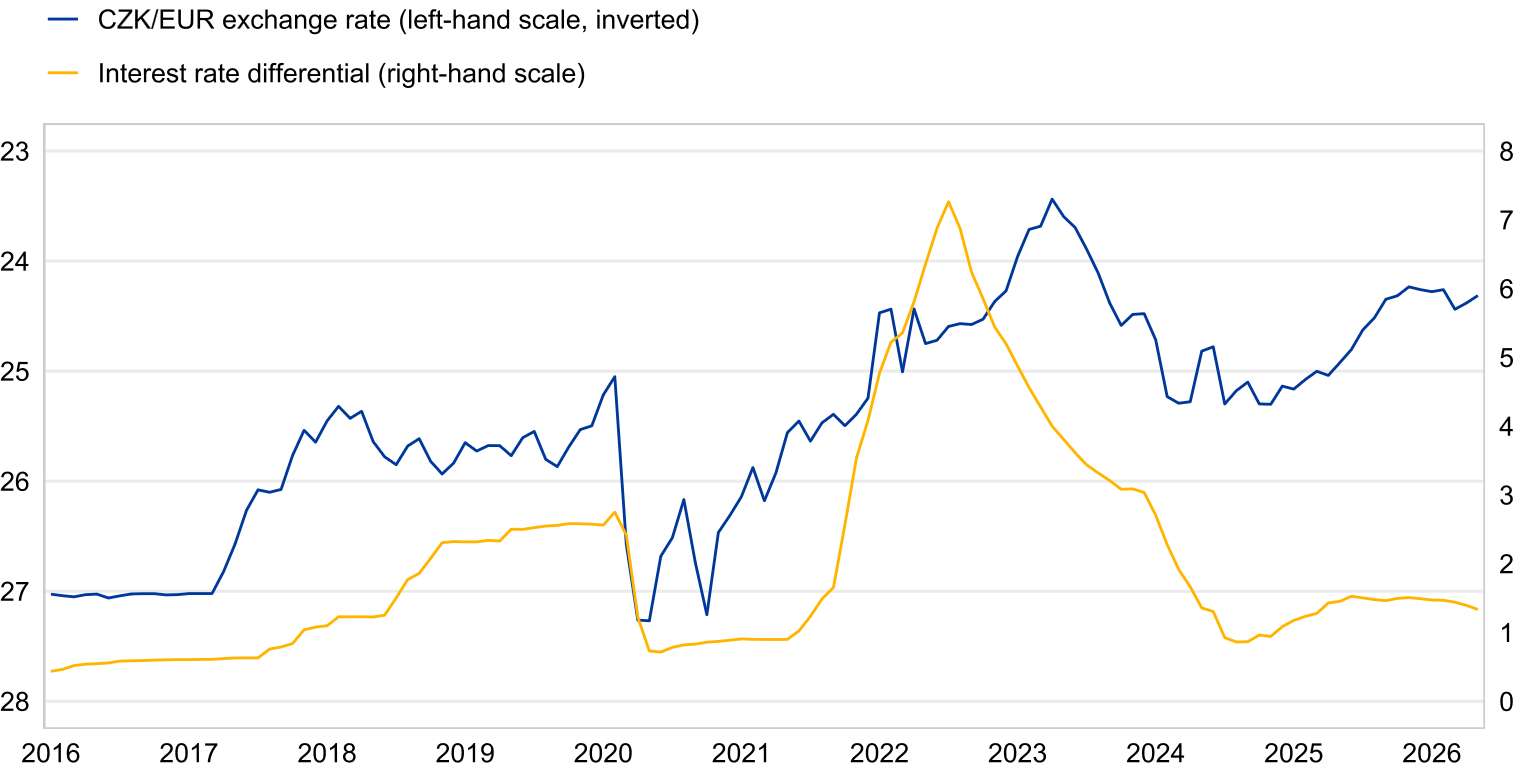
Sources: European System of Central Banks and ECB calculations.
Chart 5.1.4
Effective exchange rates 1)
(EER-40 group of trading partners; monthly averages; index: Q1 1999 = 100)

Source: ECB.
1) The real EER-40 is CPI-deflated. An increase (decrease) in the EER indicates an appreciation (depreciation).
Table 5.1.3
External developments
(as a percentage of GDP, unless otherwise indicated)
2016- |
2016- |
2021- |
2021 |
2022 |
2023 |
2024 |
2025 |
20262) |
20272) |
|
|---|---|---|---|---|---|---|---|---|---|---|
Balance of payments |
||||||||||
Current account and capital account balance3) |
1.2 |
2.0 |
0.4 |
-0.4 |
-4.1 |
1.0 |
3.3 |
2.2 |
2.0 |
2.1 |
Current account balance |
0.1 |
1.2 |
-0.9 |
-2.1 |
-4.7 |
-0.1 |
1.7 |
0.7 |
0.4 |
0.8 |
Goods |
3.8 |
4.6 |
3.0 |
1.7 |
-0.3 |
3.8 |
5.1 |
4.6 |
. |
. |
Services |
1.8 |
2.2 |
1.4 |
1.9 |
1.4 |
1.1 |
1.4 |
1.2 |
. |
. |
Primary income |
-5.0 |
-5.2 |
-4.8 |
-5.3 |
-5.3 |
-4.4 |
-4.4 |
-4.6 |
. |
. |
Secondary income |
-0.5 |
-0.5 |
-0.5 |
-0.4 |
-0.5 |
-0.7 |
-0.5 |
-0.5 |
. |
. |
Capital account balance |
1.1 |
0.8 |
1.3 |
1.7 |
0.6 |
1.2 |
1.6 |
1.5 |
. |
. |
Combined direct and portfolio investment balance3) |
-2.1 |
-4.5 |
0.3 |
0.7 |
3.5 |
0.1 |
-2.6 |
-0.3 |
. |
. |
Direct investment |
-1.4 |
-2.1 |
-0.7 |
-0.5 |
-1.2 |
-1.0 |
-0.2 |
-0.5 |
. |
. |
Portfolio investment |
-0.7 |
-2.4 |
1.0 |
1.2 |
4.7 |
1.1 |
-2.4 |
0.3 |
. |
. |
Other investment balance |
-0.9 |
-1.4 |
-0.4 |
-4.8 |
-2.6 |
0.6 |
5.9 |
-1.0 |
. |
. |
Reserve assets |
4.3 |
7.7 |
0.9 |
4.7 |
-4.3 |
0.4 |
0.5 |
3.1 |
. |
. |
Exports of goods and services |
72.1 |
74.7 |
69.6 |
70.5 |
72.7 |
68.4 |
69.3 |
66.9 |
. |
. |
Imports of goods and services |
66.5 |
67.9 |
65.2 |
66.8 |
71.6 |
63.5 |
62.8 |
61.1 |
. |
. |
Net international investment position4) |
-17.8 |
-22.3 |
-13.3 |
-14.9 |
-20.2 |
-14.4 |
-7.4 |
-9.8 |
. |
. |
Gross external debt4) |
71.9 |
77.2 |
66.7 |
72.8 |
66.1 |
62.8 |
65.3 |
66.4 |
. |
. |
Trade with the euro area5) |
||||||||||
Exports of goods and services |
62.7 |
63.0 |
62.3 |
62.7 |
63.8 |
63.3 |
60.9 |
60.8 |
. |
. |
Imports of goods and services |
51.2 |
52.8 |
49.5 |
49.7 |
47.7 |
49.9 |
50.1 |
50.2 |
. |
. |
Investment position with the euro area5) |
||||||||||
Direct investment assets4) |
72.4 |
77.2 |
67.7 |
72.1 |
66.8 |
67.4 |
66.4 |
65.7 |
. |
. |
Direct investment liabilities4) |
78.7 |
80.3 |
77.1 |
78.5 |
76.6 |
77.1 |
76.9 |
76.4 |
. |
. |
Portfolio investment assets4) |
70.1 |
70.0 |
70.2 |
70.1 |
69.7 |
69.0 |
70.0 |
72.5 |
. |
. |
Portfolio investment liabilities4) 6) |
65.4 |
64.9 |
65.9 |
72.6 |
66.3 |
62.6 |
64.4 |
63.6 |
. |
. |
Sources: European System of Central Banks and European Commission (Eurostat, Directorate-General for Economic and Financial Affairs).
1) Multi-annual averages calculated using the arithmetic mean.
2) Data from the European Commission’s Spring 2026 Economic Forecast.
3) Differences between totals and the sum of their components are due to rounding.
4) End-of-period outstanding amounts.
5) As a percentage of the total.
6) Portfolio investment liabilities are derived from the ECB’s data on euro area portfolio investment assets.
5.1.5.4 Long-term interest rate developments
Chart 5.1.5
Long-term interest rate 1)
(monthly averages in percentages)

Sources: European System of Central Banks and ECB calculations.
1) The basis of the calculation of the reference value for the period from June 2025 to May 2026 is the unweighted arithmetic average of the interest rate levels in Cyprus, France and Denmark plus 2 percentage points. The reference value is 5.1%.
Chart 5.1.6
Long-term interest rate and HICP inflation differentials vis-à-vis the euro area
(monthly averages in percentage points)
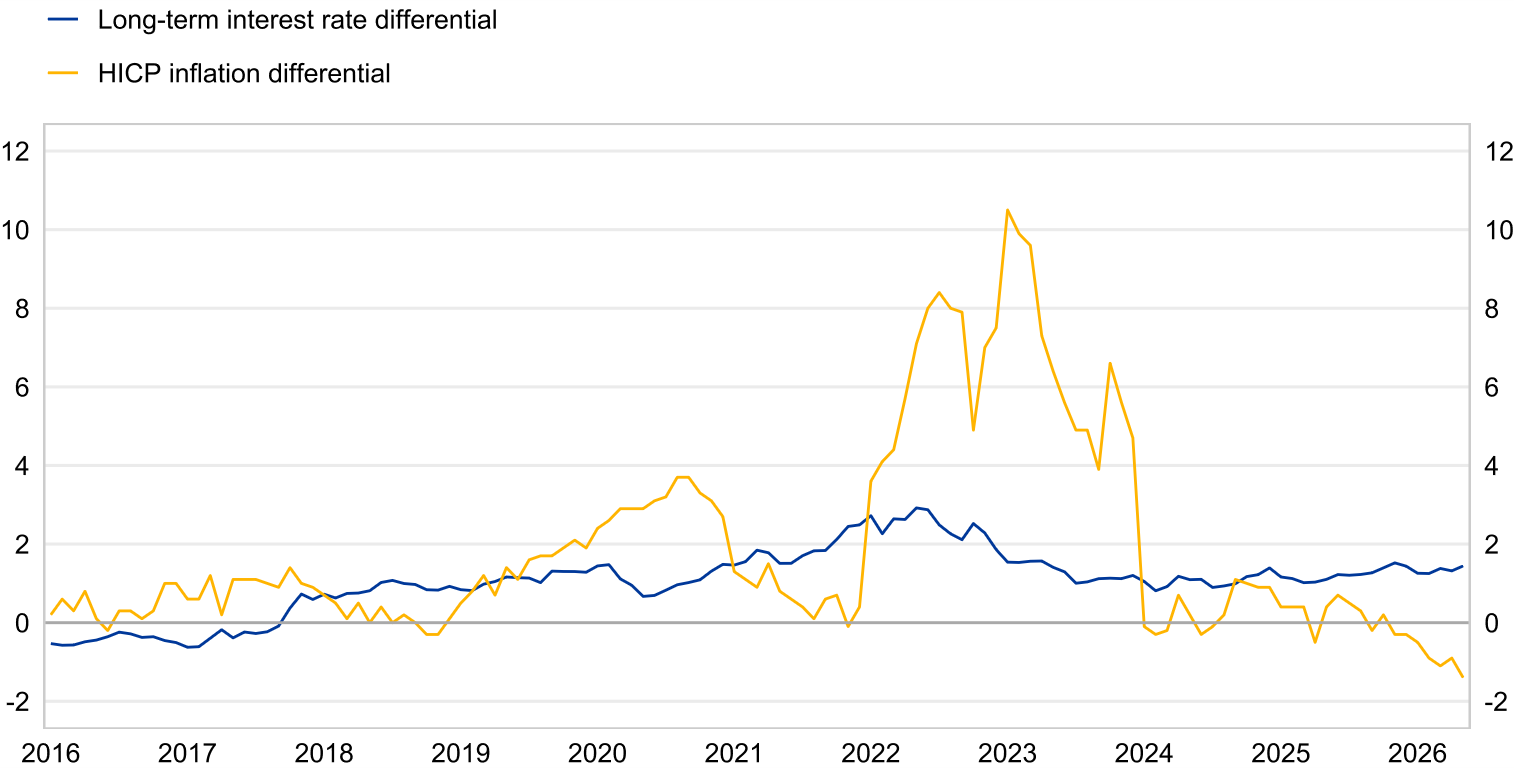
Sources: European System of Central Banks, ECB calculations and European Commission (Eurostat).
Table 5.1.4
Long-term interest rates and indicators of financial development and integration
(as a percentage of GDP, unless otherwise indicated)
2016- |
2016- |
2021- |
2022 |
2023 |
2024 |
2025 |
June 2025 to May 2026 |
Memo item: euro area 2025 |
|
|---|---|---|---|---|---|---|---|---|---|
Long-term interest rates |
|||||||||
Czech Republic2) |
2.5 |
1.2 |
3.8 |
4.3 |
4.4 |
4.0 |
4.3 |
4.5 |
- |
Euro area3) 4) |
1.5 |
0.7 |
2.2 |
1.9 |
3.1 |
2.9 |
3.1 |
3.2 |
- |
Euro area AAA par curve, ten-year residual maturity2) 4) |
0.9 |
0.1 |
1.7 |
1.2 |
2.5 |
2.4 |
2.7 |
2.8 |
- |
Indicators of financial development and integration |
|||||||||
Debt securities issued by financial corporations5) |
13.8 |
12.2 |
15.4 |
16.8 |
14.5 |
13.0 |
13.0 |
- |
60.3 |
Debt securities issued by non-financial corporations6) |
5.5 |
6.5 |
4.6 |
3.9 |
4.3 |
5.1 |
5.3 |
- |
11.7 |
Stock market capitalisation7) |
11.2 |
11.3 |
11.1 |
9.1 |
10.0 |
10.3 |
13.3 |
- |
73.9 |
MFI credit to non-government residents8) |
53.8 |
54.4 |
53.2 |
53.0 |
52.0 |
52.3 |
52.8 |
- |
95.4 |
Claims of euro area MFIs on resident MFIs9) |
20.1 |
23.2 |
17.1 |
16.5 |
13.1 |
15.9 |
17.3 |
- |
26.0 |
Sources: European System of Central Banks and ECB calculations.
1) Multi-annual averages calculated using the arithmetic mean.
2) Average interest rate.
3) GDP-weighted average of the euro area long-term interest rates for the purpose of assessing convergence.
4) Included for information only.
5) Outstanding amount of debt securities issued by resident MFIs (excluding the national central bank) and other financial corporations.
6) Outstanding amount of debt securities issued by resident non-financial corporations.
7) Outstanding amount of listed shares issued by residents at market values.
8) MFI (excluding national central bank) credit to domestic non-MFI residents other than general government. Credit comprises outstanding amounts of loans and debt securities.
9) Outstanding amount of deposits and debt securities issued by resident MFIs (excluding the national central bank) held by euro area MFIs as a percentage of total liabilities of resident MFIs (excluding the national central bank). Total liabilities exclude capital
and reserves and remaining liabilities.
5.2 Hungary
5.2.1 Price developments
In May 2026 the 12‑month average rate of HICP inflation in Hungary was 3.3%, i.e. well above the reference value of 2.7% for the criterion on price stability (Chart 5.2.1). This rate is expected to increase gradually over the coming months, driven mainly by higher commodity prices and broadening inflationary pressures related to the war in the Middle East.
Over the past ten years the 12‑month average rate of HICP inflation has fluctuated within a very wide range, from 0.2% to 22.5%. Between 2016 and 2019 inflation increased gradually from very subdued levels, reaching 3.4% in 2019 on the back of robust domestic demand, strong wage growth and changes to indirect taxes. In 2020 it remained broadly stable despite the outbreak of the COVID-19 pandemic, as economic activity was supported by policy measures. In particular, the Magyar Nemzeti Bank reduced its key policy rate, down to a historical low of 0.6%, and purchased government securities in the secondary market. In 2021 inflation rose to 5.2%, driven by the economic recovery, rising energy prices and pandemic-related supply bottlenecks. This prompted the central bank to start a cycle of interest rate hikes in June and gradually phase out its quantitative easing schemes. In 2022 inflation accelerated further, reaching 15.3% on average, reflecting soaring energy and commodity prices in the wake of Russia’s invasion of Ukraine, drought-related increases in food prices, strong fiscal stimulus, an exchange rate depreciation and robust wage growth (Table 5.2.1). To mitigate the impact of this increase in inflation, the Hungarian Government introduced temporary price caps on motor fuels and selected basic food items, while the Magyar Nemzeti Bank tightened monetary policy significantly, raising its key policy rate to 13% in September 2022, setting higher minimum reserve requirements and introducing additional liquidity-absorbing facilities. Following a rapid depreciation of the exchange rate, it also introduced one-day deposit tenders at an interest rate of 18%, which became its key policy rate. After peaking in early 2023, inflation declined gradually as energy prices moderated. The Magyar Nemzeti Bank subsequently began to ease monetary policy, reducing its base rate to 10.75% by the end of year and reinstating it as the key policy rate. In 2024 inflation declined markedly to 3.7%, reflecting a tight monetary policy stance and lower global energy prices. Against this backdrop, the central bank continued its easing cycle, lowering its key policy rate to 6.5% by September that year. Despite this disinflation, underlying price pressures remained elevated, driven by strong wage growth, which was not backed by improvements in productivity, and persistent services inflation. In 2025 inflation rose again, averaging 4.4%. This increase, which was due to higher global food prices and still elevated services inflation owing to slow-moving inflation expectations, as well as indirect tax adjustments, prompted the central bank to pause its easing cycle.
In May 2026 the annual rate of HICP inflation stood at 2.3%. In the first two months of 2026, inflation continued to decline, sustaining the downward trend observed towards the end of 2025. This was attributable to lower energy and commodity prices, the past monetary policy tightening, an appreciation of the exchange rate and weaker than usual repricing activity by companies at the beginning of the year. In this context, the Magyar Nemzeti Bank reduced its base rate by 25 basis points to 6.25% in February 2026. However, in March inflationary pressures started to increase again, largely on the back of a rebound in energy prices amid the heightened geopolitical tensions related to the war in the Middle East. In response, the authorities introduced measures aimed at mitigating the impact of higher energy prices. These measures, which include a reduction in the excise duty on fuel, the reintroduction of price caps on motor vehicle fuels, the release of national strategic oil reserves and a ban on crude oil exports, are expected to cushion the inflationary pressures. As with the other central and eastern European countries under review, Hungary is particularly vulnerable to global energy shocks, owing to the relatively high energy intensity of its economy and the relatively large share of energy in the consumption basket. This vulnerability is also exacerbated by the limited diversification of its energy supply.
Policy choices have played an important role in shaping inflation dynamics in Hungary over the past decade, most notably the orientation of monetary policy towards price stability. Since 2015 the Magyar Nemzeti Bank has had an inflation target of 3%, with an ex ante tolerance band of ±1 percentage point, as measured by the national consumer price index. Under this inflation-targeting framework, the central bank has continuously adjusted its monetary policy toolkit to evolving macroeconomic challenges. At times, this has been complicated by economic and fiscal policies, such as the caps on bank interest rates and on consumer prices for energy and food, and by the legal provisions restricting the purchase of debt instruments issued by the central bank and therefore its ability to absorb liquidity.
Inflation is expected to remain slightly above the central target of 3% over the forecast horizon, with risks to the sustainability of inflation convergence persisting over the longer term. According to the European Commission’s Spring 2026 Economic Forecast, HICP inflation is expected to remain slightly above 3% in 2026 and 2027. The near-term inflation outlook mainly reflects upward pressures stemming from higher energy prices due to the war in the Middle East, which are being partly offset by the significant exchange rate appreciation in the first half of 2026. In addition, labour market conditions remain tight despite signs of a softening, with robust wage growth driven partly by increases in public sector wages and the minimum wages. These forecasts are subject to considerable uncertainty in terms of the evolution of energy prices, their pass-through to other price components and the geopolitical situation, especially in view of the sensitivity of the Hungarian economy to external shocks. Risks to the inflation outlook are tilted to the upside, as further volatility in global commodity prices and renewed global supply bottlenecks could lead to more broad-based inflationary pressures. This includes through the emergence of indirect and second-round effects, particularly given that Hungary has a high energy intensity of production and that its economy is deeply rooted in regional and global supply chains. Furthermore, a continued accommodative fiscal stance could add to inflationary pressures. Looking further ahead, unless offset by an appreciation of the nominal exchange rate, the catching-up process is likely to result in positive inflation differentials vis-à-vis the euro area, given that GDP per capita and price levels are still lower in Hungary than in the euro area. While equilibrium inflation differentials associated with the catching-up process tend not to be very large, they may become a concern if they are accompanied by potentially unsustainable developments in credit and asset prices. In this context, the catching-up process needs to be supported by appropriate policies to avoid unduly jeopardising competitiveness and to prevent the build-up of unsustainable levels of credit growth and other macroeconomic imbalances.
Achieving an environment that is conducive to sustainable convergence in Hungary requires stability‑oriented economic policies and wide‑ranging structural reforms. Further improving the quality of public institutions and ensuring that they are free from undue political interference, fighting corruption, implementing adequate product market policies and safeguarding the rule of law, are prerequisites for private sector-led economic growth. Enhanced governance, stronger institutions and a better functioning administration at the national level should, among other things, help to improve the absorption of EU funds. In this respect, it remains of utmost importance that the authorities address the concerns over the rule of law expressed by the European Commission under the general regime of conditionality for the protection of the Union budget, in order to facilitate the full disbursement of EU funds. Hungary is also faced with structural challenges related to adverse demographic trends and emerging skill mismatches in the labour market, which may weigh on labour productivity and growth potential. Maintaining sound macroeconomic policies and ensuring policy consistency will also be key to supporting confidence and sustainable growth. With regard to macroeconomic imbalances, the European Commission selected Hungary for an in‑depth review in its Alert Mechanism Report 2026 based on concerns related to significant price and cost pressures, the soundness of government finances, and developments in the housing market.
Financial sector policies should be aimed at safeguarding financial stability – and ultimately the functioning of monetary policy transmission – as well as ensuring that the financial sector makes a sound contribution to sustainable economic growth. The resilience of the banking sector in Hungary is underpinned by the relatively strong capital and liquidity positions of its banks. Moreover, the profitability of banks has improved, and non-performing loan ratios have declined further. However, signs of overvaluation in real estate markets amid rising prices and credit growth, alongside higher interest rates and past declines in the real incomes of borrowers, may exacerbate debt servicing difficulties in the wake of adverse shocks. Despite being partly phased out, interest rate ceilings, including on new mortgage loans, and manifold subsidised loan schemes are distorting borrowers’ incentives and complicating the transmission of monetary policy. Furthermore, lending to corporates in foreign currency may lead to significant currency mismatches and heighten the credit risk of banks. In turn, the deterioration in the quality of loan portfolios could put pressure on banks’ profitability. At the same time, tax and regulatory policies aimed at incentivising banks to increase their holdings of government debt have strengthened the sovereign-bank nexus. Enhancing the intermediary role of the banking sector could foster economic growth in the long term, particularly if supported by a stable business environment. In order to bolster confidence in the financial system, the national competent authorities can further improve their supervisory practices by, among other things, following the applicable recommendations from the relevant international and European bodies, and by collaborating closely with other national supervisors of EU Member States within the supervisory colleges.
5.2.2 Fiscal developments
Hungary’s general government budget deficit was well above the 3% reference value in 2025 and its debt ratio was above the 60% reference value. In the reference year 2025, the general government budget balance recorded a deficit of 4.7% of GDP, i.e. well above the 3% reference value. The general government gross debt-to-GDP ratio was 74.6%, i.e. above the 60% reference value (Table 5.2.2). Compared with the previous year, the deficit ratio decreased by 0.4 percentage points of GDP and the debt ratio increased moderately by 1.1 percentage points of GDP. With regard to other fiscal factors, the deficit ratio exceeded the ratio of public investment to GDP in 2025.
Hungary has been subject to an excessive deficit procedure since 2024. Following a recommendation from the European Commission of 8 July 2024 on the basis of an excessive deficit in 2023, the Council decided on 26 July 2024, in accordance with Article 126(6) of the Treaty, that an excessive deficit existed in Hungary, and on 21 January 2025, it issued a recommendation to correct the excessive deficit by 2026 at the latest. In June 2026, the Commission found that Hungary’s net expenditure growth in 2025 and its projected net expenditure growth in 2026 (both in annual and cumulative terms) were above the ceilings recommended by the Council. In 2025 the cumulated deviation was within the flexibility provided for by the national escape clause for defence expenditure. The Council activated this national escape clause on 8 July 2025, which allows Hungary to deviate from the net expenditure path if this is due to higher defence expenditure. This clause covers a period of four years and a maximum of 1.5% of GDP in flexibility. That said, the corresponding cumulated deviation for 2026 is expected to remain above 0.6% of GDP, the level above which there would be a strong presumption of no effective action. While the excessive deficit procedure is currently held in abeyance, Hungary is projected to be at risk of material non-compliance in 2026 and may therefore fall short of delivering effective action, which could require a stepping-up of the procedure. Moreover, the Commission found that there is a clear risk that Hungary will not correct its excessive deficit by 2026, which is the final year of the corrective path.
Both cyclical and non-cyclical factors contributed to a deterioration in the budget balance over the period 2020-23, which was only partly reversed by 2025. From 2016 until the outbreak of the pandemic, the budget deficit was relatively stable at between 1.8% and 2.5% of GDP. As a result of the pandemic, the budget balance declined by 5.5 percentage points in 2020 to a deficit of 7.5% of GDP. This was due to cyclical factors, as well as a deterioration in the structural deficit, which rose by 3.4 percentage points between 2019 and 2021, reflecting a sharp increase in expenditure to address the impact of the pandemic. Between 2020 and 2025, the budget deficit decreased by 2.8 percentage points on account of an improving structural balance. However, the budget deficit in 2025 was still 2.6 percentage points higher than in 2019, i.e. the year before the outbreak of the pandemic.
The government debt-to-GDP ratio has remained above 60% of GDP since 2005. Prior to the pandemic, the debt ratio was on a downward path, largely underpinned by a favourable interest-growth differential and a primary surplus. Having declined by 9.6 percentage points since 2016, the debt ratio reached a trough of 65.0% of GDP in 2019. It then increased markedly on account of the impact of the pandemic, rising by 13.7 percentage points to reach 78.7% of GDP in 2020. It subsequently declined by 5.4 percentage points by 2023 on account of economic growth and high inflation, both of which counterbalanced the primary deficits and unfavourable deficit-debt adjustments. The downward path came to a halt as of 2024 when the debt ratio increased slightly by 0.2 percentage points in 2024 and by 1.1 percentage points in 2025 to reach 74.6% of GDP.
The level and structure of government debt indicate that fiscal balances are relatively sensitive to interest rate fluctuations and sensitive to exchange rate movements. In 2025 the share of debt with a short-term maturity amounted to 7.4% and the average residual maturity was 5.3 years. However, the share of debt with variable interest rates increased substantially, from 10.6% of the total debt in 2021 to 17.8% in 2025. Therefore, fiscal balances remain relatively sensitive to interest rate changes. Moreover, Hungary increased its proportion of foreign currency-denominated government debt, which is exclusively denominated in euro, from 20.5% in 2019 to 32.2% in 2025. Consequently, the sensitivity of fiscal balances to changes in the exchange rate vis-à-vis the euro has significantly increased.
The European Commission’s Spring 2026 Economic Forecast foresees a deterioration in the budget balance and a subsequent increase in the debt ratio. According to the European Commission’s latest forecast, the headline deficit is expected to increase, reaching 6.2% of GDP in 2026, i.e. significantly above the 3% reference value, before decreasing to 5.8% in 2027. In 2026 the deficit is projected to widen to 6.2% of GDP, mainly due to new tax cuts targeted at households, housing support measures and rising public sector wages, only partly offset by extended windfall taxes. In response to the energy price shock following the outbreak of war in the Middle East, Hungary implemented limited fiscal energy measures, notably a reduction in excise tax rates. In 2027 the deficit is expected to remain high, at 5.8% of GDP, owing to the growing cost of income tax measures and the expiry of windfall taxes. The debt ratio is projected to increase to 75.1% of GDP in 2026 and 76.8% of GDP in 2027, therefore remaining above the 60% reference value.
No progress on reforming the fiscal framework has been observed recently, neither has an alignment with the new European fiscal rules been achieved nor a transparent assessment by an independent fiscal institution been made. In December 2019, the Hungarian Parliament adopted amendments aimed at increasing the transparency of national fiscal rules and enhancing their implementation. According to the adopted debt ratio rule, if the general government debt ratio exceeds 50% of GDP, the Hungarian Parliament may only adopt an act on the central budget which leads to a reduction in the debt level of at least 0.1% of GDP during normal economic times. More recently, changes to the national fiscal rules removed any numerical threshold for debt reduction. Hungary’s independent fiscal institutions, national fiscal rules and medium-term budgetary framework remain among the weakest in the EU according to the March 2026 fiscal governance database update.[157] Stronger emphasis still needs to be placed on the multi-annual dimension of the budget process. In particular, the Fiscal Council of Hungary has, in practice, only a limited role, if any, in assessing the impact of policy on long-term fiscal sustainability and medium-term fiscal-structural plans, even though this is provided for in the legislation. Furthermore, there are also no constraints on possible deviations from medium-term plans or well-defined corrective actions in place in this respect.
Hungary faces high sustainability risks over both the medium and long term, mainly due to debt being projected to be on an upward path and to remain well above the 60% reference value, but also due to its ageing population. The European Commission’s 2025 Debt Sustainability Monitor points to high risks in both the medium and long term, with a projected increase in the debt ratio over the forecast horizon. The medium-term risk has increased compared with the 2023 assessment (which pointed to a medium risk), driven by the notable increase in the debt-to-GDP ratio and significantly worse debt dynamics over the projected horizon. Under the baseline scenario of no policy change, the debt ratio was expected to reach 93.7% of GDP in 2034, compared with 62.2% projected by the 2023 Debt Sustainability Monitor. Looking at the longer term, the risks have increased from medium, according to the 2023 Debt Sustainability Monitor, to high based on the long-term sustainability gap indicator S2. According to the 2024 Ageing Report prepared by the Ageing Working Group (AWG) of the EU’s Economic Policy Committee, Hungary would experience a significant increase in age-related expenditure of 5.3 percentage points of GDP by 2070 under the baseline scenario, rising from 16.0% of GDP in 2022 to 21.3% of GDP in 2070.[158] Under the AWG’s risk scenario, this increase is projected to be 4.0 percentage points higher than under the baseline (mainly owing to increases of 3.1 and 1.0 percentage points of GDP in long-term care and healthcare respectively), which is significantly above the EU average. All these factors suggest that reforms are needed to improve the long-term sustainability of public finances.
Looking ahead, a credible fiscal policy and further structural reforms are crucial for putting government debt on a downward path and complying with the Stability and Growth Pact. Hungary must ensure compliance with the requirements of the excessive deficit procedure through further consolidation. A credible fiscal policy is needed to safeguard the sustainability of public finances. Consistent and multi-annual planning of fiscal policy will also ensure that Hungary complies with the Stability and Growth Pact, reduces its public debt and maintains buffers to alleviate adverse shocks. Policies aimed at improving tax collection and shrinking the informal economy should continue to be pursued. Distortive tax measures should be avoided. Since Hungary is one of the weakest performers according to the European Commission’s fiscal governance database, reinforcing its multi-annual fiscal planning and national fiscal rules as well as strengthening its Fiscal Council would mitigate the procyclicality of fiscal policy and increase the effectiveness of its public spending. Structural reforms to the pension system, as well as the health and long-term care systems, are also necessary to address longer-term risks to fiscal sustainability. Finally, growth-friendly fiscal adjustments, based on reversing the downward trend in government investment through careful reprioritisation of public spending, are important.
5.2.3 Exchange rate developments
Over the reference period from 18 June 2024 to 17 June 2026, the Hungarian forint did not participate in ERM II but traded under a flexible exchange rate regime. In the two‑year reference period the Hungarian forint mostly traded close to its June 2024 average exchange rate against the euro of 394.76 forints per euro, which is used as a benchmark for illustrative purposes in the absence of an ERM II central rate (Chart 5.2.3). The maximum upward deviation from this benchmark was 11.5%, while the maximum downward deviation amounted to 5.4%. On 17 June 2026 the exchange rate stood at 349.68 forints per euro, i.e. the forint was trading 11.4% stronger than its average level in June 2024. The Magyar Nemzeti Bank entered a repo line arrangement with the ECB in June 2020, under which it could borrow up to €4 billion against high-quality euro-denominated collateral to provide euro liquidity to Hungarian financial institutions in order to address possible needs. This agreement remained in place over the reference period as it was extended again in January 2025 for a period of two years. As this arrangement helped to reduce the potential risk of financial vulnerabilities, it may also have had an impact on exchange rate developments over the reference period. Over the past ten years the exchange rate of the Hungarian forint against the euro has depreciated by 11.4%.
The exchange rate of the Hungarian forint against the euro exhibited, on average, a relatively high degree of volatility over the reference period. Between June and December 2024 the Hungarian forint gradually weakened, following a series of interest rate cuts by the Magyar Nemzeti Bank and declining interest rate differentials vis-à-vis the euro area, amid weaker global risk sentiment and subdued economic growth, as well as uncertainty regarding the disbursement of EU funds and regarding fiscal policies in Hungary. This trend reversed in January 2025 as the Hungarian forint started to appreciate, while the Magyar Nemzeti Bank paused its monetary policy easing cycle and interest rate differentials started to widen again as the risk appetite of global investors improved. After February 2026 the forint came under renewed depreciation pressures, as the Magyar Nemzeti Bank gradually resumed its easing cycle while uncertainty about the external environment increased again, although it appreciated strongly following the elections in April. During the reference period short-term interest rate differentials against the three-month EURIBOR were high, on average, and stood at 4.1 percentage points in the three-month period ending in May 2026.
The HICP-based real effective exchange rate of the Hungarian forint has appreciated over the past ten years (Chart 5.2.4). While the real effective exchange rate depreciated between 2016 and 2021, mainly reflecting the depreciation of the nominal exchange rate in effective terms, it began to appreciate sharply from 2022. This real appreciation reflected the very high level of inflation following the sharp rise in energy prices in 2021, which was exacerbated by Russia’s invasion of Ukraine in February 2022. Looking ahead, this indicator should be interpreted with caution, as Hungary is subject to a process of economic convergence, which complicates any long-term assessment of real exchange rate developments.
Over the past ten years Hungary’s combined current and capital account balance has remained in surplus and contributed to a reduction in net foreign liabilities (Table 5.2.3). Between 2016 and 2020 Hungary recorded robust combined current and capital account surpluses, averaging 2.3% of GDP over the period. This reflected (i) a large trade surplus, particularly in services, which more than offset the deficit on income payments; and (ii) a sizeable capital account surplus, which was due to large transfers from the EU budget. The external balance started to worsen in 2019 and Hungary recorded a significant current account deficit of 4.4% of GDP in 2021 on account of exports lagging behind imports. Primarily as a result of the large increases in energy prices around Russia’s invasion of Ukraine, the current account deficit continued to increase in 2022, reaching 9.0% of GDP, mainly owing to a further sharp increase in the goods deficit. However, the current account balance moved into positive territory in 2023, standing at 1.2% of GDP, as energy prices receded from their peak levels causing the goods balance to improve by almost 9 percentage points of GDP. In 2024 the current account balance improved further, to 1.6% of GDP, as the surplus in services increased to 4.9% of GDP. Until 2020 the current and capital account surplus had been mirrored in net financial outflows, largely in the category of other investment. As the current account balance turned into a deficit, Hungary started to record large net inflows of portfolio and direct investment, averaging 4.5% of GDP from 2021 to 2025. Against this background, gross external debt gradually increased from an average of 115.0% of GDP over the period 2016-20 to 159.8% of GDP in 2021. This increase largely reflected the operations of special purpose vehicles, and subsequently gross external debt gradually declined to stand at 118% of GDP in 2025, while net foreign liabilities also continued their declining trend and stood at 32.4% of GDP in 2025. Fiscal and structural policies continue to be important for supporting external sustainability and the competitiveness of the economy, especially in a more volatile environment characterised by geopolitical tensions and commodity price shocks.
The Hungarian economy is well integrated with the euro area through trade and investment linkages. In 2025 exports of goods and services to the euro area constituted 57.8% of total exports, while the corresponding figure for imports was marginally lower, at 56.8%. In the same year the share of the euro area in the stock of inward direct investment in Hungary stood at 55.0% and its share in the country’s stock of portfolio investment liabilities was 51.3%. The share of Hungary’s stock of foreign assets invested in the euro area amounted to 47.3% in the case of direct investment and 66.9% for portfolio investment in 2025.
5.2.4 Long‑term interest rate developments
Over the reference period from June 2025 to May 2026, long-term interest rates in Hungary stood at 6.7% on average and were therefore above the 5.1% reference value for the interest rate convergence criterion (Chart 5.2.5).
Long-term interest rates in Hungary have stabilised since hitting a cyclical peak in October 2022. Long-term interest rates in Hungary declined from around 3.5% in early 2016 to around 2% in December 2017 amid a general improvement in domestic macroeconomic conditions. During this period the Magyar Nemzeti Bank implemented several measures aimed at stabilising financial markets and fostering credit growth, which eased financing conditions and therefore helped to lower long-term rates. A short-lived rebound in 2018 was linked to the resurgence of inflationary pressures. However, long-term interest rates resumed their decline in 2019 when both the deterioration in the global economic outlook and the increase in global risk aversion favoured global portfolio flows into low-risk assets, including Hungarian fixed income assets. In 2020 long-term rates stabilised at around 2%, partly thanks to decisive action by the Magyar Nemzeti Bank, which sought to counteract the adverse effect of the pandemic on financing conditions and safeguard the proper functioning of the monetary policy transmission mechanism. The ensuing robust recovery in mid-2021, combined with the Russian invasion of Ukraine in February 2022, led to an acceleration in inflation dynamics. This was followed by a sharp tightening of monetary policy and long-term interest rates climbing to 10% in October 2022. Domestic and global disinflationary pressures both contributed to bringing long-term interest rates in Hungary down from this cyclical peak to around 6-7% by mid-2024. Over the past two years, long-term interest rates have oscillated around 7% in an environment of subdued growth, with inflation hovering slightly above the upper end of the tolerance band around the central bank’s target and fiscal policy deficits higher than previously planned. The parliamentary elections held in mid-April 2026 led to a significant decline in the long-term interest rate in Hungary, which in May 2026 stood at 5.7%. Ten-year credit default swap spreads on Hungarian government debt have declined over the past two years to stand at around 120 basis points in May 2026, 45 basis points lower than their level in June 2024. Hungarian government debt, whether issued in domestic or foreign currency, is rated lower-tier investment grade by all three main rating agencies (Moody’s: Baa2; S&P: BBB‑; Fitch: BBB).
Hungary’s long-term interest rate differential vis-à-vis the euro area average has declined significantly over the review period (Chart 5.2.6). The long-term interest rate differential was relatively stable at around 2% from 2016 until mid-2020, then rose for the following two years. It reached more than 7% in October 2022. This was initially driven by the relatively sharper decline in euro area interest rates and then, from 2021 onwards, also by the positive and increasing inflation differential and the relatively larger increase in policy rates in Hungary. Since its cyclical peak in October 2022, the long-term interest rate differential vis-à-vis the euro area average has declined significantly. By the end of 2023 it had stabilised at levels slightly below 4 percentage points and in May 2026 it stood at 2.2 percentage points. After increasing temporarily with the outbreak of the war in the Middle East, reflecting possible market concerns over higher inflation or potential fiscal slippage, the long-term interest rate differential declined sharply following the April elections.
Capital markets in Hungary are smaller and much less developed than those in the euro area (Table 5.2.4). Stock market capitalisation stood at 23.5% of GDP in 2025, having increased significantly four years in a row – to levels well above the annual average for the period 2016-25. In 2025 outstanding debt securities issued by non‑financial corporations remained at low levels, standing at 4.8% of GDP, but were higher than the five-year average of 3.5% over the period 2016-25. Debt securities issued by financial institutions in 2025 amounted to 12.9% of GDP, which is considerably above the average value recorded over the period 2016-25. Borrowing from euro area banks by Hungarian banks – a measure of banking system integration – increased. Claims by euro area MFIs on Hungarian resident MFIs stood at 9.5% of total liabilities of resident MFIs in 2025, compared with 5.4% over the period 2016-25. The degree of financial intermediation is lower than the euro area average and is among the lowest in the region. MFI credit to non‑government residents stood at 35.4% of GDP in 2025, slightly below the average level recorded over the period 2016-25.
5.2.5 Statistical tables and charts
5.2.5.1 Hungary – Price developments
Chart 5.2.1
HICP inflation and reference value1)
(annual percentage changes)

Sources: European Commission (Eurostat) and ECB calculations.
1) The basis of the calculation of the reference value for the period from June 2025 to May 2026 is the unweighted arithmetic average of the annual percentage changes in the HICP for Cyprus, France and Denmark plus 1.5 percentage points. The reference value is 2.7%.
Table 5.2.1
Measures of inflation and related indicators
(annual percentage changes, unless otherwise indicated)
2016- |
2016- |
2021- |
2021 |
2022 |
2023 |
2024 |
2025 |
20262) |
20272) |
|
|---|---|---|---|---|---|---|---|---|---|---|
Measures of inflation |
||||||||||
HICP |
5.7 |
2.5 |
9.0 |
5.2 |
15.3 |
17.0 |
3.7 |
4.4 |
3.2 |
3.1 |
HICP excluding unprocessed food and energy |
5.7 |
2.6 |
8.9 |
4.5 |
14.1 |
16.6 |
4.7 |
5.1 |
3.1 |
3.4 |
HICP at constant tax rates3) |
5.6 |
2.7 |
8.6 |
4.7 |
15.3 |
16.2 |
3.3 |
4.2 |
. |
. |
CPI |
5.6 |
2.4 |
8.8 |
5.1 |
14.5 |
17.6 |
3.7 |
4.4 |
3.2 |
3.1 |
Private consumption deflator |
6.0 |
3.0 |
9.2 |
5.9 |
15.4 |
13.8 |
5.7 |
5.7 |
4.3 |
3.2 |
GDP deflator |
7.0 |
4.3 |
9.7 |
6.2 |
14.0 |
15.0 |
7.6 |
6.3 |
3.9 |
3.1 |
Producer prices4) |
9.4 |
2.4 |
16.9 |
16.9 |
53.1 |
21.5 |
-1.8 |
2.3 |
. |
. |
Related indicators |
||||||||||
Real GDP growth |
2.4 |
2.5 |
2.3 |
7.2 |
4.2 |
-0.8 |
0.7 |
0.5 |
1.8 |
2.1 |
GDP per capita in PPS5) (euro area = 100) |
69.9 |
67.4 |
72.4 |
71.4 |
72.2 |
72.1 |
73.0 |
73.3 |
. |
. |
Comparative price levels (euro area = 100) |
64.7 |
62.2 |
67.9 |
64.7 |
64.5 |
71.0 |
71.3 |
. |
. |
. |
Output gap6) |
1.0 |
1.8 |
0.2 |
1.0 |
2.5 |
-0.3 |
-0.8 |
-1.3 |
-0.6 |
0.2 |
Unemployment rate (%)7) |
4.1 |
4.0 |
4.1 |
4.0 |
3.6 |
4.1 |
4.5 |
4.4 |
4.5 |
4.4 |
Unit labour costs, whole economy |
7.4 |
4.3 |
10.7 |
3.2 |
14.3 |
16.4 |
11.6 |
8.6 |
7.4 |
3.9 |
Compensation per employee, whole economy |
9.3 |
6.7 |
11.9 |
6.0 |
16.6 |
16.7 |
12.0 |
8.7 |
9.3 |
5.9 |
Labour productivity, whole economy |
1.7 |
2.3 |
1.1 |
2.8 |
1.9 |
0.3 |
0.4 |
0.1 |
1.9 |
1.9 |
Imports of goods and services deflator |
4.0 |
1.3 |
6.7 |
10.3 |
27.7 |
-4.2 |
2.0 |
0.3 |
-0.4 |
-0.8 |
Nominal effective exchange rate8) |
-1.5 |
-1.4 |
-1.6 |
-1.5 |
-9.3 |
4.7 |
-2.3 |
0.9 |
. |
. |
Money supply (M3)9) |
9.1 |
10.5 |
7.8 |
15.4 |
5.5 |
2.7 |
7.2 |
8.6 |
. |
. |
Lending from banks10) |
9.2 |
9.4 |
9.0 |
12.3 |
11.5 |
5.5 |
5.0 |
11.2 |
. |
. |
Stock prices (BUX)11) |
364.2 |
76.0 |
163.7 |
20.5 |
-13.7 |
38.4 |
30.9 |
40.0 |
. |
. |
Residential property prices |
13.9 |
12.3 |
15.5 |
16.5 |
22.3 |
7.1 |
13.7 |
18.3 |
. |
. |
Sources: European Commission (Eurostat, Directorate-General for Economic and Financial Affairs), national data for CPI, money supply, lending from banks and ECB calculations based on LSEG data for stock prices.
1) Multi-annual averages calculated using the geometric mean, except for GDP per capita in PPS, comparative price levels, output gap and unemployment rate, for which the arithmetic mean is used.
2) Data from the European Commission’s Spring 2026 Economic Forecast.
3) The difference between the HICP and the HICP at constant tax rates shows the theoretical impact of changes in indirect taxes (e.g. VAT and excise duties) on the overall rate
of inflation. This impact assumes a full and instantaneous pass-through of tax rate changes to the price paid by the consumer.
4) Domestic sales, total industry excluding construction.
5) PPS stands for purchasing power standards.
6) Percentage difference from potential GDP: a positive (negative) sign indicates that actual GDP is above (below) potential GDP.
7) Definition conforms to International Labor Organization guidelines.
8) EER-40 group of trading partners. A positive (negative) sign indicates an appreciation (depreciation).
9) The series includes repurchase agreements with central counterparties.
10) Adjusted for the derecognition of loans from the MFI statistical balance sheet due to their sale or securitisation.
11) Multi-annual and annual figures represent the percentage change between the end of the given period and the end of the previous period.
5.2.5.2 Fiscal developments
Chart 5.2.2
General government balance and debt
(as a percentage of GDP)

Sources: European System of Central Banks and European Commission (Eurostat).
Table 5.2.2
Government budgetary developments and projections
(as a percentage of GDP, unless otherwise indicated)
2016- |
2016- |
2021- |
2021 |
2022 |
2023 |
2024 |
2025 |
20262) |
20272) |
|
|---|---|---|---|---|---|---|---|---|---|---|
Government balance |
-4.6 |
-3.2 |
-6.0 |
-7.1 |
-6.2 |
-7.0 |
-5.1 |
-4.7 |
-6.2 |
-5.8 |
Total revenue |
43.2 |
44.1 |
42.3 |
41.0 |
42.9 |
42.8 |
42.2 |
42.6 |
42.5 |
41.6 |
Current revenue |
41.9 |
42.7 |
41.2 |
39.0 |
41.3 |
41.8 |
41.7 |
42.0 |
41.5 |
40.6 |
Direct taxes |
6.9 |
6.8 |
7.0 |
5.6 |
6.9 |
7.4 |
7.6 |
7.5 |
7.1 |
6.8 |
Indirect taxes |
17.7 |
17.9 |
17.5 |
17.4 |
18.2 |
17.5 |
17.1 |
17.2 |
17.3 |
16.5 |
Net social contributions |
11.3 |
12.2 |
10.3 |
10.5 |
9.9 |
10.0 |
10.5 |
10.7 |
11.0 |
11.1 |
Other current revenue3) |
6.1 |
5.8 |
6.4 |
5.5 |
6.3 |
6.9 |
6.6 |
6.6 |
6.2 |
6.2 |
Capital revenue |
1.2 |
1.3 |
1.1 |
2.0 |
1.6 |
1.0 |
0.4 |
0.6 |
1.0 |
1.0 |
Total expenditure |
47.8 |
47.2 |
48.3 |
48.1 |
49.1 |
49.7 |
47.3 |
47.3 |
48.7 |
47.4 |
Current expenditure |
40.0 |
39.4 |
40.7 |
38.6 |
39.4 |
42.5 |
41.5 |
41.5 |
42.5 |
41.2 |
Compensation of employees |
10.5 |
10.6 |
10.3 |
10.5 |
10.3 |
9.8 |
10.3 |
10.7 |
11.4 |
10.8 |
Social benefits |
12.5 |
13.0 |
12.0 |
12.1 |
11.7 |
12.0 |
12.0 |
12.0 |
12.2 |
12.1 |
Interest payable |
3.1 |
2.5 |
3.7 |
2.2 |
2.8 |
4.7 |
4.9 |
3.8 |
3.9 |
3.7 |
Other current expenditure4) |
14.0 |
13.2 |
14.7 |
13.8 |
14.5 |
16.0 |
14.3 |
15.0 |
14.9 |
14.6 |
Capital expenditure |
7.7 |
7.8 |
7.6 |
9.4 |
9.7 |
7.3 |
5.8 |
5.8 |
6.2 |
6.2 |
of which: Investment |
5.1 |
5.2 |
5.0 |
6.2 |
5.3 |
5.4 |
4.4 |
3.8 |
4.0 |
4.1 |
Cyclically adjusted balance |
-5.0 |
-4.0 |
-6.1 |
-7.6 |
-7.3 |
-6.8 |
-4.8 |
-4.1 |
-5.9 |
-5.9 |
One-off and temporary measures |
0.0 |
0.0 |
0.0 |
-0.1 |
0.0 |
0.0 |
0.0 |
0.0 |
0.0 |
0.0 |
Structural balance5) |
-5.1 |
-4.0 |
-6.1 |
-7.5 |
-7.3 |
-6.8 |
-4.8 |
-4.1 |
-5.9 |
-5.9 |
Government debt |
73.1 |
71.8 |
74.3 |
76.2 |
74.1 |
73.3 |
73.5 |
74.6 |
75.1 |
76.8 |
Average residual maturity (in years) |
5.0 |
4.3 |
5.7 |
6.0 |
5.9 |
6.0 |
5.5 |
5.3 |
. |
. |
In foreign currencies (% of total) |
26.9 |
24.5 |
29.2 |
22.6 |
28.5 |
29.7 |
33.2 |
32.2 |
. |
. |
of which: Euro |
26.9 |
24.5 |
29.2 |
22.6 |
28.5 |
29.7 |
33.2 |
32.2 |
. |
. |
Domestic ownership (% of total) |
64.2 |
63.5 |
65.0 |
68.1 |
65.8 |
63.7 |
63.6 |
63.6 |
. |
. |
Medium and long-term maturity (% of total)6) |
88.9 |
85.2 |
92.5 |
94.2 |
90.2 |
92.7 |
93.2 |
92.6 |
. |
. |
of which: Variable interest rate (% of total) |
15.2 |
12.7 |
17.7 |
10.6 |
17.0 |
21.3 |
21.9 |
17.8 |
. |
. |
Deficit-debt adjustment |
1.7 |
2.0 |
1.4 |
0.0 |
3.7 |
1.4 |
0.7 |
1.1 |
. |
. |
Net acquisitions of main financial assets |
1.4 |
1.8 |
1.0 |
-0.1 |
1.5 |
3.7 |
-0.5 |
0.6 |
. |
. |
Currency and deposits |
0.6 |
1.3 |
-0.2 |
-1.7 |
0.4 |
1.9 |
-1.7 |
0.2 |
. |
. |
Debt securities |
0.0 |
0.0 |
0.1 |
0.0 |
0.3 |
0.1 |
0.0 |
0.3 |
. |
. |
Loans |
0.5 |
0.4 |
0.6 |
1.4 |
0.4 |
1.5 |
-0.1 |
0.0 |
. |
. |
Equity and investment fund shares or units |
0.3 |
0.2 |
0.4 |
0.2 |
0.4 |
0.2 |
1.2 |
0.2 |
. |
. |
Revaluation effects on debt |
0.5 |
0.7 |
0.4 |
0.7 |
2.0 |
-1.4 |
1.2 |
-0.5 |
. |
. |
of which: Foreign exchange holding gains/losses |
0.4 |
0.5 |
0.2 |
0.4 |
1.3 |
-0.8 |
1.7 |
-1.7 |
. |
. |
Other7) |
0.0 |
0.0 |
-0.1 |
0.0 |
1.7 |
-2.5 |
0.0 |
0.4 |
. |
. |
Net expenditure growth (%) |
. |
. |
. |
. |
. |
. |
2.8 |
8.1 |
9.7 |
3.7 |
Medium-term fiscal-structural plan: net expenditure growth (%) |
. |
. |
. |
. |
. |
. |
4.6 |
4.3 |
4.0 |
3.9 |
Sources: European System of Central Banks and European Commission (Eurostat, Directorate-General for Economic and Financial Affairs).
1) Multi-annual averages calculated using the arithmetic mean.
2) Data from the European Commission’s Spring 2026 Economic Forecast.
3) Sales and other current revenue.
4) Intermediate consumption, subsidies payable and other current expenditure.
5) Cyclically adjusted balance excluding one-off and other temporary measures.
6) Original maturity of more than one year.
7) Time of recording differences and other factors (sector reclassifications and statistical discrepancies).
5.2.5.3 Exchange rate and external developments
Chart 5.2.3
Bilateral exchange rate and short-term interest rate differential
(HUF/EUR exchange rate: monthly averages; difference between three-month interbank interest rates and three-month EURIBOR: basis points, monthly values)

Sources: European System of Central Banks and ECB calculations.
Chart 5.2.4
Effective exchange rates 1)
(EER-40 group of trading partners; monthly averages; index: Q1 1999 = 100)

Source: ECB.
1) The real EER-40 is CPI-deflated. An increase (decrease) in the EER indicates an appreciation (depreciation).
Table 5.2.3
External developments
(as a percentage of GDP, unless otherwise indicated)
2016- |
2016- |
2021- |
2021 |
2022 |
2023 |
2024 |
2025 |
20262) |
20272) |
|
|---|---|---|---|---|---|---|---|---|---|---|
Balance of payments |
||||||||||
Current account and capital account balance3) |
0.8 |
2.3 |
-0.7 |
-2.0 |
-7.1 |
1.2 |
2.2 |
2.2 |
0.6 |
1.3 |
Current account balance |
-0.5 |
0.9 |
-2.0 |
-4.4 |
-8.9 |
0.0 |
1.8 |
1.7 |
-0.2 |
0.5 |
Goods |
-1.6 |
-0.3 |
-2.9 |
-3.3 |
-9.4 |
-0.6 |
-0.5 |
-0.9 |
. |
. |
Services |
4.6 |
4.9 |
4.4 |
2.9 |
4.1 |
4.7 |
5.0 |
5.3 |
. |
. |
Primary income |
-2.7 |
-2.8 |
-2.7 |
-3.0 |
-2.8 |
-3.1 |
-2.0 |
-2.4 |
. |
. |
Secondary income |
-0.8 |
-0.8 |
-0.8 |
-1.0 |
-0.8 |
-1.1 |
-0.6 |
-0.4 |
. |
. |
Capital account balance |
1.3 |
1.3 |
1.2 |
2.4 |
1.8 |
1.2 |
0.4 |
0.5 |
. |
. |
Combined direct and portfolio investment balance3) |
-1.7 |
-0.2 |
-3.1 |
-1.7 |
-4.8 |
-5.0 |
-6.1 |
1.8 |
. |
. |
Direct investment |
-1.6 |
-1.5 |
-1.6 |
-2.2 |
-2.4 |
-0.7 |
-6.7 |
3.9 |
. |
. |
Portfolio investment |
-0.1 |
1.3 |
-1.5 |
0.5 |
-2.4 |
-4.2 |
0.6 |
-2.1 |
. |
. |
Other investment balance |
0.3 |
1.2 |
-0.6 |
-4.3 |
-3.1 |
2.4 |
6.4 |
-4.1 |
. |
. |
Reserve assets |
0.8 |
0.4 |
1.1 |
2.4 |
0.5 |
1.3 |
0.2 |
1.3 |
. |
. |
Exports of goods and services |
81.4 |
82.9 |
79.9 |
79.4 |
89.9 |
81.3 |
76.3 |
72.5 |
. |
. |
Imports of goods and services |
78.4 |
78.4 |
78.4 |
79.8 |
95.2 |
77.1 |
71.8 |
68.0 |
. |
. |
Net international investment position4) |
-44.3 |
-48.7 |
-39.8 |
-49.7 |
-44.7 |
-38.9 |
-33.3 |
-32.4 |
. |
. |
Gross external debt4) |
128.2 |
115.0 |
141.4 |
159.8 |
156.6 |
129.2 |
143.3 |
118.0 |
. |
. |
Trade with the euro area5) |
||||||||||
Exports of goods and services |
59.7 |
60.0 |
59.4 |
59.7 |
60.4 |
60.6 |
57.7 |
58.9 |
. |
. |
Imports of goods and services |
57.9 |
59.2 |
56.7 |
58.4 |
55.7 |
56.0 |
56.3 |
57.0 |
. |
. |
Investment position with the euro area5) |
||||||||||
Direct investment assets4) |
33.9 |
27.8 |
40.0 |
32.2 |
34.1 |
38.1 |
48.6 |
47.3 |
. |
. |
Direct investment liabilities4) |
52.0 |
54.2 |
49.8 |
42.1 |
44.7 |
48.8 |
58.3 |
55.0 |
. |
. |
Portfolio investment assets4) |
65.4 |
64.5 |
66.4 |
63.2 |
65.1 |
68.4 |
68.3 |
66.9 |
. |
. |
Portfolio investment liabilities4) 6) |
46.0 |
40.5 |
51.6 |
48.0 |
48.6 |
52.5 |
57.3 |
51.3 |
. |
. |
Sources: European System of Central Banks and European Commission (Eurostat, Directorate-General for Economic and Financial Affairs).
1) Multi-annual averages calculated using the arithmetic mean.
2) Data from the European Commission’s Spring 2026 Economic Forecast.
3) Differences between totals and the sum of their components are due to rounding.
4) End-of-period outstanding amounts.
5) As a percentage of the total.
6) Portfolio investment liabilities are derived from the ECB’s data on euro area portfolio investment assets.
5.2.5.4 Long-term interest rate developments
Chart 5.2.5
Long-term interest rate 1)
(monthly averages in percentages)

Sources: European System of Central Banks and ECB calculations.
1) The basis of the calculation of the reference value for the period from June 2025 to May 2026 is the unweighted arithmetic average of the interest rate levels in Cyprus, France and Denmark plus 2 percentage points. The reference value is 5.1%.
Chart 5.2.6
Long-term interest rate and HICP inflation differentials vis-à-vis the euro area
(monthly averages in percentage points)

Sources: European System of Central Banks, ECB calculations and European Commission (Eurostat).
Table 5.2.4
Long-term interest rates and indicators of financial development and integration
(as a percentage of GDP, unless otherwise indicated)
2016- |
2016- |
2021- |
2022 |
2023 |
2024 |
2025 |
June 2025 to May 2026 |
Memo item: euro area 2025 |
|
|---|---|---|---|---|---|---|---|---|---|
Long-term interest rates |
|||||||||
Hungary2) |
4.5 |
2.8 |
6.3 |
7.6 |
7.5 |
6.5 |
6.9 |
6.7 |
- |
Euro area3) 4) |
1.5 |
0.7 |
2.2 |
1.9 |
3.1 |
2.9 |
3.1 |
3.2 |
- |
Euro area AAA par curve, ten-year residual maturity2) 4) |
0.9 |
0.1 |
1.7 |
1.2 |
2.5 |
2.4 |
2.7 |
2.8 |
- |
Indicators of financial development and integration |
|||||||||
Debt securities issued by financial corporations5) |
8.5 |
6.0 |
10.9 |
9.4 |
12.6 |
12.7 |
12.9 |
- |
60.3 |
Debt securities issued by non-financial corporations6) |
3.5 |
1.9 |
5.1 |
5.3 |
4.7 |
5.1 |
4.8 |
- |
11.7 |
Stock market capitalisation7) |
18.7 |
19.0 |
18.4 |
13.3 |
17.6 |
19.8 |
23.5 |
- |
73.9 |
MFI credit to non-government residents8) |
36.4 |
36.0 |
36.8 |
38.2 |
35.0 |
34.5 |
35.4 |
- |
95.4 |
Claims of euro area MFIs on resident MFIs9) |
5.4 |
3.8 |
7.0 |
5.2 |
7.3 |
9.3 |
9.5 |
- |
26.0 |
Sources: European System of Central Banks and ECB calculations.
1) Multi-annual averages calculated using the arithmetic mean.
2) Average interest rate.
3) GDP-weighted average of the euro area long-term interest rates for the purpose of assessing convergence.
4) Included for information only.
5) Outstanding amount of debt securities issued by resident MFIs (excluding the national central bank) and other financial corporations.
6) Outstanding amount of debt securities issued by resident non-financial corporations.
7) Outstanding amount of listed shares issued by residents at market values.
8) MFI (excluding national central bank) credit to domestic non-MFI residents other than general government. Credit comprises outstanding amounts of loans and debt securities.
9) Outstanding amount of deposits and debt securities issued by resident MFIs (excluding the national central bank) held by euro area MFIs as a percentage of total liabilities of resident MFIs (excluding the national central bank). Total liabilities exclude capital
and reserves and remaining liabilities.
5.3 Poland
5.3.1 Price developments
In May 2026 the 12‑month average rate of HICP inflation in Poland was 2.9%, i.e. above the reference value of 2.7% for the criterion on price stability (Chart 5.3.1). This rate is expected to increase gradually over the coming months, driven mainly by higher commodity prices and broadening inflationary pressures related to the war in the Middle East.
Over the past ten years the 12‑month average rate of HICP inflation has fluctuated within a very wide range, from ‑0.4% to 15.1%. After a period of showing subdued dynamics, inflation started to increase gradually from 2016, supported by robust economic activity. The outbreak of the COVID-19 pandemic in 2020 led to an economic slowdown and a decline in inflationary pressures. Narodowy Bank Polski responded by substantially easing its monetary policy stance, including by reducing its main policy rate, down to a historical low of 0.1% in May that year. In 2021 inflation rose sharply, driven by surging energy prices, pandemic-related supply bottlenecks and strong global demand as the economy recovered. These inflationary pressures were then compounded by Russia’s invasion of Ukraine in 2022, with the rate of inflation accelerating strongly again that year, up to 13.2% (Table 5.3.1). To counter the risk of inflation expectations becoming unanchored, Narodowy Bank Polski significantly increased its main policy rate up to 6.75% over the period from October 2021 to September 2022. The Polish Government also introduced fiscal support measures, mainly in 2022 and 2023. These included caps on electricity and gas prices, and reductions in indirect taxes. After peaking at 17.2% in February 2023, inflation decreased markedly, owing to lower food and energy prices, weaker domestic demand and an appreciation of the exchange rate amid the earlier monetary policy tightening. Against this background, Narodowy Bank Polski began to ease monetary policy in late 2023. The decline in inflation moderated in early 2024, reflecting the fading impact of the unwinding of the sharp energy price rises a year earlier and the reinstatement of a 5% value added tax on food products from April 2024. From mid-2024 through to the first few months of 2025 inflation picked up again. This was due to a reduction in energy-related fiscal measures and increases in gas tariffs in January 2025, as well as a rise in food inflation. Core inflation also remained elevated owing to robust wage growth, labour market bottlenecks and a gradual improvement in economic activity. Thereafter it started to fall towards rates within the inflation target range, supported by easing pressures on core inflation and a stronger exchange rate. Since mid-2025 inflation in Poland has been consistent with the target. In this context, Narodowy Bank Polski gradually reduced its main policy rate between May 2025 and March 2026, down to 3.75%.
In May 2026 the annual rate of HICP inflation stood at 3.3%. At the start of 2026 headline inflation had continued to decline, down to 2.5% in February, reflecting lower food and services inflation. However, in March it started to rise again, driven mainly by energy inflation on the back of sharp increases in oil and gas prices amid the heightened geopolitical tensions related to the war in the Middle East. In response, the authorities introduced measures aimed at mitigating the impact of higher energy prices. These measures, which include caps on petrol and diesel fuel prices, as well as a reduction in the excise duty and VAT rate on fuels, are expected to cushion the inflationary pressures. As with the other central and eastern European countries under review, Poland is particularly vulnerable to global energy shocks, owing to the relatively high energy intensity of its economy and the relatively large share of energy in the consumption basket.
Policy choices have played an important role in anchoring inflation expectations in Poland over the past decade, most notably the orientation of monetary policy towards price stability. Narodowy Bank Polski operates a floating exchange rate regime and has had an inflation-targeting monetary policy framework in place since 1998. Since 2004 the medium-term inflation target has been set at 2.5% (±1 percentage point), based on the national consumer price index. Despite periods of high inflation since 2021, long-term inflation expectations have remained broadly consistent with the inflation target range over the medium term, supported by the prevailing monetary policy stance, the credibility of the monetary policy framework and structural factors, such as increased labour market flexibility and product market competition.
Inflation is projected to remain above the target in 2026. According to the European Commission’s Spring 2026 Economic Forecast, HICP inflation is expected to rise to 3.6% in 2026 and to moderate to 2.9% in 2027. The near-term inflation outlook mainly reflects upward pressures stemming from higher energy prices due to the war in the Middle East. These forecasts are subject to considerable uncertainty in terms of the evolution of energy prices, their pass-through to other price components and the geopolitical situation, especially in view of the sensitivity of the Polish economy to external shocks. Risks to the inflation outlook are tilted to the upside, reflecting the possibility of further increases in commodity prices, stronger wage dynamics amid persistently tight, albeit softening, labour market conditions and adverse demographic trends, and the growing frequency of extreme weather events. Looking further ahead, unless offset by an appreciation of the nominal exchange rate, the further catching-up process is likely to result in positive inflation differentials vis-à-vis the euro area, given that GDP per capita and price levels are still lower in Poland than in the euro area. While equilibrium inflation differentials associated with the catching-up process tend not to be very large, they may become a concern if they are accompanied by potentially unsustainable developments in credit and asset prices. In this context, the catching-up process needs to be supported by appropriate policies to avoid unduly jeopardising competitiveness and to prevent the build-up of unsustainable levels of credit growth and other macroeconomic imbalances.
Achieving an environment that is conducive to sustainable convergence in Poland requires stability‑oriented economic policies and targeted structural reforms. While the fundamentals of the Polish economy remain on solid ground amid a more uncertain global outlook, a number of structural challenges still need to be addressed. It is important that fiscal and structural policies continue to support external sustainability, enhance competitiveness and preserve investor confidence. In the labour market, in view of adverse demographic trends, boosting labour force participation and addressing skill mismatches would help to alleviate labour shortages, including by facilitating labour mobility and supporting the integration of refugees. To sustain potential growth, further efforts to improve the business environment, drive investment and innovation, and advance infrastructure modernisation can support economic growth. In the energy sector, reducing reliance on fossil fuels and diversifying energy sources would help to limit exposure to volatility in global energy prices, strengthen energy security and support the green transition. Against this background, it will be important to ensure the efficient and effective absorption of EU funds. With regard to macroeconomic imbalances, the European Commission did not select Poland for an in-depth review in its Alert Mechanism Report 2026.
Financial sector policies should be aimed at safeguarding financial stability and ensuring that the financial sector makes a sound contribution to economic growth. The resilience of the banking sector in Poland is underpinned by the strong capital and liquidity positions of its banks. The increase in the countercyclical capital buffer from 0% to 2% will also support this resilience in an environment of heightened uncertainty. In addition, favourable labour market conditions, firms’ still solid debt servicing capacity and prudent lending standards are contributing to a moderation in credit risk. However, recent geopolitical developments could weigh on the debt servicing capacity of borrowers in the future, particularly in the context of heightened uncertainty and elevated interest rates. At the same time, regulatory and legal uncertainty remains a key challenge for banks. There continue to be costs associated with settlements of foreign exchange-denominated loans, although the stock of such loans has declined. Additionally, there has been a wave of new litigation cases related to consumer protection and local currency lending, which is squeezing the profitability of banks. In this context, reducing barriers to financial intermediation would support financial deepening. Cyber risk may also add to the geopolitical challenges facing the financial sector. In order to further strengthen the financial system, the national competent authorities can further improve their supervisory practices, among other things, by following the applicable recommendations from the relevant international and European bodies, and by collaborating closely with other national supervisors of EU Member States within the supervisory colleges.
5.3.2 Fiscal developments
Poland’s general government budget deficit was significantly above the 3% reference value in 2025, while its government debt ratio remained below the 60% reference threshold. In the reference year 2025, the general government budget balance recorded a deficit of 7.3% of GDP, i.e. significantly above the 3% reference value. The general government gross debt-to-GDP ratio stood at 59.7%, i.e. below the 60% reference value (Table 5.3.2). Compared with the previous year, the deficit saw an increase of 0.9 percentage points of GDP, with a notable rise of 4.9 percentage points of GDP in the debt ratio. With regard to other fiscal factors, the deficit ratio exceeded the ratio of public investment to GDP in 2025.
Poland has been subject to an excessive deficit procedure since 2024. Following a recommendation from the European Commission of 8 July 2024 on the basis of an excessive deficit in 2023, the Council decided on 26 July 2024, in accordance with Article 126(6) of the Treaty, that an excessive deficit existed in Poland, and on 14 January 2025 it issued a recommendation to correct the excessive deficit by 2028 at the latest. In June 2026, the Commission found that Poland’s net expenditure growth in 2025 (in annual and cumulative terms) was above the ceilings recommended by the Council and that its net expenditure growth in 2026 was projected to be above the recommended ceiling in cumulative terms. However, the cumulated deviation in 2025 and the projected cumulated deviation in 2026 were assessed as being within the flexibility provided for by the national escape clause. The Council activated this national escape clause on 8 July 2025, which allows Poland to deviate from the net expenditure path if this is due to higher defence expenditure. This clause covers a period of four years and a maximum of 1.5% of GDP in flexibility. Consequently, Poland was assessed as being compliant with the recommended maximum growth rate of net expenditure in 2025 and it was projected to be compliant in 2026. Poland was assessed as having taken effective action and the excessive deficit procedure was therefore held in abeyance.
The budget balance in Poland has deteriorated significantly since 2021, with the deficit standing at much higher levels than those prior to the pandemic. The budget balance had shown a marked improvement prior to the pandemic, with a low deficit of 0.7% of GDP in 2019, which was 1.7 percentage points lower than in 2016. However, in 2020, during the pandemic, the deficit ratio surged by 6.2 percentage points, driven by cyclical factors and fiscal measures to protect the economy. Once the pandemic-related support had been phased out and the economy had begun to recover, the deficit improved significantly, dropping to 1.7% of GDP in 2021. This improvement was short-lived, as the deficit began to increase steadily after 2021, initially mainly due to measures to address the energy crisis, which were only gradually phased out. Massive expenditure on defence, higher spending on healthcare and social benefits, salary increases in the public sector and high interest payments also contributed to the 3.9 percentage points of GDP increase in the government deficit between 2022 and 2025. The budget deficit in 2025 was 6.6 percentage points of GDP higher than in 2019, the year before the outbreak of the pandemic.
The debt-to-GDP ratio has increased steadily in recent years to close to the 60% threshold. Prior to the pandemic, the ratio had been on a downward trajectory, falling from 54.1% in 2016 to 45.2% in 2019, thanks to a very favourable interest-growth differential and modest primary surpluses. The pandemic subsequently led to an increasing primary deficit and negative growth, along with a significant deficit-debt adjustment (5.5% of GDP), resulting in an 11.4 percentage point increase in the debt ratio in 2020. While the debt ratio declined by 7.8 percentage points of GDP over the following two years on account of strong nominal GDP growth, it started to steadily increase again from 2023 onwards, driven by high deficits and debt-increasing stock-flow adjustments. The debt ratio increased by 10.9 percentage points of GDP over the period 2022-25 to 59.7% of GDP, which was 14.6 percentage points above the 2019 level.
The composition of Poland’s government debt makes it vulnerable to fluctuations in interest rates and exchange rates. In 2025, while short-term debt constituted only 3.1% of total government debt, 22.0% of government debt was tied to variable interest rates (Table 5.3.2). Considering these factors, along with the debt-to-GDP ratio, the budget balance is relatively sensitive to shifts in interest rates. Furthermore, a relatively high share of the debt, 26.2%, is denominated in foreign currencies, predominantly in euro. Given these factors, as well as the rising debt-to-GDP ratio, the budget balance is also relatively sensitive to changes in exchange rates.
The European Commission’s Spring 2026 Economic Forecast foresees a slight improvement in the budget balance by 2027 and a notable increase in the debt ratio, exceeding the 60% reference value. The forecast predicts that the general government deficit will reach 6.5% and 6.3% of GDP in 2026 and 2027, respectively, which is significantly above the 3% reference value. This sizeable deficit reflects persistently high spending pressures, most notably in the areas of public wages, social transfers and defence investments, which will be only marginally reduced by discretionary revenue-increasing consolidation measures. In response to the energy price shock following the outbreak of the war in the Middle East, Poland implemented limited fiscal energy measures. Namely, as from the end of March, it made temporary cuts in excise duties and VAT on petrol and diesel fuels and also placed a cap on the maximum retail price for fuel. The government debt ratio is projected to increase during this period, exceeding the 60% reference value and reaching 64.5% and 68.3% in 2026 and 2027 respectively. The divergence between developments in the budget balance and the debt ratio is partly due to substantial stock-flow adjustments, primarily on account of the timing of payments and deliveries of military-related investments. Based on the European Commission’s Spring 2026 Economic Forecast, additional consolidation will be required to correct Poland’s excessive deficit.
The Polish fiscal framework is strong overall, with recent reforms expected to bolster its effectiveness amid recent debt ratio increases. The constitutional debt limit of 60% of GDP acted as a constraint against the accumulation of excessive debt and, therefore, helped to ensure fiscal sustainability.[159] Medium-term budgetary planning is based on the Multiannual State Financial Plan, as well as a permanent expenditure rule which was redesigned by widening its coverage to fully align with the reformed EU framework. Until recently, Poland was the only EU country without an independent fiscal council, which was required by the provisions of the fiscal compact. The newly established independent Fiscal Council in Poland became operational on 1 January 2026.
Poland faces high risks to fiscal sustainability in the medium term and medium risks in the long term, as the adequacy of the pension system needs to be safeguarded. The European Commission’s 2025 Debt Sustainability Monitor found that Poland faces high fiscal sustainability risks over the medium term, unchanged from the assessment by the 2023 Debt Sustainability Monitor.[160] The high medium-term risks are mainly driven by the high projected structural primary deficit as of 2026 and the increase in government gross financing needs, reaching around 20% of GDP in 2036. Long-term risks are classified as medium due to an unfavourable initial budgetary position and projected age-related expenditure. In this respect, the 2024 Ageing Report prepared by the Ageing Working Group of the EU’s Economic Policy Committee shows a 1.9 percentage point rise in age-related expenditure by 2070 under the baseline scenario, from 19.1% of GDP in 2022.[161] The expected increase is mostly driven by healthcare and long-term care spending, while pension spending is projected to decline slightly. However, amid a marked increase in population ageing and the old-age dependency ratio, only a substantial decline in the benefit ratio can stabilise the pension bill, unless reforms are undertaken to increase contributions or raise the retirement age.[162] This poses risks of old-age poverty and could trigger additional social payments to support the elderly, thereby weighing on long-term fiscal sustainability.
Looking ahead, fiscal policy should focus on reducing the budgetary deficit in compliance with the Stability and Growth Pact, pushing through structural reforms to ensure the long-term sustainability of public finances. Poland must ensure compliance with the requirements of the excessive deficit procedure through additional consolidation. Fiscal consolidation also allows the creation of buffers which can help to counter adverse shocks. Efforts to strengthen the role of national institutions that monitor compliance with EU fiscal rules are encouraging and need to be fully implemented. Additionally, efforts to simplify labour taxation, reduce the tax wedge and improve the progressivity of tax and social benefits schemes should continue. Preserving the long-term sustainability of public finances and providing adequate pension payments, as well as healthcare and long-term care services, continues to be of paramount importance.
5.3.3 Exchange rate developments
In the two-year reference period from 18 June 2024 to 17 June 2026, the Polish zloty did not participate in ERM II but traded under a flexible exchange rate regime. Over the reference period, the Polish zloty mostly traded close to its June 2024 average exchange rate against the euro of 4.321 zlotys per euro, which is used as a benchmark for illustrative purposes in the absence of an ERM II central rate (Chart 5.3.3). The maximum upward deviation from this benchmark was 4.4%, while the maximum downward deviation amounted to 0.9%. On 17 June 2026 the exchange rate stood at 4.241 zlotys per euro, i.e. the zloty was 1.9% stronger than its average level in June 2024. Over the past ten years, the exchange rate of the Polish zloty against the euro has appreciated by 3.6%.
The exchange rate of the Polish zloty against the euro exhibited, on average, a relatively high degree of volatility over the reference period. From June to November 2024, the Polish zloty fluctuated mostly within a narrow range. Thereafter, the zloty started to appreciate against the euro, reaching its strongest levels for several years in early 2025, on the back of robust economic growth, widening interest rate differentials, and a steady inflow of EU funds. In April 2025 the Polish zloty depreciated amid a deterioration in global risk sentiment and the strengthening of the euro after the outbreak of trade tensions, as well as a shift in market expectations regarding Narodowy Bank Polski’s monetary policy. From May 2025 to February 2026, the exchange rate remained stable as concerns regarding the outlook for sovereign ratings were outweighed by robust economic growth. In March 2026 depreciation pressures emerged again amid heightened risk aversion in global foreign exchange markets following the escalation of the war in the Middle East. Moreover, Narodowy Bank Polski started a monetary policy easing cycle in May 2025 and had cut the key policy rate by a total of 2.0 percentage points by March 2026. On average during the reference period, short-term interest rate differentials against the three-month EURIBOR were relatively wide and stood at 1.6 percentage points in the three-month period ending in May 2026.
The HICP-based real effective exchange rate of the Polish zloty has appreciated somewhat over the past ten years (Chart 5.3.4). The real effective exchange rate remained broadly stable from 2016 to 2021 and then recorded a strong appreciation from early 2022. This real appreciation reflected relatively high inflation following the sharp rise in energy prices in 2021, which was exacerbated by Russia’s invasion of Ukraine in February 2022. Looking ahead, this indicator should be interpreted with caution, as Poland is subject to a process of economic convergence, which complicates any long-term assessment of real exchange rate developments.
Poland’s combined current and capital account balance has recorded a modest surplus over the past ten years, while net foreign liabilities have declined (Table 5.3.3). After standing virtually in balance on average over the period 2016-18, the combined current and capital account subsequently recorded an increasing surplus which reached a peak of slightly above 4% of GDP in 2020. It then declined to a deficit of close to 2% of GDP in 2022, largely owing to a reduction in the goods trade balance. In 2023 the goods trade balance rebounded, leading to a surplus of 1.7% of GDP in the combined current and capital account. Subsequently, the current account surplus declined, turning into a deficit by 2025, amid muted foreign demand and robust imports driven by solid consumption and later also by fixed investment. While the capital account surplus rose in 2025 on the back of the inflow of EU funds, it did not increase sufficiently to fully offset the change in the current account. As a result, in 2025 the current and capital account balance was in balance. On the financing side, Poland has consistently recorded net inflows over the past ten years, although direct investment inflows have declined from their 2021-22 levels. Against this background, gross external debt has steadily declined since 2016 and stood at 50.1% of GDP in 2025. Over this ten-year period, Poland’s negative net international investment position has also declined gradually, from around 60% of GDP in 2016 to 29.5% of GDP in 2025. Fiscal and structural policies continue to be important for supporting external sustainability, maintaining the attractiveness of Poland as a target for foreign direct investment and enhancing the competitiveness of the economy, especially in a more volatile environment characterised by geopolitical and commodity price shocks.
The Polish economy is well integrated with the euro area through trade and investment linkages. In 2025 exports of goods and services to the euro area constituted 57.7% of total exports, while the corresponding figure for imports was slightly lower at 56.9%. In the same year, the share of the euro area in the stock of inward direct investment in Poland stood at 75.4%, and its share in the country’s stock of portfolio investment liabilities was 45.3%. The share of Poland’s stock of foreign assets invested in the euro area amounted to 56.8% in the case of direct investment and 43.9% for portfolio investment in 2025.
5.3.4 Long‑term interest rate developments
Over the reference period from June 2025 to May 2026, long-term interest rates in Poland stood at 5.4% on average and were therefore above the reference value of 5.1% for the interest rate convergence criterion (Chart 5.3.5).
Overall, long-term interest rates in Poland have increased since 2016, when they averaged around 3.0%. In 2016, driven by the positive economic cycle, long-term interest rates in Poland increased, peaking at around 4% at the start of 2017. Long-term interest rates then gradually but continuously declined, reflecting falling inflation, a consolidation of fiscal expenditure and, in 2019, the moderation in the global economy. In 2020 long-term interest rates declined even further, despite increasing inflation. They stabilised at historical lows of slightly above 1% in the wake of Narodowy Bank Polski’s swift easing of monetary policy in response to the surge in the pandemic. Between 2021 and late 2022, long-term interest rates increased significantly. The rise was mostly due to a combination of economic recovery, rising realised and expected inflation, and risks to the fiscal balance posed by Russia’s invasion of Ukraine. Also, Narodowy Bank Polski responded to this changing environment with a decisive tightening of monetary policy. Consequently, long-term interest rates peaked at around 8% in October 2022. By the end of 2023, the improvement in the inflation outlook and the deceleration in economic growth had begun contributing to a decline and subsequent stabilisation in long-term interest rates, which settled at around 5.5% in 2024. From then on, long-term interest rates declined until February 2026, amid falling inflation, resilient economic growth, and a decisive easing of monetary policy that brought the reference rate to 4% in December 2025. The outbreak of the war in the Middle East at the end of February 2026 pushed up long-term interest rates rather sharply to reach 5.7% in May 2026. Credit default swap spreads have declined since June 2024 to around 85 basis points. These spreads therefore remain low by historical standards and among the lowest in the group of peer countries in the region. Poland’s government debt issued in domestic (foreign) currency is currently rated investment grade by all three main rating agencies (Moody’s: A2 (A2); S&P: A (A‑); Fitch: A‑ (A‑)).
The long-term interest rate differential of Poland vis-à-vis the euro area average declined over the review period that started in June 2024, reaching 2.3 percentage points in May 2026 (Chart 5.3.6). The large widening in the interest rate differential that began in summer 2021, with accelerating inflation in Poland leading to a diverging monetary policy path, had been almost entirely retraced by the end of 2023. Subsequently, over the review period the interest rate differential continued to decline gradually. It returned to its 2021 level – a level justified by the differences in the dynamism of economic activity between Poland and the euro area. As a result, the interest rate differential vis-à-vis the euro area average declined, standing at 2.3 percentage points in May 2026, at the end of the review period. The outbreak of the war in the Middle East led to a temporary increase in the interest rate differential of 0.4 percentage points, reflecting possible market concerns over higher inflation or fiscal slippage in Poland. As of May 2026, the differential stood at 2.3 percentage points, which is 0.3 percentage points below its level in June 2024.
Capital markets in Poland are smaller and much less developed than those in the euro area (Table 5.3.4). The markets for financial and non‑financial corporate debt were still much smaller than the respective markets in the euro area at the end of 2025. Debt securities issued by financial and non-financial corporations stood at 4.5% and 1.9% of GDP respectively. In 2025 stock market capitalisation was 25.2% of GDP, higher than the annual average over the period 2016-25 and one of the highest levels among peer countries in the region. The provision of funds to the Polish banking system by euro area banks remained quite limited, in line with historical regularities. The claims of euro area MFIs on Polish resident MFIs accounted for 4.0% of the liabilities of resident MFIs at the end of 2025, which is in line with the average value over the period 2016-25. The degree of financial intermediation in Poland, as measured by credit extended by MFIs to the private sector, is in line with that of peer countries in the region, amounting to 37.9% of GDP in 2025 (compared with 95.4% in the euro area). Foreign ownership of banks in Poland, while remaining elevated, has declined markedly in recent years on the back of government initiatives. At the end of 2024 the share of foreign banks in total Polish banking sector assets stood at around 41%.
5.3.5 Statistical tables and charts
5.3.5.1 Poland – Price developments
Chart 5.3.1
HICP inflation and reference value1)
(annual percentage changes)
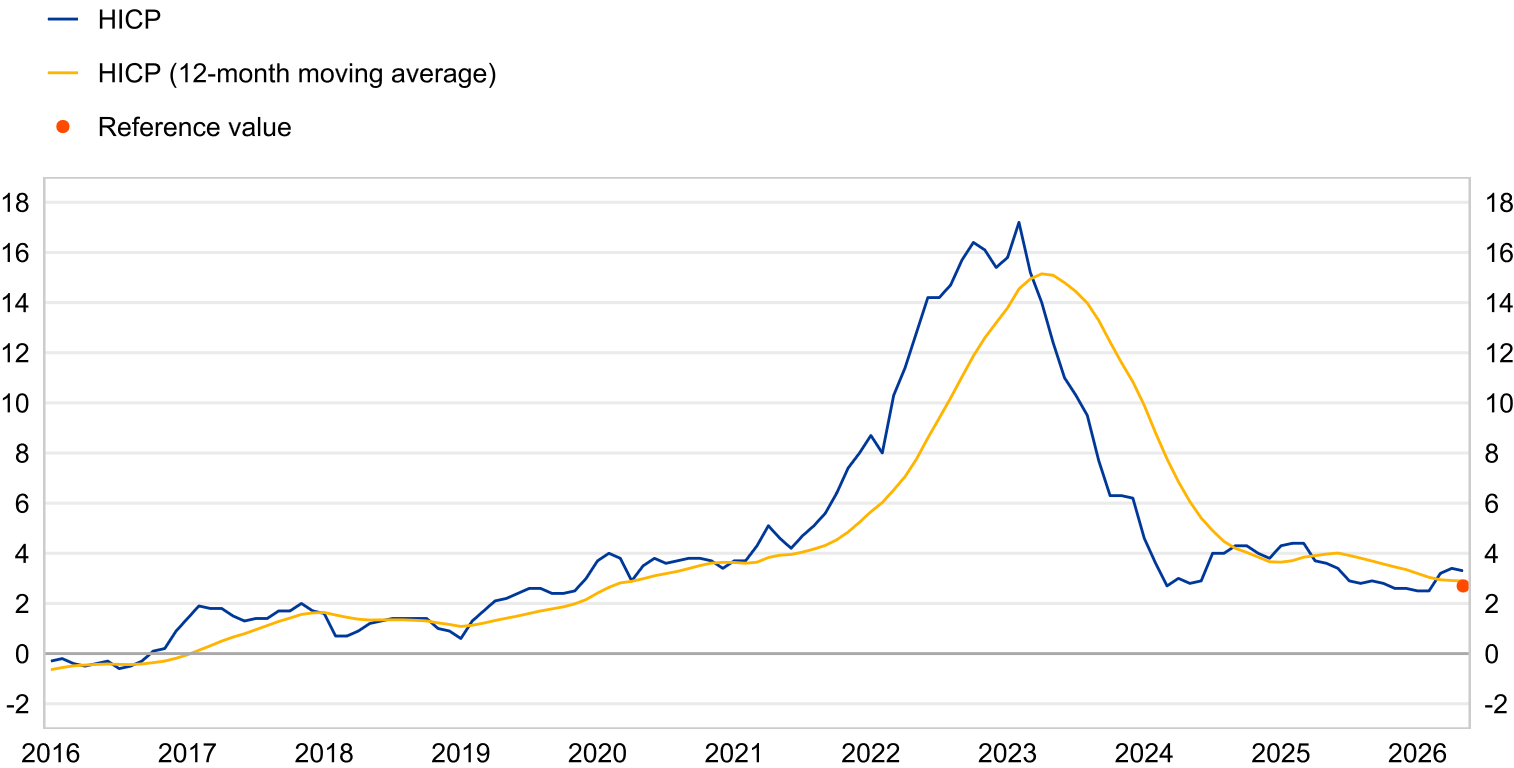
Sources: European Commission (Eurostat) and ECB calculations.
1) The basis of the calculation of the reference value for the period from June 2025 to May 2026 is the unweighted arithmetic average of the annual percentage changes in the HICP for Cyprus, France and Denmark plus 1.5 percentage points. The reference value is 2.7%.
Table 5.3.1
Measures of inflation and related indicators
(annual percentage changes, unless otherwise indicated)
2016- |
2016- |
2021- |
2021 |
2022 |
2023 |
2024 |
2025 |
20262) |
20272) |
|
|---|---|---|---|---|---|---|---|---|---|---|
Measures of inflation |
||||||||||
HICP |
4.4 |
1.7 |
7.2 |
5.2 |
13.2 |
10.8 |
3.7 |
3.3 |
3.6 |
2.9 |
HICP excluding unprocessed food and energy |
4.1 |
1.7 |
6.5 |
4.3 |
10.3 |
10.6 |
4.1 |
3.4 |
2.8 |
3.1 |
HICP at constant tax rates3) |
4.4 |
1.6 |
7.2 |
5.1 |
16.1 |
9.6 |
3.0 |
2.8 |
. |
. |
CPI |
0.5 |
0.9 |
0.0 |
5.1 |
14.4 |
11.4 |
3.6 |
3.6 |
3.8 |
2.9 |
Private consumption deflator |
4.4 |
1.6 |
7.2 |
5.6 |
14.1 |
9.5 |
3.4 |
3.8 |
3.4 |
2.6 |
GDP deflator |
4.3 |
2.1 |
6.5 |
5.3 |
10.7 |
9.9 |
4.1 |
2.9 |
3.2 |
2.9 |
Producer prices4) |
3.9 |
1.6 |
6.3 |
9.8 |
28.9 |
4.0 |
-6.7 |
-1.2 |
. |
. |
Related indicators |
||||||||||
Real GDP growth |
3.6 |
3.4 |
3.8 |
6.9 |
5.3 |
0.2 |
3.2 |
3.6 |
3.5 |
2.8 |
GDP per capita in PPS5) (euro area = 100) |
72.0 |
68.5 |
75.4 |
75.4 |
74.4 |
73.5 |
75.5 |
78.3 |
. |
. |
Comparative price levels (euro area = 100) |
58.8 |
55.6 |
62.8 |
57.4 |
59.0 |
65.3 |
69.4 |
. |
. |
. |
Output gap6) |
0.1 |
0.0 |
0.1 |
0.9 |
1.6 |
-1.0 |
-0.6 |
-0.2 |
0.1 |
-0.1 |
Unemployment rate (%)7) |
3.7 |
4.3 |
3.0 |
3.4 |
2.9 |
2.8 |
2.9 |
3.1 |
3.1 |
3.0 |
Unit labour costs, whole economy |
5.2 |
3.3 |
7.2 |
1.5 |
8.1 |
13.9 |
8.5 |
4.2 |
3.3 |
3.3 |
Compensation per employee, whole economy |
8.4 |
6.2 |
10.6 |
2.7 |
13.1 |
14.8 |
14.0 |
8.6 |
6.7 |
6.0 |
Labour productivity, whole economy |
3.0 |
2.8 |
3.2 |
1.2 |
4.6 |
0.8 |
5.1 |
4.1 |
3.3 |
2.6 |
Imports of goods and services deflator |
2.6 |
1.1 |
4.1 |
11.3 |
22.9 |
-3.9 |
-5.4 |
-1.9 |
2.5 |
1.5 |
Nominal effective exchange rate8) |
0.9 |
0.0 |
1.9 |
-2.4 |
-3.7 |
6.1 |
6.9 |
3.1 |
. |
. |
Money supply (M3)9) |
9.1 |
9.5 |
8.7 |
8.5 |
4.6 |
9.8 |
9.6 |
10.8 |
. |
. |
Lending from banks10) |
4.3 |
4.4 |
4.2 |
5.7 |
1.1 |
2.3 |
5.8 |
6.2 |
. |
. |
Stock prices (Warsaw General Index)11) |
152.3 |
22.7 |
105.6 |
21.5 |
-17.1 |
36.5 |
1.4 |
47.3 |
. |
. |
Residential property prices |
8.0 |
6.2 |
9.9 |
9.2 |
11.8 |
8.8 |
15.0 |
4.9 |
. |
. |
Sources: European Commission (Eurostat, Directorate-General for Economic and Financial Affairs), national data for CPI, money supply, lending from banks and ECB calculations based on LSEG data for stock prices.
1) Multi-annual averages calculated using the geometric mean, except for GDP per capita in PPS, comparative price levels, output gap and unemployment rate, for which the arithmetic mean is used.
2) Data from the European Commission’s Spring 2026 Economic Forecast.
3) The difference between the HICP and the HICP at constant tax rates shows the theoretical impact of changes in indirect taxes (e.g. VAT and excise duties) on the overall rate
of inflation. This impact assumes a full and instantaneous pass-through of tax rate changes to the price paid by the consumer.
4) Domestic sales, total industry excluding construction.
5) PPS stands for purchasing power standards.
6) Percentage difference from potential GDP: a positive (negative) sign indicates that actual GDP is above (below) potential GDP.
7) Definition conforms to International Labor Organization guidelines.
8) EER-40 group of trading partners. A positive (negative) sign indicates an appreciation (depreciation).
9) The series includes repurchase agreements with central counterparties.
10) Adjusted for the derecognition of loans from the MFI statistical balance sheet due to their sale or securitisation.
11) Multi-annual and annual figures represent the percentage change between the end of the given period and the end of the previous period.
5.3.5.2 Fiscal developments
Chart 5.3.2
General government balance and debt
(as a percentage of GDP)

Sources: European System of Central Banks and European Commission (Eurostat).
Table 5.3.2
Government budgetary developments and projections
(as a percentage of GDP, unless otherwise indicated)
2016- |
2016- |
2021- |
2021 |
2022 |
2023 |
2024 |
2025 |
20262) |
20272) |
|
|---|---|---|---|---|---|---|---|---|---|---|
Government balance |
-3.6 |
-2.3 |
-4.8 |
-1.7 |
-3.4 |
-5.2 |
-6.4 |
-7.3 |
-6.5 |
-6.3 |
Total revenue |
41.0 |
40.1 |
42.0 |
41.9 |
39.9 |
41.7 |
42.8 |
43.6 |
45.3 |
44.6 |
Current revenue |
40.1 |
39.2 |
41.1 |
40.9 |
39.1 |
40.7 |
42.2 |
42.7 |
43.6 |
43.8 |
Direct taxes |
7.7 |
7.6 |
7.8 |
8.2 |
7.6 |
7.4 |
7.8 |
8.0 |
8.5 |
8.8 |
Indirect taxes |
14.0 |
13.7 |
14.2 |
15.0 |
13.6 |
14.1 |
14.4 |
14.2 |
14.2 |
14.5 |
Net social contributions |
14.2 |
14.0 |
14.4 |
13.8 |
13.6 |
14.2 |
15.1 |
15.4 |
15.4 |
15.5 |
Other current revenue3) |
4.3 |
4.0 |
4.6 |
3.8 |
4.4 |
4.9 |
4.9 |
5.1 |
5.5 |
5.1 |
Capital revenue |
0.9 |
1.0 |
0.9 |
1.0 |
0.8 |
1.0 |
0.6 |
0.9 |
1.7 |
0.8 |
Total expenditure |
44.6 |
42.5 |
46.8 |
43.6 |
43.2 |
46.9 |
49.2 |
50.9 |
51.8 |
50.9 |
Current expenditure |
39.3 |
37.7 |
40.9 |
38.8 |
37.8 |
40.5 |
43.3 |
44.3 |
44.9 |
44.3 |
Compensation of employees |
10.5 |
10.3 |
10.8 |
10.3 |
9.7 |
10.2 |
11.6 |
12.0 |
11.9 |
11.9 |
Social benefits |
17.7 |
17.2 |
18.2 |
17.8 |
16.8 |
17.5 |
19.1 |
19.7 |
19.7 |
19.8 |
Interest payable |
1.7 |
1.5 |
1.9 |
1.1 |
1.5 |
2.1 |
2.2 |
2.5 |
2.8 |
2.9 |
Other current expenditure4) |
9.5 |
8.8 |
10.1 |
9.6 |
9.8 |
10.7 |
10.4 |
10.2 |
10.5 |
9.7 |
Capital expenditure |
5.3 |
4.7 |
5.8 |
4.8 |
5.4 |
6.4 |
5.9 |
6.5 |
6.9 |
6.6 |
of which: Investment |
4.3 |
4.1 |
4.6 |
4.1 |
3.8 |
5.1 |
4.8 |
5.2 |
5.3 |
5.4 |
Cyclically adjusted balance |
-3.6 |
-2.4 |
-4.9 |
-2.1 |
-4.2 |
-4.7 |
-6.1 |
-7.1 |
-6.6 |
-6.2 |
One-off and temporary measures |
0.1 |
0.0 |
0.1 |
0.2 |
0.3 |
0.0 |
-0.1 |
-0.1 |
0.0 |
0.0 |
Structural balance5) |
-3.7 |
-2.4 |
-4.9 |
-2.3 |
-4.4 |
-4.7 |
-6.1 |
-7.1 |
-6.6 |
-6.2 |
Government debt |
52.0 |
50.9 |
53.2 |
53.0 |
48.8 |
49.5 |
54.8 |
59.7 |
64.5 |
68.3 |
Average residual maturity |
5.2 |
5.0 |
5.4 |
5.0 |
5.0 |
5.0 |
6.0 |
6.0 |
. |
. |
In foreign currencies (% of total) |
27.3 |
29.9 |
24.8 |
22.3 |
24.2 |
24.4 |
27.1 |
26.2 |
. |
. |
of which: Euro |
23.1 |
24.3 |
21.9 |
19.5 |
21.5 |
21.5 |
23.7 |
23.1 |
. |
. |
Domestic ownership (% of total) |
59.2 |
52.9 |
65.5 |
66.9 |
64.3 |
66.4 |
64.6 |
65.4 |
. |
. |
Medium and long-term maturity (% of total)6) |
98.5 |
98.9 |
98.1 |
98.8 |
98.2 |
98.4 |
98.1 |
96.9 |
. |
. |
of which: Variable interest rate (% of total) |
21.7 |
21.4 |
22.0 |
20.1 |
21.6 |
23.7 |
22.8 |
22.0 |
. |
. |
Deficit-debt adjustment |
1.1 |
1.4 |
0.9 |
1.1 |
-0.1 |
0.0 |
2.3 |
1.0 |
. |
. |
Net acquisitions of main financial assets |
1.5 |
1.8 |
1.2 |
1.6 |
0.1 |
0.9 |
2.4 |
1.0 |
. |
. |
Currency and deposits |
0.9 |
1.1 |
0.6 |
1.1 |
0.9 |
-0.2 |
1.5 |
-0.2 |
. |
. |
Debt securities |
0.1 |
0.2 |
0.0 |
0.4 |
-0.8 |
0.1 |
0.2 |
0.0 |
. |
. |
Loans |
0.6 |
0.5 |
0.6 |
0.2 |
0.3 |
0.8 |
0.7 |
1.1 |
. |
. |
Equity and investment fund shares or units |
-0.1 |
-0.1 |
0.0 |
-0.1 |
-0.3 |
0.2 |
0.0 |
0.1 |
. |
. |
Revaluation effects on debt |
0.0 |
0.2 |
-0.2 |
0.0 |
0.6 |
-1.1 |
0.0 |
-0.4 |
. |
. |
of which: Foreign exchange holding gains/losses |
0.0 |
0.2 |
-0.2 |
0.1 |
0.2 |
-0.9 |
-0.2 |
-0.4 |
. |
. |
Other7) |
-0.3 |
-0.3 |
-0.3 |
-0.3 |
0.1 |
-1.1 |
-0.1 |
-0.1 |
. |
. |
Net expenditure growth (%) |
. |
. |
. |
. |
. |
. |
13.3 |
8.5 |
4.0 |
4.9 |
Medium-term fiscal-structural plan: net expenditure growth (%) |
. |
. |
. |
. |
. |
. |
12.5 |
6.3 |
4.4 |
4.0 |
Sources: European System of Central Banks and European Commission (Eurostat, Directorate-General for Economic and Financial Affairs).
1) Multi-annual averages calculated using the arithmetic mean.
2) Data from the European Commission’s Spring 2026 Economic Forecast.
3) Sales and other current revenue.
4) Intermediate consumption, subsidies payable and other current expenditure.
5) Cyclically adjusted balance excluding one-off and other temporary measures.
6) Original maturity of more than one year.
7) Time of recording differences and other factors (sector reclassifications and statistical discrepancies).
5.3.5.3 Exchange rate and external developments
Chart 5.3.3
Bilateral exchange rate and short-term interest rate differential
(PLN/EUR exchange rate: monthly averages; difference between three-month interbank interest rates and three-month EURIBOR: basis points, monthly values)

Sources: European System of Central Banks and ECB calculations.
Chart 5.3.4
Effective exchange rates 1)
(EER-40 group of trading partners; monthly averages; index: Q1 1999 = 100)

Source: ECB.
1) The real EER-40 is CPI-deflated. An increase (decrease) in the EER indicates an appreciation (depreciation).
Table 5.3.3
External developments
(as a percentage of GDP, unless otherwise indicated)
2016- |
2016- |
2021- |
2021 |
2022 |
2023 |
2024 |
2025 |
20262) |
20272) |
|
|---|---|---|---|---|---|---|---|---|---|---|
Balance of payments |
||||||||||
Current account and capital account balance3) |
0.5 |
1.0 |
-0.1 |
-0.6 |
-2.1 |
1.7 |
0.6 |
0.0 |
-1.4 |
-1.4 |
Current account balance |
-0.5 |
-0.4 |
-0.5 |
-1.3 |
-2.3 |
1.5 |
0.3 |
-0.9 |
-1.2 |
-1.2 |
Goods |
-0.9 |
-0.6 |
-1.2 |
-1.3 |
-3.3 |
0.6 |
-0.7 |
-1.5 |
. |
. |
Services |
4.4 |
4.0 |
4.8 |
4.5 |
5.4 |
5.2 |
4.7 |
4.3 |
. |
. |
Primary income |
-4.0 |
-4.0 |
-3.9 |
-4.4 |
-3.9 |
-4.1 |
-3.3 |
-3.6 |
. |
. |
Secondary income |
0.0 |
0.2 |
-0.2 |
-0.2 |
-0.4 |
-0.3 |
-0.3 |
0.0 |
. |
. |
Capital account balance |
0.9 |
1.4 |
0.4 |
0.8 |
0.2 |
0.2 |
0.3 |
0.8 |
. |
. |
Combined direct and portfolio investment balance3) |
-2.2 |
-1.5 |
-2.8 |
-2.3 |
-4.5 |
-2.3 |
-2.3 |
-2.5 |
. |
. |
Direct investment |
-2.3 |
-2.0 |
-2.7 |
-4.0 |
-4.1 |
-2.9 |
-1.1 |
-1.2 |
. |
. |
Portfolio investment |
0.2 |
0.5 |
-0.1 |
1.7 |
-0.4 |
0.6 |
-1.2 |
-1.3 |
. |
. |
Other investment balance |
0.3 |
0.6 |
-0.1 |
-0.6 |
0.3 |
0.9 |
-1.7 |
0.8 |
. |
. |
Reserve assets |
2.0 |
1.8 |
2.2 |
2.8 |
2.0 |
2.6 |
3.2 |
0.8 |
. |
. |
Exports of goods and services |
53.9 |
51.8 |
55.9 |
57.0 |
62.8 |
57.9 |
51.9 |
50.0 |
. |
. |
Imports of goods and services |
50.4 |
48.4 |
52.4 |
53.8 |
60.7 |
52.1 |
48.0 |
47.2 |
. |
. |
Net international investment position4) |
-43.4 |
-53.9 |
-32.9 |
-40.6 |
-34.6 |
-31.8 |
-28.2 |
-29.5 |
. |
. |
Gross external debt4) |
58.6 |
65.1 |
52.1 |
56.0 |
53.3 |
49.8 |
51.6 |
50.1 |
. |
. |
Trade with the euro area5) |
||||||||||
Exports of goods and services |
57.1 |
56.2 |
58.0 |
58.1 |
58.8 |
57.8 |
57.7 |
57.7 |
. |
. |
Imports of goods and services |
57.3 |
58.1 |
56.4 |
56.8 |
54.7 |
56.7 |
56.9 |
56.9 |
. |
. |
Investment position with the euro area5) |
||||||||||
Direct investment assets4) |
58.1 |
59.3 |
56.8 |
58.5 |
55.7 |
56.9 |
56.2 |
56.8 |
. |
. |
Direct investment liabilities4) |
76.7 |
77.8 |
75.6 |
77.6 |
75.3 |
74.9 |
74.8 |
75.4 |
. |
. |
Portfolio investment assets4) |
42.5 |
39.8 |
45.1 |
45.5 |
45.4 |
48.1 |
42.7 |
43.9 |
. |
. |
Portfolio investment liabilities4) 6) |
46.6 |
46.3 |
46.9 |
47.5 |
48.7 |
46.4 |
46.8 |
45.3 |
. |
. |
Sources: European System of Central Banks and European Commission (Eurostat, Directorate-General for Economic and Financial Affairs).
1) Multi-annual averages calculated using the arithmetic mean.
2) Data from the European Commission’s Spring 2026 Economic Forecast.
3) Differences between totals and the sum of their components are due to rounding.
4) End-of-period outstanding amounts.
5) As a percentage of the total.
6) Portfolio investment liabilities are derived from the ECB’s data on euro area portfolio investment assets.
5.3.5.4 Long-term interest rate developments
Chart 5.3.5
Long-term interest rate 1)
(monthly averages in percentages)

Sources: European System of Central Banks and ECB calculations.
1) The basis of the calculation of the reference value for the period from June 2025 to May 2026 is the unweighted arithmetic average of the interest rate levels in Cyprus, France and Denmark plus 2 percentage points. The reference value is 5.1%.
Chart 5.3.6
Long-term interest rate and HICP inflation differentials vis-à-vis the euro area
(monthly averages in percentage points)

Sources: European System of Central Banks, ECB calculations and European Commission (Eurostat).
Table 5.3.4
Long-term interest rates and indicators of financial development and integration
(as a percentage of GDP, unless otherwise indicated)
2016- |
2016- |
2021- |
2022 |
2023 |
2024 |
2025 |
June 2025 to May 2026 |
Memo item: euro area 2025 |
|
|---|---|---|---|---|---|---|---|---|---|
Long-term interest rates |
|||||||||
Poland2) |
3.8 |
2.7 |
5.0 |
6.1 |
5.8 |
5.5 |
5.5 |
5.4 |
- |
Euro area3) 4) |
1.5 |
0.7 |
2.2 |
1.9 |
3.1 |
2.9 |
3.1 |
3.2 |
- |
Euro area AAA par curve, ten-year residual |
0.9 |
0.1 |
1.7 |
1.2 |
2.5 |
2.4 |
2.7 |
2.8 |
- |
Indicators of financial development and integration |
|||||||||
Debt securities issued by financial corporations5) |
6.3 |
5.9 |
6.7 |
9.6 |
4.0 |
4.2 |
4.5 |
- |
60.3 |
Debt securities issued by non-financial corporations6) |
3.0 |
4.1 |
1.9 |
1.8 |
1.8 |
1.8 |
1.9 |
- |
11.7 |
Stock market capitalisation7) |
24.0 |
26.5 |
21.4 |
17.9 |
21.1 |
18.9 |
25.2 |
- |
73.9 |
MFI credit to non-government residents8) |
48.9 |
55.4 |
42.5 |
44.4 |
40.2 |
38.8 |
37.9 |
- |
95.4 |
Claims of euro area MFIs on resident MFIs9) |
3.9 |
4.1 |
3.7 |
3.5 |
3.8 |
3.9 |
4.0 |
- |
26.0 |
Sources: European System of Central Banks and ECB calculations.
1) Multi-annual averages calculated using the arithmetic mean.
2) Average interest rate.
3) GDP-weighted average of the euro area long-term interest rates for the purpose of assessing convergence.
4) Included for information only.
5) Outstanding amount of debt securities issued by resident MFIs (excluding the national central bank) and other financial corporations.
6) Outstanding amount of debt securities issued by resident non-financial corporations.
7) Outstanding amount of listed shares issued by residents at market values.
8) MFI (excluding national central bank) credit to domestic non-MFI residents other than general government. Credit comprises outstanding amounts of loans and debt securities.
9) Outstanding amount of deposits and debt securities issued by resident MFIs (excluding the national central bank) held by euro area MFIs as a percentage of total liabilities of resident MFIs (excluding the national central bank). Total liabilities exclude capital
and reserves and remaining liabilities.
5.4 Romania
5.4.1 Price developments
In May 2026 the 12‑month average rate of HICP inflation in Romania was 8.4%, i.e. considerably above the reference value of 2.7% for the criterion on price stability (Chart 5.4.1). This rate is expected to remain elevated over the coming months, owing partly to higher commodity prices and broadening inflationary pressures related to the war in the Middle East.
Over the past ten years the 12‑month average rate of HICP inflation has fluctuated within a very wide range, from ‑1.7% to 13.2%. Following a prolonged period of subdued inflation, strong fiscal stimulus and rising wages pushed up inflation to an average of around 4% in 2018 and 2019. Inflation declined significantly in 2020, reflecting the downturn in economic activity during the COVID-19 pandemic. From the second half of 2021, strong increases in energy and food prices, together with supply bottlenecks, exerted significant upward pressure on inflation. This pressure intensified further in the wake of Russia’s invasion of Ukraine in 2022, with inflation peaking at 14.6% in November that year (Table 5.4.1). To address this, Banca Naţională a României raised its key policy rate from 1.25% to 7% over the period from October 2021 to January 2023. From the end of 2022, inflation declined, falling from 12% on average in 2022 to 9.7% in 2023, on the back of easing supply-side pressures, the monetary policy tightening and government measures to mitigate the impact of higher energy prices. In 2024 inflation moderated further, down to 5.8% on average, but remained well above the euro area average and the central bank’s target, owing to continued pressure on prices for services, food and other goods, amid strong growth in wages and pensions. In this context, Banca Naţională a României reduced its key policy rate twice, by a cumulative 50 basis points, in July and August 2024, and has since then kept it unchanged at 6.5%. Inflation increased significantly again in mid-2025 and remained at levels above 8% for the rest of the year. This increase was driven by the removal of electricity price caps, tax rises built into fiscal consolidation measures and a depreciation of the exchange rate, as well as rising food prices on the back of global supply disruptions and domestic weather-related shocks.
In May 2026 the annual rate of HICP inflation stood at 9.7%. In the first two months of 2026, inflation was still above 8%, with core inflation remaining particularly sticky as a result of strong, albeit moderating, wage growth and elevated short-term inflation expectations. In March inflation started to increase again, largely on the back of a rebound in energy prices amid the heightened geopolitical tensions related to the war in the Middle East. In response, the authorities introduced measures aimed at mitigating the impact of higher energy prices. These measures, which include a reduction in the excise duty on diesel for farmers and transport companies, profit margin caps on fuels and subsidies for road transporters, are expected to cushion these pressures. As with the other central and eastern European countries under review, Romania is particularly vulnerable to global energy shocks, owing to the relatively large share of energy in the consumption basket and the importance of energy-intensive sectors in the economy.
The orientation of monetary policy towards price stability has played an important role in shaping inflation dynamics in Romania over the past decade. In 2005 Banca Naţională a României shifted to an inflation-targeting framework combined with a managed floating exchange rate regime and set its inflation target at 7.5%, as measured by the national consumer price index. The target was gradually reduced until 2012. In 2013 the central bank adopted a flat target of 2.5%, with a variation band of ±1 percentage point. Monetary policy rates have remained relatively high compared with those of most of the other countries under review and the euro area. At the same time, the expansionary fiscal stance adopted by the Romanian Government has contributed to inflationary pressures in recent years, particularly between 2022 and 2025 (see Section 5.4.2). However, since mid-2025 the fiscal stance has become more restrictive as a result of a fiscal consolidation package to reduce the twin deficits.
Inflation is projected to remain above the central target of 2.5% over the forecast horizon, with risks to the sustainability of inflation convergence persisting over the longer term. According to the European Commission’s Spring 2026 Economic Forecast, HICP inflation is expected to remain elevated at 7% in 2026, before decreasing to 3.7% in 2027. The near-term inflation outlook reflects opposing forces: upward pressures stemming from higher energy prices due to the ongoing war in the Middle East and downward pressures that are expected to arise from weak private consumption on the back of fiscal consolidation measures and favourable base effects due to the 2025 increase in indirect taxes in domestic electricity prices. These forecasts are subject to considerable uncertainty in terms of the evolution of energy prices, their pass-through to other price components and the geopolitical situation, especially in view of the sensitivity of the Romanian economy to external shocks. Risks to the inflation outlook are tilted to the upside, as further volatility in global commodity prices and renewed global supply bottlenecks could lead to more protracted inflationary pressures. This includes through the emergence of indirect and second-round effects, particularly given that the economy is deeply rooted in regional and global supply chains. Looking further ahead, unless offset by an appreciation of the nominal exchange rate, the catching-up process is likely to result in positive inflation differentials vis-à-vis the euro area, given that GDP per capita and price levels are still lower in Romania than in the euro area. While equilibrium inflation differentials associated with the catching-up process tend not to be very large, they may become a concern if they are accompanied by potentially unsustainable developments in credit and asset prices. In this context, the catching-up process needs to be supported by appropriate policies to avoid unduly jeopardising competitiveness and to prevent the build-up of unsustainable levels of credit growth and other macroeconomic imbalances.
Achieving an environment that is conducive to sustainable convergence in Romania requires stability‑oriented economic policies and wide‑ranging structural reforms. With regard to macroeconomic imbalances, the European Commission selected Romania for an in‑depth review in its Alert Mechanism Report 2026, highlighting substantial external sustainability risks and persistent competitiveness concerns, in the context of very strong growth in unit labour costs, large and persistent current account deficits and sizeable fiscal imbalances. Romania is also subject to an excessive deficit procedure (see Section 5.4.2). To safeguard competitiveness and ensure that Romania remains attractive to foreign investors, wage developments need to be aligned with productivity growth, particularly in an environment of elevated sovereign bond yields and global uncertainty. However, institutional weaknesses and a still challenging business environment continue to weigh on productivity and growth potential. In view of adverse demographic trends, including population ageing and migration outflows, supporting potential growth will require a gradual shift towards a more innovation-driven and higher value-added economic structure. Enhancing human capital and reducing regional disparities would also contribute to more inclusive growth. Furthermore, additional reforms aimed at improving governance, strengthening competition and enhancing the predictability of the tax, judicial, insolvency, regulatory and administrative frameworks would support investment and confidence. Lastly, ensuring the efficient and effective absorption of EU funds remains key to fostering economic convergence in the medium term and to supporting the green and digital transition.
Financial sector policies should be aimed at safeguarding financial stability and ensuring that the financial sector makes a sound contribution to economic growth. The resilience of the banking sector in Romania is underpinned by the strong capital and liquidity positions of its banks. The sovereign exposures of banks have increased in recent years and are still significantly higher than the euro area average. This may amplify vulnerabilities in the event of fiscal stress or a reassessment of sovereign risk, potentially affecting banks’ balance sheets, funding conditions and credit supply. The relatively high share of foreign currency lending to non-financial corporations warrants close monitoring, although many firms mitigate this risk by using the euro as their settlement/invoicing currency. Non-performing loan ratios have declined towards EU levels in recent years, although there are early signs of rising insolvencies and an increase in the number of non-performing loans, in particular government-guaranteed loans. Elevated inflation and fiscal consolidation measures, amid heightened geopolitical uncertainty, may squeeze the debt servicing capacity of households and, in turn, drive up credit risk for banks. At the same time, the degree of financial intermediation remains relatively low, reflecting a continued reliance on internal financing and non-bank funding sources. This may limit access to credit for some firms and is likely to weigh on investment and potential growth over the medium term. In order to further strengthen the resilience of the financial system, the national competent authorities can further improve their supervisory practices by, among other things, following the applicable recommendations from the relevant international and European bodies and by collaborating closely with other national supervisors of EU Member States within the supervisory colleges.
5.4.2 Fiscal developments
Romania’s general government budget deficit was significantly above the 3% reference value in 2025, while its debt level was below the 60% reference value. In the reference year 2025, the general government budget balance recorded a deficit of 7.9% of GDP, i.e. significantly above the 3% reference value. The general government gross debt ratio was 59.3% of GDP, i.e. below the 60% reference value (Table 5.4.2). Compared with the previous year, the general government deficit decreased by 1.4 percentage points of GDP and the debt ratio increased notably by 4.5 percentage points of GDP. With regard to other fiscal factors, the deficit ratio exceeded the ratio of public investment to GDP in 2025.
Romania has been subject to an excessive deficit procedure since 2020. Following a recommendation from the European Commission of 4 March 2020 on the basis of a projected excessive deficit in 2019, the Council decided on 3 April 2020, in accordance with Article 126(6) of the Treaty, that an excessive deficit existed in Romania and it issued a recommendation to correct the excessive deficit by 2022 at the latest. In 2021, a Council recommendation revised the date for correcting this excessive deficit to 2024, with the argument being that the economic recovery following the pandemic should not be compromised. On 8 July 2025, the Council revised its recommendation to Romania following a decision establishing that Romania had not taken effective action in response to previous Council recommendations under the excessive deficit procedure. The revised recommendation sets out an updated net expenditure path for Romania to bring its excessive deficit situation to an end by 2030. In June 2026, the Commission found that Romania’s net expenditure growth in 2025 and its projected net expenditure growth in 2026 (both in annual and cumulative terms) were below the ceilings recommended by the Council. Consequently, Romania was assessed as having taken effective action and the excessive deficit procedure was therefore held in abeyance.
Both cyclical and non-cyclical factors contributed to the budgetary deterioration in Romania over the period 2019-25. The fiscal position appeared highly vulnerable even before the outbreak of the pandemic, with the deficit having reached 4.4% of GDP by 2019, following a steady deterioration which had begun in 2016. In 2020 the deficit ratio deteriorated by almost 5 percentage points and the structural balance by 3.0 percentage points. This was mainly the result of pre-existing expansionary policies (including significant increases in pension payments), as well as temporary measures taken in the face of the pandemic (albeit these were smaller in size than those implemented in other countries) and adverse cyclical factors. Following an improvement in the budget balance in 2021 and 2022, the budgetary situation deteriorated again in 2023 and 2024 by 2.8 percentage points of GDP in total. This was on account of very fast growth in government spending, mostly due to large increases in public sector wages, expenditure in goods and services and social transfers, including pensions. The improvement by 1.4 percentage points of GDP recorded in 2025 was the result of the adoption of significant consolidation measures, which are expected to deliver around half of the adjustment needed to correct the excessive deficit situation. Some measures were implemented at the beginning of 2025, while the large package of measures only took effect as from August 2025, meaning that the full set of measures will not make its full-year impact until 2026. Key consolidation measures on the revenue side include an increase in the rate of VAT and a revamp of reduced VAT rates, increases in excise duties, a new mandatory health contribution levied on pension income and residential property tax reform. The key measure taken on the expenditure side is a freeze on public pensions and wages in 2025 and 2026. The 2025 budget deficit nonetheless stands 3.5 percentage points above the pre-pandemic deficit level seen in 2019, with the structural deficit being 2.7 percentage points higher than in 2019.
The debt-to-GDP ratio has been strongly increasing since 2019 and is close to the 60% reference value. Prior to the pandemic, the debt ratio had fluctuated around 35% of GDP. During the pandemic, the debt ratio increased strongly by 13.4 percentage points over the period 2020-21, reaching 48.6% of GDP. Since then, it has increased strongly by 10.7 percentage points of GDP, reaching 59.3% of GDP in 2025, i.e. 24.1 percentage points above its pre-pandemic level. The increases over the period 2019-25 were largely the result of primary deficits, with a favourable, albeit shrinking, interest-growth differential helping to contain the debt increase over the period 2021-25 (Table 5.4.2).
The level and structure of government debt indicate that Romania’s fiscal balances are protected from sudden changes in interest rates, but they are highly sensitive to exchange rate fluctuations. The share of government debt with a short-term maturity is low (7.0% of overall debt in 2025 – Table 5.4.2). Taking into account medium and long-term debt with a variable interest rate as a percentage of GDP, fiscal balances appear relatively insensitive to interest rate changes. The proportion of foreign currency-denominated government debt is high (52.9% in 2025). Taking the size of the debt in relation to GDP into consideration, it can therefore be concluded that the fiscal balances are highly sensitive to exchange rate movements, mainly the euro/leu exchange rate, as a large part of the debt is denominated in euro (81.1% of foreign-denominated debt in 2025).
The European Commission’s Spring 2026 Economic Forecast foresees an improvement in Romania’s budget balance by 2027 but a notable increase in the debt ratio to above 60% of GDP. According to the Commission’s Spring 2026 Economic Forecast, the deficit is projected to decrease to 6.2% of GDP in 2026 and to 5.8% of GDP in 2027. This forecast includes the consolidation measures that were legislated in the period from July to September 2025. With regard to the debt ratio, the Commission forecasts an increase of 2.2 percentage points of GDP in 2026, followed by a further increase of 1.8 percentage points of GDP in 2027. The debt ratio is projected to move slightly above the 60% reference value, reaching 63.4% of GDP in 2027, its highest level since 1995. On the basis of the Commission’s Spring 2026 Economic Forecast, further consolidation will be required to correct Romania’s excessive deficit. In response to the energy price shock following the outbreak of the war in the Middle East, Romania implemented limited fiscal energy measures, including, as from April, a cut in the excise duty on diesel, partly offset by a special tax aimed at operators that extract and refine oil in Romania.
Romania has yet to fully align its national fiscal governance framework, which had been significantly strengthened but has not been complied with or applied effectively, with the reformed EU framework. Romania’s fiscal governance framework was strengthened in 2013 following the adoption of the fiscal compact (through the implementation of a structural budget balance rule, a debt rule and a correction mechanism), the creation of an independent fiscal council in 2010 and a reform of the tax collection agency. Its national framework is yet to be fully aligned with the reformed EU governance framework. Despite this earlier strengthening, Romania has systematically and repeatedly derogated from its national fiscal rules, thereby rendering these rules largely ineffective. In particular, the Romanian authorities should fully support the Fiscal Council by submitting the budget in a timely manner and by increasing the transparency of the macroeconomic and fiscal forecasts as well as the budget documentation. The government should also increase efforts to reform the public administration and make tax policy and administration more efficient. Some progress has been made with public finance management, including through a law tasking the Fiscal Council with a regular impact assessment of spending reviews. Limited progress has been made in public investment project preparation and prioritisation. However, while progress has been made in improving the governance and performance of state-owned enterprises, significant shortcomings persist in terms of implementation. Romania’s budgetary adjustment would be well supported by the full application of the national fiscal framework.
Romania faces high sustainability risks in the medium term and medium sustainability risks in the long term, with only slight increases in age-related public expenditure projected over the period 2022-70. Over both the medium and long term, the European Commission’s 2025 Debt Sustainability Monitor risk classification remains unchanged compared with the 2023 Debt Sustainability Monitor. The high-risk classification in the medium term is due to debt being on an upward path given the unfavourable initial budgetary position, and while it would remain just below 90% of GDP under the no-fiscal-policy-change baseline, it would exceed that threshold under more adverse macro-financial assumptions. The medium sustainability risk classification in the long term is driven by the unfavourable initial budgetary position, which is partly offset by developments in ageing costs. The Commission’s 2024 Ageing Report prepared by the Ageing Working Group (AWG) of the EU’s Economic Policy Committee, which incorporates the pension reforms adopted in November 2023, points to a slight increase of 0.2 percentage points of GDP in age-related public expenditure over the period 2022-70 under its baseline, from a level of 15.8% of GDP in 2022.[163] The projected decrease in pension expenditure by 0.9 percentage points of GDP over the period 2022-70 largely compensates for the projected increase in healthcare and long-term care expenditure. While over the full projection horizon of the Ageing Report, pension spending is projected to fall, a notable increase is expected during the first period of the projection horizon (2022-45). Under the AWG’s risk scenario, the increase in the cost of ageing amounted to 4.3 percentage points of GDP.
Looking ahead, additional reforms and further consolidation in line with the requirements of the Stability and Growth Pact are needed to safeguard the sustainability of public finances over the medium term. Romania must ensure compliance with the requirements of the excessive deficit procedure through further consolidation. This needs to be supported by efforts geared towards enhancing the quality of public finances and reinforcing the growth potential of the economy. The Romanian Government should make further efforts to improve the tax collection system, fight tax evasion, increase spending efficiency, advance structural fiscal reforms (including in the corporate governance of state-owned enterprises) and complete tax system reforms. A tax reform aimed at increasing revenues and improving fairness, while strengthening work incentives and remaining attractive to capital investment, would contribute to a growth-friendly consolidation which also enhances equity.
5.4.3 Exchange rate developments
Over the reference period from 18 June 2024 to 17 June 2026, the Romanian leu did not participate in ERM II but traded under a flexible exchange rate regime involving a managed float of the exchange rate. Over the two‑year reference period the Romanian leu mostly traded close to its June 2024 average exchange rate against the euro of 4.977 lei per euro, which is used as a benchmark for illustrative purposes in the absence of an ERM II central rate (Chart 5.4.3). The maximum upward deviation from this benchmark was 0.2%, while the maximum downward deviation amounted to 5.8%. On 17 June 2026 the exchange rate stood at 5.232 lei per euro, i.e. the leu was 5.1% weaker than its average level in June 2024. Banca Naţională a României entered a repo line arrangement with the ECB in June 2020, under which it could borrow up to €4.5 billion against high-quality euro-denominated collateral to provide euro liquidity to Romanian financial institutions in order to address possible liquidity needs. This agreement remained in place over the reference period as it was extended again in January 2025 for a period of two years. As this arrangement helped to reduce the potential risk of financial vulnerabilities, it may also have had an impact on exchange rate developments over the reference period. Over the past ten years the Romanian leu has depreciated against the euro by 15.7%.
The exchange rate of the Romanian leu against the euro exhibited, on average, a low degree of volatility over the reference period, while trending towards a gradual depreciation. In the second half of 2024 and the first four months of 2025 the leu traded mostly between 4.97 lei and 4.99 lei per euro, showing a relatively low degree of volatility. However, increased macroeconomic imbalances, including twin fiscal and external deficits, against a backdrop of high political and fiscal uncertainty around the 2025 presidential elections, contributed to a weakening of the leu in May 2025. The depreciation was then partly reversed and the exchange rate broadly stabilised. Subsequently the leu weakened significantly at the end of April and in the first few days of May 2026, reaching a new historical low of 5.2646 lei per euro on 7 May 2026, amid heightened domestic political tensions. Overall, this pattern reflects a continued trend depreciation of the leu against the euro, influenced by both domestic and external factors, including the country’s challenging fiscal position and global trade and geopolitical tensions contributing to lower global risk appetite. Over the reference period short‑term interest rate differentials against the three‑month EURIBOR were relatively wide. After reaching a peak of 4.5 points in the three‑month period ending in September 2025, the interest rate differential came down again and stood at 3.5 percentage points in the three‑month period ending in May 2026. The recent narrowing of short-term interest rate differentials largely reflects the gradual decrease in domestic interbank money market rates since mid-2025, with the re-emergence of a liquidity surplus in the money market, against the background of an improvement in investors’ risk perceptions regarding the Romanian economy.
The Romanian leu has appreciated over the past ten years in HICP-based real effective terms (Chart 5.4.4). Overall, this appreciation mainly reflected developments in relative prices. The relatively high level of inflation following the spike in energy and food prices around Russia’s invasion of Ukraine put additional upward pressure on the real effective exchange rate. Looking ahead, this indicator should be interpreted with caution, as Romania is subject to a process of economic convergence, which complicates any long-term assessment of real exchange rate developments.
Romania’s current and capital account balance has weakened over the past ten years, while net foreign liabilities have declined gradually but remain high (Table 5.4.3). The combined current and capital account deficit has gradually increased over the past decade. This development reflected a widening trade deficit driven by a worsening goods balance in conjunction with a flattening services surplus, as export performance weakened and strong domestic demand fuelled import growth. This trend intensified during the pandemic period when global supply chain disruptions and rising energy prices further worsened the trade balance. As a result, the current account deficit reached a peak of around 9-10% of GDP in 2022. The subsequent gradual decline reflected in particular slower domestic demand growth, although the current account deficit remained persistently large at around 7-8% of GDP. The sizeable fiscal consolidation packages adopted in 2025 seem to have had a limited impact on the current account deficit so far. On the financing side, net foreign direct investment inflows and non-reimbursable EU funds have covered only part of the deficit, while increased government external borrowing is reflected in large inflows of portfolio investment. In the context of expansionary fiscal policies, the gross external debt ratio has gradually increased over the past decade and stood at 60.8% in 2025. While the negative net international investment position has improved steadily over the past ten years, reaching -41.3% in 2024, it decreased again, to -45.1% of GDP, in 2025. Hence, fiscal consolidation and structural reforms continue to be important for supporting external sustainability, maintaining the attractiveness of Romania to foreign direct investors and enhancing the competitiveness of the economy, especially in a more volatile environment characterised by geopolitical and commodity price shocks.
The Romanian economy is well integrated with the euro area through trade and investment linkages. In 2025 exports of goods and services to the euro area constituted 58.8% of total exports, while the corresponding figure for imports amounted to 58.0%. In the same year the share of the euro area in the stock of inward direct investment in Romania stood at 80.0% and its share in the country’s stock of portfolio investment liabilities was 54.1%. The share of Romania’s stock of foreign assets invested in the euro area amounted to 69.0% in the case of direct investment and 74.9% for portfolio investment in 2025.
5.4.4 Long‑term interest rate developments
Over the reference period from June 2025 to May 2026, long-term interest rates in Romania stood at 6.7% on average, above the 5.1% reference value for the interest rate convergence criterion (Chart 5.4.5).
Long-term interest rates in Romania came down from the peak of more than 9% reached in 2022. Over the period 2016-20, long-term interest rates had gradually increased from around 3.5% to almost 5%. Persistent domestic and external imbalances in the Romanian economy had resulted in faster inflation dynamics, sizeable current account deficits and uncertainty regarding the sustainability of the Government’s fiscal policy. The surge in the pandemic in spring 2020 led to a decline in inflation and economic growth, to which Banca Naţională a României responded with a decisive easing of monetary policy. Long-term interest rates declined accordingly and hit a historical low of 2.7% in January 2021. Thereafter, inflation rose and a series of supply-side shocks posed upside risks to medium-term inflation expectations, for instance Russia’s invasion of Ukraine in February 2022 had an impact on expected food and energy prices. This led to a rapid tightening of monetary policy by Banca Naţională a României, in line with the developments in the global policy cycle. Long-term interest rates in Romania peaked at more than 9% in October 2022. In the subsequent two years, economic activity in Romania slowed down and inflation fell from around 16% at the end of 2022 to around 5% by the end of 2024, with long-term interest rates dropping to around 7% over the same period. Since 2025 long-term interest rates have fluctuated within a range of 6.5%-7%. This reflects sluggish growth dynamics, persistent fiscal imbalances and renewed upward pressures on inflation from the VAT increase and the expiry of energy price caps in summer 2025. In May 2026 long-term interest rates stood at 6.2%. During the review period, credit default swap spreads for Romanian government bonds increased to more than 300 basis points in May 2025 before falling back to around 220 basis points in May 2026, which is about the same level as in June 2024. This is one of the highest levels among the group of peer countries in the region and is mainly related to market concerns about the structural sustainability of domestic government finances. Romanian government debt, whether issued in domestic or foreign currency, is rated at the lowest investment-grade notch by all three main rating agencies (Moody’s: Baa3; S&P: BBB‑; Fitch: BBB‑).
The long-term interest rate differential of Romanian bonds vis-à-vis the euro area average declined slightly over the review period (Chart 5.4.6). The interest rate differential increased over the period 2016-20 due to the persistent macroeconomic imbalances in the Romanian economy. It fell back to 2016 levels during the pandemic in 2020-21, before spiking in 2022 and then gradually narrowing again. It stabilised in mid-2023 at values last experienced in 2018-20. At the end of the review period, in May 2026, the differential vis-à-vis the euro area average interest rate stood at 2.7 percentage points. The outbreak of the war in the Middle East did not have a significant impact on the long-term interest rate differential in Romania.
Capital markets in Romania are much smaller than those in the euro area and are still underdeveloped (Table 5.4.4). At the end of 2025 the Romanian corporate debt market was almost non-existent, with outstanding debt securities issued by financial and non-financial corporations amounting to only 2.1% and 0.6% of GDP respectively. The equity market in Romania also remains quite small, with a stock market capitalisation of 15.5% of GDP in 2025, which ranks among the lowest in the region. Foreign‑owned banks play a major role in Romania and accounted for around 55% of total banking assets in 2024. The degree of financial intermediation is the lowest in the region, with MFIs extending the equivalent of 23.4% of GDP in credit to the private sector in 2025. Over the past decade Romanian banks have gradually relied less on euro area banks for their funding needs. The claims of euro area MFIs on Romanian resident MFIs have declined from an annual average of 4.4% of total liabilities of resident MFIs over the period 2016-25 to 3.5% in 2025. Since 2016 MFI loans denominated in domestic currency as a share of total loans extended to the private sector have increased consistently, from about 57% at the end of 2016 to 68% in May 2026.
5.4.5 Statistical tables and charts
5.4.5.1 Romania – Price developments
Chart 5.4.1
HICP inflation and reference value1)
(annual percentage changes)

Sources: European Commission (Eurostat) and ECB calculations.
1) The basis of the calculation of the reference value for the period from June 2025 to May 2026 is the unweighted arithmetic average of the annual percentage changes in the HICP for Cyprus, France and Denmark plus 1.5 percentage points. The reference value is 2.7%.
Table 5.4.1
Measures of inflation and related indicators
(annual percentage changes, unless otherwise indicated)
2016- |
2016- |
2021- |
2021 |
2022 |
2023 |
2024 |
2025 |
20262) |
20272) |
|
|---|---|---|---|---|---|---|---|---|---|---|
Measures of inflation |
||||||||||
HICP |
4.8 |
2.0 |
7.7 |
4.1 |
12.0 |
9.7 |
5.8 |
6.8 |
7.0 |
3.7 |
HICP excluding unprocessed food and energy |
4.6 |
2.0 |
7.2 |
3.3 |
8.6 |
10.8 |
7.0 |
6.6 |
6.4 |
4.2 |
HICP at constant tax rates3) |
5.0 |
2.8 |
7.2 |
3.9 |
12.2 |
9.5 |
5.1 |
5.4 |
. |
. |
CPI |
5.2 |
2.2 |
8.4 |
5.1 |
13.8 |
10.4 |
5.6 |
7.3 |
6.7 |
3.4 |
Private consumption deflator |
5.6 |
3.0 |
8.2 |
4.6 |
13.9 |
9.0 |
6.4 |
7.6 |
7.6 |
4.0 |
GDP deflator |
7.2 |
4.9 |
9.5 |
5.6 |
12.1 |
12.4 |
9.6 |
8.2 |
7.4 |
4.8 |
Producer prices4) |
7.8 |
2.2 |
13.8 |
17.4 |
55.1 |
5.6 |
-3.6 |
3.1 |
. |
. |
Related indicators |
||||||||||
Real GDP growth |
3.0 |
3.3 |
2.7 |
5.6 |
4.2 |
2.3 |
0.9 |
0.7 |
0.1 |
2.3 |
GDP per capita in PPS5) (euro area = 100) |
66.6 |
61.5 |
71.6 |
68.9 |
68.5 |
71.5 |
73.8 |
75.2 |
. |
. |
Comparative price levels (euro area = 100) |
54.7 |
52.2 |
57.9 |
53.1 |
57.9 |
59.1 |
61.5 |
. |
. |
. |
Output gap6) |
-1.1 |
-0.8 |
-1.3 |
-2.4 |
-0.5 |
-0.8 |
-1.4 |
-1.4 |
-2.5 |
-1.7 |
Unemployment rate (%)7) |
5.8 |
5.9 |
5.7 |
5.6 |
5.6 |
5.6 |
5.4 |
6.1 |
6.3 |
5.9 |
Unit labour costs, whole economy |
9.0 |
8.1 |
9.9 |
1.8 |
10.3 |
15.9 |
18.0 |
4.2 |
4.4 |
4.2 |
Compensation per employee, whole economy |
12.2 |
12.2 |
12.2 |
2.7 |
15.4 |
21.0 |
14.6 |
8.3 |
4.9 |
6.2 |
Labour productivity, whole economy |
3.0 |
3.8 |
2.1 |
0.9 |
4.6 |
4.4 |
-2.9 |
3.9 |
0.6 |
1.9 |
Imports of goods and services deflator |
2.8 |
0.1 |
5.7 |
9.1 |
16.2 |
2.1 |
0.2 |
1.6 |
2.8 |
1.8 |
Nominal effective exchange rate8) |
0.2 |
-0.2 |
0.7 |
-0.7 |
0.3 |
2.5 |
1.1 |
0.3 |
. |
. |
Money supply (M3)9) |
11.0 |
11.2 |
10.8 |
14.9 |
8.2 |
10.7 |
11.2 |
9.1 |
. |
. |
Lending from banks10) |
9.9 |
7.6 |
12.2 |
15.4 |
13.2 |
8.8 |
11.6 |
12.3 |
. |
. |
Stock prices (BET)11) |
246.4 |
39.0 |
149.2 |
34.2 |
-10.7 |
31.8 |
10.1 |
43.4 |
. |
. |
Residential property prices |
5.1 |
5.1 |
5.1 |
4.4 |
7.2 |
3.3 |
5.0 |
5.7 |
. |
. |
Sources: European Commission (Eurostat, Directorate-General for Economic and Financial Affairs), national data for CPI, money supply, lending from banks and ECB calculations based on LSEG data for stock prices.
1) Multi-annual averages calculated using the geometric mean, except for GDP per capita in PPS, comparative price levels, output gap and unemployment rate, for which the arithmetic mean is used.
2) Data from the European Commission’s Spring 2026 Economic Forecast.
3) The difference between the HICP and the HICP at constant tax rates shows the theoretical impact of changes in indirect taxes (e.g. VAT and excise duties) on the overall rate
of inflation. This impact assumes a full and instantaneous pass-through of tax rate changes to the price paid by the consumer.
4) Domestic sales, total industry excluding construction.
5) PPS stands for purchasing power standards.
6) Percentage difference from potential GDP: a positive (negative) sign indicates that actual GDP is above (below) potential GDP.
7) Definition conforms to International Labor Organization guidelines.
8) EER-40 group of trading partners. A positive (negative) sign indicates an appreciation (depreciation).
9) The series includes repurchase agreements with central counterparties.
10) Adjusted for the derecognition of loans from the MFI statistical balance sheet due to their sale or securitisation.
11) Multi-annual and annual figures represent the percentage change between the end of the given period and the end of the previous period.
5.4.5.2 Fiscal developments
Chart 5.4.2
General government balance and debt
(as a percentage of GDP)

Sources: European System of Central Banks and European Commission (Eurostat).
Table 5.4.2
Government budgetary developments and projections
(as a percentage of GDP, unless otherwise indicated)
2016- |
2016- |
2021- |
2021 |
2022 |
2023 |
2024 |
2025 |
20262) |
20272) |
|
|---|---|---|---|---|---|---|---|---|---|---|
Government balance |
-5.9 |
-4.3 |
-7.5 |
-7.2 |
-6.5 |
-6.6 |
-9.3 |
-7.9 |
-6.2 |
-5.8 |
Total revenue |
33.1 |
31.9 |
34.2 |
32.8 |
34.4 |
34.5 |
34.0 |
35.4 |
36.7 |
36.1 |
Current revenue |
31.5 |
30.8 |
32.3 |
31.0 |
32.5 |
31.8 |
32.8 |
33.0 |
34.2 |
33.6 |
Direct taxes |
5.6 |
5.4 |
5.8 |
5.1 |
6.2 |
5.4 |
6.0 |
6.3 |
6.4 |
6.5 |
Indirect taxes |
10.8 |
10.6 |
11.0 |
10.7 |
11.0 |
11.0 |
11.0 |
11.2 |
11.9 |
11.9 |
Net social contributions |
10.9 |
10.6 |
11.3 |
11.3 |
10.8 |
11.0 |
11.7 |
11.7 |
11.7 |
11.7 |
Other current revenue3) |
4.2 |
4.2 |
4.2 |
3.9 |
4.5 |
4.4 |
4.1 |
3.9 |
4.1 |
3.6 |
Capital revenue |
1.5 |
1.1 |
2.0 |
1.8 |
1.9 |
2.6 |
1.2 |
2.4 |
2.5 |
2.5 |
Total expenditure |
39.0 |
36.2 |
41.7 |
40.0 |
40.9 |
41.1 |
43.3 |
43.3 |
42.9 |
41.9 |
Current expenditure |
33.3 |
31.5 |
35.0 |
34.6 |
34.8 |
34.0 |
36.2 |
35.3 |
34.2 |
33.9 |
Compensation of employees |
10.7 |
10.7 |
10.7 |
11.2 |
10.2 |
10.2 |
11.2 |
10.5 |
10.0 |
10.0 |
Social benefits |
12.7 |
12.0 |
13.3 |
13.2 |
13.3 |
12.6 |
13.6 |
13.9 |
13.3 |
13.1 |
Interest payable |
1.6 |
1.2 |
2.1 |
1.5 |
1.5 |
2.0 |
2.4 |
2.8 |
3.0 |
3.0 |
Other current expenditure4) |
8.2 |
7.6 |
8.9 |
8.7 |
9.8 |
9.1 |
9.0 |
8.1 |
7.9 |
7.7 |
Capital expenditure |
5.7 |
4.6 |
6.8 |
5.4 |
6.2 |
7.1 |
7.0 |
8.0 |
8.7 |
8.1 |
of which: Investment |
4.2 |
3.3 |
5.1 |
4.1 |
4.3 |
5.4 |
5.9 |
6.0 |
6.8 |
6.3 |
Cyclically adjusted balance |
-5.5 |
-4.0 |
-7.1 |
-6.4 |
-6.3 |
-6.4 |
-8.8 |
-7.4 |
-5.4 |
-5.3 |
One-off and temporary measures |
-0.1 |
-0.2 |
0.0 |
0.0 |
0.0 |
0.0 |
0.0 |
-0.2 |
0.0 |
0.0 |
Structural balance5) |
-5.4 |
-3.8 |
-7.0 |
-6.4 |
-6.3 |
-6.4 |
-8.8 |
-7.3 |
-5.4 |
-5.3 |
Government debt |
45.0 |
38.0 |
52.0 |
48.6 |
48.1 |
49.3 |
54.8 |
59.3 |
61.6 |
63.4 |
Average residual maturity (in years) |
7.0 |
6.6 |
7.3 |
7.3 |
7.3 |
7.7 |
7.2 |
6.8 |
. |
. |
In foreign currencies (% of total) |
51.9 |
51.1 |
52.7 |
53.4 |
53.8 |
51.8 |
51.5 |
52.9 |
. |
. |
of which: Euro |
42.9 |
42.3 |
43.5 |
45.5 |
45.2 |
43.0 |
41.0 |
42.9 |
. |
. |
Domestic ownership (% of total) |
50.9 |
51.6 |
50.1 |
50.8 |
50.4 |
49.2 |
50.3 |
50.0 |
. |
. |
Medium and long-term maturity (% of total)6) |
94.5 |
95.7 |
93.4 |
94.9 |
93.8 |
93.5 |
91.7 |
93.0 |
. |
. |
of which: Variable interest rate (% of total) |
6.1 |
7.7 |
4.6 |
4.6 |
4.4 |
3.8 |
4.4 |
5.8 |
. |
. |
Deficit-debt adjustment |
0.4 |
0.3 |
0.5 |
-0.6 |
-0.1 |
0.9 |
1.0 |
1.1 |
. |
. |
Net acquisitions of main financial assets |
0.7 |
0.4 |
1.0 |
-0.5 |
1.3 |
1.9 |
1.3 |
0.8 |
. |
. |
Currency and deposits |
0.6 |
0.4 |
0.8 |
-0.6 |
1.4 |
1.7 |
1.2 |
0.4 |
. |
. |
Debt securities |
0.0 |
0.1 |
0.0 |
0.1 |
0.0 |
0.0 |
0.0 |
0.0 |
. |
. |
Loans |
0.2 |
0.2 |
0.1 |
0.1 |
0.0 |
0.1 |
0.2 |
0.4 |
. |
. |
Equity and investment fund shares or units |
-0.1 |
-0.2 |
0.0 |
-0.2 |
-0.1 |
0.1 |
0.0 |
0.0 |
. |
. |
Revaluation effects on debt |
0.1 |
0.2 |
0.0 |
0.3 |
0.5 |
-0.2 |
-0.2 |
-0.3 |
. |
. |
of which: Foreign exchange holding gains/losses |
0.2 |
0.3 |
0.2 |
0.4 |
0.0 |
0.1 |
0.3 |
0.1 |
. |
. |
Other7) |
-0.2 |
0.2 |
-0.5 |
0.1 |
-1.3 |
-1.2 |
-0.3 |
0.3 |
. |
. |
Net expenditure growth (%) |
. |
. |
. |
. |
. |
. |
18.5 |
0.5 |
1.8 |
7.5 |
Medium-term fiscal-structural plan: net expenditure growth (%) |
. |
. |
. |
. |
. |
. |
. |
2.8 |
2.6 |
4.6 |
Sources: European System of Central Banks and European Commission (Eurostat, Directorate-General for Economic and Financial Affairs).
1) Multi-annual averages calculated using the arithmetic mean.
2) Data from the European Commission’s Spring 2026 Economic Forecast.
3) Sales and other current revenue.
4) Intermediate consumption, subsidies payable and other current expenditure.
5) Cyclically adjusted balance excluding one-off and other temporary measures.
6) Original maturity of more than one year.
7) Time of recording differences and other factors (sector reclassifications and statistical discrepancies).
5.4.5.3 Exchange rate and external developments
Chart 5.4.3
Bilateral exchange rate and short-term interest rate differential
(RON/EUR exchange rate: monthly averages; difference between three-month interbank interest rates and three-month EURIBOR: basis points, monthly values)

Sources: European System of Central Banks and ECB calculations.
Chart 5.4.4
Effective exchange rates 1)
(EER-40 group of trading partners; monthly averages; index: Q1 1999 = 100)

Source: ECB.
1) The real EER-40 is CPI-deflated. An increase (decrease) in the EER indicates an appreciation (depreciation).
Table 5.4.3
External developments
(as a percentage of GDP, unless otherwise indicated)
2016- |
2016- |
2021- |
2021 |
2022 |
2023 |
2024 |
2025 |
20262) |
20272) |
|
|---|---|---|---|---|---|---|---|---|---|---|
Balance of payments |
||||||||||
Current account and capital account balance3) |
-4.3 |
-2.7 |
-5.9 |
-5.4 |
-7.4 |
-3.9 |
-6.7 |
-6.0 |
-4.8 |
-4.2 |
Current account balance |
-5.9 |
-4.0 |
-7.9 |
-7.2 |
-9.6 |
-6.7 |
-8.2 |
-7.9 |
-6.9 |
-6.4 |
Goods |
-8.5 |
-7.3 |
-9.6 |
-9.6 |
-11.4 |
-9.0 |
-9.3 |
-8.6 |
. |
. |
Services |
4.0 |
4.2 |
3.8 |
3.9 |
4.5 |
4.1 |
3.3 |
3.3 |
. |
. |
Primary income |
-1.9 |
-1.3 |
-2.5 |
-1.8 |
-3.0 |
-2.5 |
-2.4 |
-2.6 |
. |
. |
Secondary income |
0.4 |
0.4 |
0.3 |
0.2 |
0.4 |
0.7 |
0.2 |
0.0 |
. |
. |
Capital account balance |
1.7 |
1.3 |
2.0 |
1.8 |
2.1 |
2.8 |
1.5 |
1.9 |
. |
. |
Combined direct and portfolio investment balance3) |
-4.9 |
-4.4 |
-5.4 |
-5.1 |
-5.1 |
-6.3 |
-4.8 |
-5.5 |
. |
. |
Direct investment |
-2.4 |
-2.2 |
-2.5 |
-3.7 |
-3.3 |
-2.0 |
-1.3 |
-2.0 |
. |
. |
Portfolio investment |
-2.5 |
-2.1 |
-2.9 |
-1.4 |
-1.7 |
-4.3 |
-3.5 |
-3.6 |
. |
. |
Other investment balance |
-0.2 |
1.6 |
-1.9 |
-1.9 |
-4.0 |
-1.1 |
-1.0 |
-1.6 |
. |
. |
Reserve assets |
1.3 |
0.7 |
1.8 |
0.9 |
2.3 |
4.1 |
0.2 |
1.2 |
. |
. |
Exports of goods and services |
39.9 |
40.8 |
38.9 |
40.7 |
43.5 |
39.3 |
35.6 |
35.5 |
. |
. |
Imports of goods and services |
44.3 |
43.9 |
44.7 |
46.4 |
50.4 |
44.1 |
41.6 |
40.8 |
. |
. |
Net international investment position4) |
-45.9 |
-48.2 |
-43.6 |
-47.3 |
-42.6 |
-41.6 |
-41.3 |
-45.1 |
. |
. |
Gross external debt4) |
57.0 |
56.0 |
58.0 |
59.5 |
54.9 |
57.2 |
57.5 |
60.8 |
. |
. |
Trade with the euro area5) |
||||||||||
Exports of goods and services |
59.5 |
60.4 |
58.6 |
59.5 |
57.0 |
58.5 |
59.1 |
58.8 |
. |
. |
Imports of goods and services |
57.6 |
57.3 |
57.9 |
57.3 |
57.4 |
58.8 |
58.0 |
58.0 |
. |
. |
Investment position with the euro area5) |
||||||||||
Direct investment assets4) |
72.8 |
75.6 |
69.9 |
74.0 |
70.1 |
68.4 |
68.1 |
69.0 |
. |
. |
Direct investment liabilities4) |
80.3 |
81.1 |
79.6 |
80.0 |
79.8 |
79.3 |
79.1 |
80.0 |
. |
. |
Portfolio investment assets4) |
68.1 |
67.5 |
68.7 |
62.5 |
60.3 |
70.8 |
75.2 |
74.9 |
. |
. |
Portfolio investment liabilities4) 6) |
61.8 |
64.6 |
59.0 |
64.5 |
62.6 |
56.9 |
56.8 |
54.1 |
. |
. |
Sources: European System of Central Banks and European Commission (Eurostat, Directorate-General for Economic and Financial Affairs).
1) Multi-annual averages calculated using the arithmetic mean.
2) Data from the European Commission’s Spring 2026 Economic Forecast.
3) Differences between totals and the sum of their components are due to rounding.
4) End-of-period outstanding amounts.
5) As a percentage of the total.
6) Portfolio investment liabilities are derived from the ECB’s data on euro area portfolio investment assets.
5.4.5.4 Long-term interest rate developments
Chart 5.4.5
Long-term interest rate 1)
(monthly averages in percentages)

Sources: European System of Central Banks and ECB calculations.
1) The basis of the calculation of the reference value for the period from June 2025 to May 2026 is the unweighted arithmetic average of the interest rate levels in Cyprus, France and Denmark plus 2 percentage points. The reference value is 5.1%.
Chart 5.4.6
Long-term interest rate and HICP inflation differentials vis-à-vis the euro area
(monthly averages in percentage points)

Sources: European System of Central Banks, ECB calculations and European Commission (Eurostat).
Table 5.4.4
Long-term interest rates and indicators of financial development and integration
(as a percentage of GDP, unless otherwise indicated)
2016- |
2016- |
2021- |
2022 |
2023 |
2024 |
2025 |
June 2025 to May 2026 |
Memo item: euro area 2025 |
|
|---|---|---|---|---|---|---|---|---|---|
Long-term interest rates |
|||||||||
Romania2) |
5.1 |
4.1 |
6.2 |
7.5 |
6.7 |
6.3 |
6.9 |
6.7 |
- |
Euro area3) 4) |
1.5 |
0.7 |
2.2 |
1.9 |
3.1 |
2.9 |
3.1 |
3.2 |
- |
Euro area AAA par curve, ten-year residual maturity2) 4) |
0.9 |
0.1 |
1.7 |
1.2 |
2.5 |
2.4 |
2.7 |
2.8 |
- |
Indicators of financial development and integration |
|||||||||
Debt securities issued by financial corporations5) |
0.9 |
0.3 |
1.5 |
1.1 |
1.6 |
1.8 |
2.1 |
- |
60.3 |
Debt securities issued by non-financial corporations6) |
0.3 |
0.1 |
0.4 |
0.4 |
0.3 |
0.3 |
0.6 |
- |
11.7 |
Stock market capitalisation7) |
10.7 |
8.9 |
12.5 |
9.0 |
13.6 |
12.7 |
15.5 |
- |
73.9 |
MFI credit to non-government residents8) |
26.0 |
26.9 |
25.1 |
26.3 |
24.3 |
24.0 |
23.4 |
- |
95.4 |
Claims of euro area MFIs on resident MFIs9) |
4.4 |
5.9 |
3.0 |
3.5 |
3.0 |
2.7 |
3.5 |
- |
26.0 |
Sources: European System of Central Banks and ECB calculations.
1) Multi-annual averages calculated using the arithmetic mean.
2) Average interest rate.
3) GDP-weighted average of the euro area long-term interest rates for the purpose of assessing convergence.
4) Included for information only.
5) Outstanding amount of debt securities issued by resident MFIs (excluding the national central bank) and other financial corporations.
6) Outstanding amount of debt securities issued by resident non-financial corporations.
7) Outstanding amount of listed shares issued by residents at market values.
8) MFI (excluding national central bank) credit to domestic non-MFI residents other than general government. Credit comprises outstanding amounts of loans and debt securities.
9) Outstanding amount of deposits and debt securities issued by resident MFIs (excluding the national central bank) held by euro area MFIs as a percentage of total liabilities of resident MFIs (excluding the national central bank). Total liabilities exclude capital
and reserves and remaining liabilities.
5.5 Sweden
5.5.1 Price developments
In May 2026 the 12‑month average rate of HICP inflation in Sweden was 2.2%, i.e. below the reference value of 2.7% for the criterion on price stability (Chart 5.5.1). This rate is expected to decrease gradually over the coming months, mainly reflecting lower value added tax (VAT) on food and the pass-through of the exchange rate appreciation in 2025. However, this decline is likely to be partly offset by higher commodity prices and broadening inflationary pressures related to the war in the Middle East.
Over the past ten years the 12‑month average rate of HICP inflation has fluctuated within a wide range, from 0.7% to 9.2%. Between 2017 and 2019, inflation hovered between 1.3% and 2.5%, with volatile energy prices contributing to the fluctuations in inflation. In 2018 and 2019 Sveriges Riksbank raised its repo rate from ‑0.50% to 0%, in light of steady economic growth and accelerating core inflation. Inflation declined significantly in 2020, averaging 0.7%, owing to the contraction in economic activity during the COVID-19 pandemic (Table 5.5.1). In 2021 it rose to 2.7% on the back of rising energy prices and a strong rebound in economic activity, before accelerating sharply in 2022, peaking at 10.8% in December, as Russia’s invasion of Ukraine fuelled sharp increases in energy and commodity prices. To address this surge in inflation, Sveriges Riksbank started a tightening cycle in April that year, bringing its policy rate up to 4.0% by September 2023. In addition, the Swedish Government introduced measures to mitigate the impact of higher energy prices, including fuel tax reductions and electricity subsidies. In 2023 inflation declined, reflecting a fall in energy prices and weaker economic activity, as real disposable incomes were squeezed by tighter financial conditions and earlier increases in energy prices. It returned to the target in 2024, averaging 2.0% over the year. However, it increased again in 2025, up to 2.6%, despite subdued economic activity due to persistent services inflation driven by wage growth and higher rental costs, rising food prices and some temporary technical factors related to changes in the weighting structure of the consumption basket. Between 2024 and 2025, Sveriges Riksbank gradually reduced its policy rate to 1.75%.
In May 2026 the annual rate of HICP inflation stood at 1.1%. After trending downwards towards the end of 2025, inflation continued to ease in the first four months of 2026, supported by an exchange rate appreciation and a temporary reduction in VAT on food, down from 12% to 6%, from April 2026. These factors more than offset the rebound in global energy prices amid the heightened geopolitical tensions related to the war in the Middle East. In this context, the authorities introduced measures aimed at mitigating the impact of higher energy prices. These measures, which include reductions in fuel taxes and an increase in electricity subsidies for households, are expected to cushion the inflationary pressures.
Policy choices have played an important role in shaping inflation dynamics in Sweden over the past decade, most notably the orientation of monetary policy towards price stability. From 1995 Sveriges Riksbank had an inflation target that was defined as an annual rise of 2.0% in the consumer price index (CPI). The institutional framework in Sweden, which aims at fostering prudent fiscal policy and wage formation, has lent support to the achievement of price stability. In September 2017, while keeping the inflation target at 2.0%, Sveriges Riksbank decided to switch to an inflation target defined in terms of the CPIF (the national CPI with a fixed interest rate) as the target variable for monetary policy. It also decided to introduce a variation band of ±1 percentage point to illustrate uncertainty surrounding the development of inflation.
Despite the increase in energy prices, inflation in Sweden is expected to remain below the monetary policy target over the forecast horizon. According to the European Commission’s Spring 2026 Economic Forecast, HICP inflation is expected to moderate to 1.5% in 2026 and to increase slightly to 1.8% in 2027. The near-term inflation outlook reflects opposing forces: upward pressures stemming from higher energy prices due to the war in the Middle East and downward pressures that are expected to arise from the reduction in VAT on food, subdued resource utilisation and the earlier exchange rate appreciation. These forecasts are subject to considerable uncertainty in terms of the evolution of energy prices, their pass-through to other price components and the geopolitical situation, especially in view of the sensitivity of the Swedish economy to external shocks. Risks to the inflation outlook are tilted to the upside, as further volatility in global commodity prices and renewed global supply bottlenecks could lead to more broad-based inflationary pressures. This includes through the emergence of indirect and second-round effects, particularly given that the Swedish economy is deeply rooted in regional and global supply chains. Over the medium term, inflation is expected to pick up, partly reflecting the reversal of the temporary reduction in VAT on food in 2028, as well as a gradual increase in resource utilisation and rising unit labour cost growth. Looking further ahead, monetary policy and the stability-oriented institutional framework should continue to support the achievement of price stability in Sweden.
Maintaining an environment that is conducive to sustainable convergence in Sweden requires the continuation of stability‑oriented economic policies and targeted structural reforms. With regard to macroeconomic imbalances, in its 2026 European Semester Spring Package, the European Commission considered that Sweden was no longer experiencing imbalances. It also noted that vulnerabilities related to the real estate market and high levels of private debt remain, but that they have eased recently. However, a more challenging external environment and heightened uncertainty may create headwinds for Sweden’s export-oriented economy, while slowing productivity growth and an ageing population are dampening long-term growth prospects. In this context, it will be important to address factors weighing on productivity growth, including demographic developments and emerging skill mismatches, in order to support sustainable growth.
Financial sector policies should be aimed at continuing to safeguard financial stability and ensuring that the financial sector makes a sound contribution to economic growth. Macro-financial risks remain elevated in Sweden, owing primarily to a volatile external environment, property overvaluation, elevated levels of household and corporate indebtedness and the banking sector’s significant exposure to the highly leveraged commercial real estate market. High levels of private debt, combined with the predominance of variable-rate mortgages, mean that Swedish households are particularly vulnerable to interest rate increases and economic downturns, especially in the current environment of heightened global uncertainty, which may, in turn, pose risks to asset prices and financial stability more generally. Although the resilience of the banking sector has improved in recent years, underpinned by the stronger capital and liquidity positions of its banks, addressing structural features of the housing market, including those related to property taxation and the functioning of the rental market, would help to mitigate vulnerabilities. In order to bolster confidence in the financial system, the national competent authorities can further improve their supervisory practices, among other things, by following the applicable recommendations from the relevant international and European bodies, and by collaborating closely with other national supervisors of EU Member States within the supervisory colleges.
5.5.2 Fiscal developments
Sweden’s general government budget deficit was well below the 3% reference value in 2025 and its debt ratio was well below the 60% reference value. In the reference year 2025, the general government budget balance recorded a deficit of 1.3% of GDP, i.e. well below the 3% deficit reference value. The general government gross debt ratio stood at 35.1% of GDP, i.e. well below the 60% reference value (Table 5.5.2). Compared with the previous year, the budget deficit decreased by 0.2 percentage points of GDP, whereas the debt ratio increased moderately by 0.9 percentage points of GDP. With regard to other fiscal factors, the deficit ratio did not exceed the ratio of public investment to GDP in 2025.
Sweden has never been subject to a Council decision on the existence of an excessive deficit. Sweden is currently subject to the preventive arm of the Stability and Growth Pact. In June 2026, the European Commission assessed Sweden as being compliant with the recommended maximum growth rate of net expenditure in 2025. For 2026, Sweden was projected to be at risk of material non-compliance with the recommended annual growth rate of net expenditure, while it was projected to be compliant with the cumulative growth rate of net expenditure.
The budget balance has deteriorated significantly over the past few years. Prior to the pandemic, Sweden had consistently recorded structural surpluses, and in the period 2016-19 it also recorded surpluses in the overall fiscal balance, amounting to 0.8% of GDP in 2019. In 2020, at the peak of the pandemic, the budget balance deteriorated swiftly and a deficit of 3.2% of GDP was recorded as a result of sharply worsening cyclical conditions and a deterioration in the structural balance. As the effects of the pandemic dissipated, the exceptional expenditure measures were gradually withdrawn and the structural balance returned to surplus territory, supported by a strong cyclical recovery, reaching 1.0% of GDP in 2022. However, since 2023, both the cyclical component and the structural balance have weakened, and the deficit was 2.3 percentage points of GDP higher in 2025 than in 2022. The deterioration in the structural balance can partly be explained by increased defence expenditure and support provided to Ukraine.
Despite a deteriorating fiscal position in recent years, the government debt-to-GDP ratio has remained relatively stable and well below the 60% reference value. In the years prior to the pandemic, the debt ratio had declined significantly, from 43.2% of GDP in 2016 to 36.0% in 2019, thanks to a combination of primary surpluses and favourable interest-growth differentials. One fallout from the pandemic was an increase in the debt ratio by 4.5 percentage points in 2020, but by 2022 the ratio had fallen back below its pre-pandemic level, driven by an improved interest-growth differential and primary surpluses. In 2023 the ratio fell further, reaching a historically low rate of 32.2% of GDP. However, in both 2024 and 2025, the debt ratio increased again, reaching 35.1% of GDP in 2025.
Sweden’s government debt structure shows that fiscal balances are relatively sensitive to interest rate fluctuations but relatively insensitive to exchange rate movements. The share of government debt with a short-term maturity is relatively high, standing at 28.9% in 2025. In addition, a part of its government debt with medium and long-term maturities is exposed to variable interest rates (9.2% in 2025 – Table 5.5.2). After taking into account the level of the debt ratio, fiscal balances remain relatively sensitive to interest rate fluctuations. The share of government debt denominated in foreign currency is low (6.5% in 2025), which leaves fiscal balances relatively insensitive to exchange rate movements.
The European Commission’s Spring 2026 Economic Forecast predicts a deterioration in the budget balance in 2026 followed by an improvement in 2027. According to the Commission’s latest forecast, the budget balance is expected to deteriorate, reaching a deficit of 2.8% of GDP in 2026, despite some recovery in economic activity, but then to improve again, reaching 2.5% in 2027, thus remaining below the reference value of 3% in both years. The expected deterioration in the general government budget balance in 2026 stems primarily from discretionary budgetary measures, notably spending on defence and support provided to Ukraine, as well as from a decline in income taxes and a temporary reduction in VAT on food. In response to the energy price shock following the outbreak of the war in the Middle East, Sweden implemented several fiscal energy measures, including a temporary reduction in excise taxes on petrol and diesel, a new temporary electricity and gas support scheme and a strengthened electric vehicle subsidy. The government debt ratio is projected to increase moderately to 36.6% of GDP in 2026 and slightly further to 37.7% of GDP in 2027, thus remaining well below the 60% reference value in both years.
Sweden has a strong fiscal governance framework. It currently has a general government surplus target of ⅓% of GDP over the business cycle, but the Swedish Parliament has adopted an update which will loosen this somewhat to a balanced budget target over the business cycle from 2027 onwards. Moreover, under a cross-party agreement announced in June 2025, new spending on military and civil defence and support provided to Ukraine will not be counted when assessing compliance with the budget target over the period 2026-34. In addition to the budget target, the fiscal framework includes a debt anchor which has been in place since 2019, targeting a debt-to-GDP ratio of 35% (Maastricht definition). A deviation from the debt anchor by 5 percentage points or more in either direction requires the government to submit a report to Parliament explaining the causes of the deviation and presenting an action plan to address it. The debt target of 35% of GDP leaves a significant safety margin vis-à-vis the Maastricht reference value of 60% of GDP. The Swedish fiscal framework also includes a three-year rolling nominal expenditure ceiling for the central government and pension system, as well as a balanced budget requirement for local governments. Notwithstanding the loosening of the budget balance target, the national fiscal framework is strong and supports the medium-term sustainability of public finances in line with the requirements of the Stability and Growth Pact.
Sweden faces low risks to the sustainability of public finances over the medium term, while long-term risks have increased somewhat. The analysis in the European Commission’s 2025 Debt Sustainability Monitor points to low risks over the medium term, while long-term risks are assessed to be medium. Compared with the 2023 assessment, the medium-term risks are unchanged, while long-term risks have increased somewhat due to a somewhat looser structural primary balance, partly due to higher defence spending and support provided to Ukraine. The assessment in the 2025 report stemmed from a low initial debt level, which was expected to increase but remain below 60% of GDP in the medium term. However, the structural primary balance would need to improve by 2.6 percentage points of GDP to ensure that this debt ratio stabilises over the long term. According to the baseline from the 2024 Ageing Report prepared by the Ageing Working Group (AWG) of the EU’s Economic Policy Committee, a moderate increase in age-related public expenditure by 0.9 percentage points of GDP is expected over the period 2022-70, from a level of 23.6% of GDP in 2022.[164] This rise is mainly driven by long-term care costs. Under the AWG’s risk scenario, the increase in the cost of ageing amounted to 2.7 percentage points of GDP, which is in line with the EU average.
Looking ahead, Sweden should build on its strong track record and continue to comply with the requirements of the preventive arm of the Stability and Growth Pact. Sweden should continue to anchor sound public finances in its rule-based fiscal framework, which would help to maintain the resilience of public finances to adverse economic shocks while ensuring fiscal space where needed for both the green and digital transitions in the years to come.
5.5.3 Exchange rate developments
In the two-year reference period from 18 June 2024 to 17 June 2026, the Swedish krona did not participate in ERM II but traded under a flexible exchange rate regime. Over the reference period the Swedish currency was often significantly weaker than its June 2024 average exchange rate against the euro of 11.285 kronor per euro, which is used as a benchmark for illustrative purposes in the absence of an ERM II central rate (Chart 5.5.3). The maximum upward deviation from this benchmark was 6.8%, while the maximum downward deviation amounted to 4.3%. On 17 June 2026 the exchange rate stood at 10.891 kronor per euro, i.e. the krona was 3.5% stronger than its average level in June 2024. Over the reference period Sveriges Riksbank maintained a swap agreement with the ECB for borrowing up to €10 billion in exchange for Swedish kronor, which has been in place since 20 December 2007, with the aim of facilitating the functioning of financial markets and providing euro liquidity to them if needed. As this agreement helped to reduce the potential risk of financial vulnerabilities, it might also have had an impact on the exchange rate of the Swedish krona against the euro over the reference period. Over the past ten years the exchange rate of the Swedish krona against the euro has depreciated by 16.7%.
The exchange rate of the Swedish krona against the euro exhibited, on average, a high degree of volatility over the two-year reference period. Between June 2024 and February 2025, the Swedish krona traded in a relatively narrow range of 11.2 kronor to 11.6 kronor per euro, following several years of steady weakening. From March 2025 the krona began to strengthen steadily. This appreciation persisted despite external uncertainties, in part related to global trade tensions, until January 2026. The strengthening was driven by a combination of factors, including favourable market expectations regarding Sweden’s economic growth, the country’s stable public finances, increased investor interest in its defence industry, and the lowering of the key ECB interest rates. From February 2026, the krona started to weaken again. During the reference period short‑term interest rate differentials against the three‑month EURIBOR were overall low and stood at -0.1 percentage points in the three‑month period ending in May 2026.
The HICP-based real effective exchange rate of the Swedish krona has depreciated over the past ten years (Chart 5.5.4). The depreciation in real terms largely reflected movements in the nominal effective exchange rate. However, from 2025 both the nominal and real effective exchange rates began to appreciate steadily, primarily driven by the strengthening of the Swedish krona.
Over the past ten years Sweden has recorded relatively large current account surpluses and has had a large positive net international investment position (Table 5.5.3). In 2025 the surplus in the combined current and capital account of the balance of payments stood at 6.1% of GDP, reflecting surpluses in the goods and primary income balances. The corresponding net capital outflows in the financial account were mainly in direct investment and in the category of other investment. Gross external debt, which is concentrated in monetary and financial institutions, stood at 155.5% of GDP in 2025. Over the past ten years Sweden has recorded a large positive net international investment position.
The Swedish economy is well integrated with the euro area through trade and investment linkages. In 2025 exports of goods and services to the euro area constituted 40.0% of total exports, while the corresponding figure for imports was higher, at 49.0%. In the same year the share of the euro area in the stock of inward direct investment in Sweden stood at 55.9% and its share in the country’s stock of portfolio investment liabilities was 43.2%. The share of Sweden’s stock of foreign assets invested in the euro area amounted to 45.3% in the case of direct investment and 33.4% for portfolio investment.
5.5.4 Long‑term interest rate developments
Over the reference period from June 2025 to May 2026, long-term interest rates in Sweden stood at 2.6% on average and therefore remained well below the 5.1% reference value for the interest rate convergence criterion (Chart 5.5.5).
Long-term interest rates in Sweden stood at very low levels over most of the review period but have gradually increased since mid-2025. Long-term interest rates fluctuated between 0% and 1% between 2016 and 2018, reflecting the positive dynamics in economic growth and inflation. In the subsequent two years, with the subdued global economic cycle being exacerbated by the deflationary impact of the pandemic, long-term interest rates in Sweden dropped to 0%, with short spells in negative territory. Against this deflationary background, Sveriges Riksbank joined other major central banks around the world in implementing a rapid easing of monetary policy. In December 2019 Sveriges Riksbank set the repo rate at 0%, leaving negative territory, while the scope of the ongoing quantitative easing measures was widened in early spring and summer 2020. At the beginning of 2022 rising and persistent inflation started putting upward pressure on long-term interest rates, which peaked at 3% in October 2023. This led Sveriges Riksbank to reverse the course of monetary policy and begin a tightening cycle. Until the end of 2024, long-term rates declined on the back of weaker economic momentum combined with declining inflation and, from May 2024 onwards, easier monetary policy. During the rest of the review period long-term rates increased, as inflation temporarily surprised on the upside at the beginning of 2025, economic growth picked up gradually and the central bank continued to cut interest rates until October 2025. In May 2026 the long-term interest rate stood at 2.7%. Sweden’s government debt, whether issued in domestic or foreign currency, is rated at the top investment-grade notch by all three main rating agencies (Moody’s: Aaa; S&P: AAA; Fitch: AAA).
The long-term interest rate differential of Sweden vis-à-vis even the highest-rated euro area countries remained negative during the review period (Chart 5.5.6). Thanks to its sound fiscal policy and its balanced and healthy economy, Sweden has historically enjoyed the same credibility as the highest-rated euro area countries. The expected increase in fiscal expenditure in the near future is in line with expectations of such increases in many euro area countries. Vis-à-vis the euro area average, the interest rate differential reached ‑0.7 percentage points at the end of the review period (‑0.3 percentage points vis-à-vis the euro area AAA yield). The outbreak of the war in the Middle East did not have a significant impact on the long-term interest rate differential between Sweden and the euro area.
Capital markets in Sweden are highly developed, with corporate bond issuance and stock market capitalisation amounting to a higher percentage of GDP than in the euro area (Table 5.5.4). Relative to GDP, outstanding amounts of debt securities issued by non‑financial corporations in Sweden are almost twice as large as in the euro area. The size of the Swedish stock market, as a percentage of GDP, is more than twice that of the euro area. The extent to which banks in Sweden fund their activities through borrowing from euro area banks tends to be limited. Claims of euro area MFIs accounted for 8.4% of Swedish resident MFIs’ total liabilities in 2025. The degree of financial intermediation in Sweden is high. At the end of 2025, bank credit to the private sector amounted to 125.4% of GDP – much higher than the figure for the euro area, which was 95.4%.
5.5.5 Statistical tables and charts
5.5.5.1 Sweden – Price developments
Chart 5.5.1
HICP inflation and reference value1)
(annual percentage changes)

Sources: European Commission (Eurostat) and ECB calculations.
1) The basis of the calculation of the reference value for the period from June 2025 to May 2026 is the unweighted arithmetic average of the annual percentage changes in the HICP for Cyprus, France and Denmark plus 1.5 percentage points. The reference value is 2.7%.
Table 5.5.1
Measures of inflation and related indicators
(annual percentage changes, unless otherwise indicated)
2016- |
2016- |
2021- |
2021 |
2022 |
2023 |
2024 |
2025 |
20262) |
20272) |
|
|---|---|---|---|---|---|---|---|---|---|---|
Measures of inflation |
||||||||||
HICP |
2.8 |
1.5 |
4.2 |
2.7 |
8.1 |
5.9 |
2.0 |
2.6 |
1.5 |
1.8 |
HICP excluding unprocessed food and energy |
2.7 |
1.3 |
4.1 |
1.7 |
5.5 |
7.4 |
3.2 |
2.8 |
1.0 |
2.0 |
HICP at constant tax rates3) |
2.8 |
1.3 |
4.2 |
2.6 |
8.2 |
5.8 |
1.9 |
2.7 |
. |
. |
CPI |
2.9 |
1.4 |
4.5 |
2.2 |
8.4 |
8.5 |
2.8 |
0.7 |
0.9 |
2.4 |
Private consumption deflator |
2.9 |
1.6 |
4.2 |
2.2 |
6.7 |
6.7 |
2.9 |
2.7 |
1.5 |
1.8 |
GDP deflator |
3.0 |
2.1 |
3.8 |
2.7 |
6.0 |
5.8 |
2.8 |
1.7 |
1.2 |
1.7 |
Producer prices4) |
3.9 |
1.9 |
5.8 |
11.0 |
20.3 |
-3.2 |
0.1 |
2.5 |
. |
. |
Related indicators |
||||||||||
Real GDP growth |
1.6 |
1.3 |
1.9 |
5.2 |
1.3 |
-0.2 |
2.0 |
1.5 |
1.8 |
2.2 |
GDP per capita in PPS5) (euro area = 100) |
110.5 |
112.5 |
108.6 |
114.2 |
108.2 |
105.8 |
107.4 |
107.2 |
. |
. |
Comparative price levels (euro area = 100) |
118.1 |
120.4 |
115.2 |
122.1 |
116.9 |
110.2 |
111.7 |
. |
. |
. |
Output gap6) |
-0.7 |
-0.3 |
-1.0 |
0.2 |
-0.1 |
-1.6 |
-1.9 |
-1.8 |
-1.4 |
-0.8 |
Unemployment rate (%)7) |
7.7 |
7.1 |
8.3 |
8.9 |
7.5 |
7.7 |
8.4 |
8.8 |
8.5 |
7.9 |
Unit labour costs, whole economy |
2.6 |
2.5 |
2.7 |
0.5 |
4.3 |
6.7 |
2.0 |
0.1 |
2.2 |
2.4 |
Compensation per employee, whole economy |
3.5 |
3.3 |
3.6 |
3.1 |
2.4 |
5.4 |
4.6 |
2.6 |
3.4 |
3.7 |
Labour productivity, whole economy |
0.8 |
0.8 |
0.9 |
2.6 |
-1.8 |
-1.2 |
2.6 |
2.5 |
1.2 |
1.3 |
Imports of goods and services deflator |
3.1 |
1.4 |
4.7 |
3.5 |
18.3 |
5.5 |
0.0 |
-2.4 |
0.7 |
0.8 |
Nominal effective exchange rate8) |
-0.7 |
-1.0 |
-0.4 |
3.6 |
-6.3 |
-4.9 |
1.2 |
5.0 |
. |
. |
Money supply (M3)9) |
5.7 |
9.2 |
2.3 |
9.1 |
1.0 |
-2.1 |
0.4 |
3.4 |
. |
. |
Lending from banks10) |
4.7 |
5.8 |
3.8 |
6.6 |
6.8 |
1.3 |
0.6 |
3.6 |
. |
. |
Stock prices (OMXS30)11) |
99.3 |
29.6 |
53.8 |
29.1 |
-15.6 |
17.3 |
3.6 |
16.1 |
. |
. |
Residential property prices |
2.9 |
4.1 |
1.8 |
10.1 |
3.6 |
-5.2 |
0.0 |
1.0 |
. |
. |
Sources: European Commission (Eurostat, Directorate-General for Economic and Financial Affairs), national data for CPI, money supply, lending from banks and ECB calculations based on LSEG data for stock prices.
1) Multi-annual averages calculated using the geometric mean, except for GDP per capita in PPS, comparative price levels, output gap and unemployment rate, for which the arithmetic mean is used.
2) Data from the European Commission’s Spring 2026 Economic Forecast.
3) The difference between the HICP and the HICP at constant tax rates shows the theoretical impact of changes in indirect taxes (e.g. VAT and excise duties) on the overall rate
of inflation. This impact assumes a full and instantaneous pass-through of tax rate changes to the price paid by the consumer.
4) Domestic sales, total industry excluding construction.
5) PPS stands for purchasing power standards.
6) Percentage difference from potential GDP: a positive (negative) sign indicates that actual GDP is above (below) potential GDP.
7) Definition conforms to International Labor Organization guidelines.
8) EER-40 group of trading partners. A positive (negative) sign indicates an appreciation (depreciation).
9) The series includes repurchase agreements with central counterparties.
10) Adjusted for the derecognition of loans from the MFI statistical balance sheet due to their sale or securitisation.
11) Multi-annual and annual figures represent the percentage change between the end of the given period and the end of the previous period.
5.5.5.2 Fiscal developments
Chart 5.5.2
General government balance and debt
(as a percentage of GDP)

Sources: European System of Central Banks and European Commission (Eurostat).
Table 5.5.2
Government budgetary developments and projections
(as a percentage of GDP, unless otherwise indicated)
2016- |
2016- |
2021- |
2021 |
2022 |
2023 |
2024 |
2025 |
20262) |
20272) |
|
|---|---|---|---|---|---|---|---|---|---|---|
Government balance |
-0.3 |
0.0 |
-0.6 |
-0.2 |
1.0 |
-0.9 |
-1.5 |
-1.3 |
-2.8 |
-2.5 |
Total revenue |
50.2 |
50.9 |
49.4 |
50.2 |
50.4 |
49.1 |
48.9 |
48.6 |
48.1 |
47.5 |
Current revenue |
49.9 |
50.6 |
49.1 |
49.8 |
50.0 |
48.7 |
48.6 |
48.3 |
47.7 |
47.3 |
Direct taxes |
18.2 |
18.7 |
17.8 |
18.7 |
18.1 |
17.4 |
17.6 |
17.4 |
17.3 |
17.4 |
Indirect taxes |
21.8 |
22.2 |
21.4 |
21.6 |
21.9 |
21.5 |
20.9 |
20.9 |
20.7 |
20.9 |
Net social contributions |
3.4 |
3.4 |
3.5 |
3.5 |
3.3 |
3.5 |
3.7 |
3.4 |
3.4 |
3.5 |
Other current revenue3) |
6.4 |
6.4 |
6.4 |
6.1 |
6.6 |
6.3 |
6.5 |
6.6 |
6.3 |
5.5 |
Capital revenue |
0.3 |
0.3 |
0.4 |
0.4 |
0.4 |
0.4 |
0.3 |
0.3 |
0.4 |
0.2 |
Total expenditure |
50.5 |
50.9 |
50.0 |
50.4 |
49.4 |
50.0 |
50.5 |
49.9 |
50.8 |
50.0 |
Current expenditure |
44.9 |
45.7 |
44.1 |
45.1 |
43.7 |
44.2 |
44.0 |
43.5 |
43.8 |
43.4 |
Compensation of employees |
12.6 |
12.8 |
12.5 |
12.6 |
12.0 |
12.5 |
12.7 |
12.5 |
12.7 |
12.6 |
Social benefits |
15.9 |
16.5 |
15.2 |
15.6 |
15.1 |
15.1 |
15.1 |
15.2 |
15.1 |
14.9 |
Interest payable |
0.5 |
0.4 |
0.5 |
0.2 |
0.5 |
0.7 |
0.7 |
0.6 |
0.6 |
0.7 |
Other current expenditure4) |
16.0 |
16.0 |
15.9 |
16.7 |
16.1 |
15.9 |
15.5 |
15.3 |
15.4 |
15.2 |
Capital expenditure |
5.6 |
5.2 |
5.9 |
5.3 |
5.6 |
5.8 |
6.4 |
6.3 |
7.1 |
6.6 |
of which: Investment |
5.2 |
5.0 |
5.4 |
5.1 |
5.1 |
5.4 |
5.5 |
5.9 |
6.2 |
6.2 |
Cyclically adjusted balance |
0.1 |
0.2 |
0.0 |
-0.3 |
1.0 |
0.0 |
-0.5 |
-0.3 |
-2.0 |
-2.1 |
One-off and temporary measures |
0.0 |
0.0 |
0.0 |
0.0 |
0.1 |
0.0 |
0.0 |
0.0 |
0.0 |
0.0 |
Structural balance5) |
0.1 |
0.2 |
0.0 |
-0.3 |
0.9 |
0.0 |
-0.5 |
-0.3 |
-2.0 |
-2.1 |
Government debt |
37.5 |
40.4 |
34.6 |
37.2 |
34.4 |
32.2 |
34.2 |
35.1 |
36.6 |
37.7 |
Average residual maturity (in years) |
. |
. |
. |
. |
. |
. |
. |
. |
. |
. |
In foreign currencies (% of total) |
17.1 |
22.9 |
11.3 |
16.7 |
15.1 |
9.7 |
8.7 |
6.5 |
. |
. |
of which: Euro |
7.8 |
9.4 |
6.3 |
8.4 |
9.0 |
5.4 |
5.0 |
3.7 |
. |
. |
Domestic ownership (% of total) |
75.9 |
72.2 |
79.5 |
78.7 |
82.6 |
80.8 |
78.4 |
77.0 |
. |
. |
Medium and long-term maturity (% of total)6) |
74.5 |
76.7 |
72.4 |
75.8 |
72.7 |
70.4 |
72.0 |
71.1 |
. |
. |
of which: Variable interest rate (% of total) |
10.5 |
10.3 |
10.7 |
10.2 |
10.6 |
12.0 |
11.5 |
9.2 |
. |
. |
Deficit-debt adjustment |
0.4 |
0.6 |
0.3 |
-0.4 |
0.7 |
-1.2 |
1.7 |
0.5 |
. |
. |
Net acquisitions of main financial assets |
0.5 |
0.6 |
0.3 |
-0.6 |
-2.1 |
-0.8 |
2.4 |
2.5 |
. |
. |
Currency and deposits |
0.1 |
0.3 |
-0.1 |
-0.4 |
0.0 |
-0.3 |
0.0 |
0.3 |
. |
. |
Debt securities |
0.2 |
0.2 |
0.3 |
0.5 |
-0.3 |
-0.1 |
0.8 |
0.5 |
. |
. |
Loans |
0.2 |
0.3 |
0.1 |
-0.5 |
-0.9 |
-0.5 |
1.1 |
1.1 |
. |
. |
Equity and investment fund shares or units |
0.0 |
-0.1 |
0.0 |
-0.2 |
-0.9 |
0.0 |
0.5 |
0.6 |
. |
. |
Revaluation effects on debt |
0.2 |
0.2 |
0.1 |
0.2 |
0.4 |
0.1 |
0.1 |
-0.1 |
. |
. |
of which: Foreign exchange holding gains/losses |
0.1 |
0.1 |
0.1 |
0.2 |
0.3 |
-0.1 |
0.1 |
-0.1 |
. |
. |
Other7) |
0.0 |
0.0 |
0.0 |
0.4 |
3.6 |
-0.5 |
-1.2 |
-2.6 |
. |
. |
Net expenditure growth (%) |
. |
. |
. |
. |
. |
. |
5.9 |
2.2 |
6.5 |
2.0 |
Medium-term fiscal-structural plan: net expenditure growth (%) |
. |
. |
. |
. |
. |
. |
6.4 |
4.0 |
4.4 |
4.4 |
Sources: European System of Central Banks and European Commission (Eurostat, Directorate-General for Economic and Financial Affairs).
1) Multi-annual averages calculated using the arithmetic mean.
2) Data from the European Commission’s Spring 2026 Economic Forecast.
3) Sales and other current revenue.
4) Intermediate consumption, subsidies payable and other current expenditure.
5) Cyclically adjusted balance excluding one-off and other temporary measures.
6) Original maturity of more than one year.
7) Time of recording differences and other factors (sector reclassifications and statistical discrepancies).
5.5.5.3 Exchange rate and external developments
Chart 5.5.3
Bilateral exchange rate and short-term interest rate differential
(SEK/EUR exchange rate: monthly averages; difference between three-month interbank interest rates and three-month EURIBOR: basis points, monthly values)

Sources: European System of Central Banks and ECB calculations.
Chart 5.5.4
Effective exchange rates 1)
(EER-40 group of trading partners; monthly averages; index: Q1 1999 = 100)

Source: ECB.
1) The real EER-40 is CPI-deflated. An increase (decrease) in the EER indicates an appreciation (depreciation).
Table 5.5.3
External developments
(as a percentage of GDP, unless otherwise indicated)
2016- |
2016- |
2021- |
2021 |
2022 |
2023 |
2024 |
2025 |
20262) |
20272) |
|
|---|---|---|---|---|---|---|---|---|---|---|
Balance of payments |
||||||||||
Current account and capital account balance3) |
4.7 |
3.5 |
5.9 |
6.2 |
4.1 |
6.2 |
6.9 |
6.1 |
4.3 |
4.0 |
Current account balance |
4.6 |
3.4 |
5.8 |
6.2 |
4.0 |
6.2 |
6.8 |
6.0 |
4.2 |
3.9 |
Goods |
3.8 |
3.1 |
4.5 |
4.4 |
3.7 |
4.7 |
5.1 |
4.8 |
. |
. |
Services |
-0.7 |
0.0 |
-1.4 |
-0.3 |
-1.9 |
-1.6 |
-1.4 |
-1.8 |
. |
. |
Primary income |
3.2 |
2.0 |
4.5 |
3.9 |
4.1 |
4.7 |
4.8 |
4.8 |
. |
. |
Secondary income |
-1.7 |
-1.7 |
-1.8 |
-1.8 |
-2.0 |
-1.6 |
-1.7 |
-1.9 |
. |
. |
Capital account balance |
0.1 |
0.0 |
0.1 |
0.0 |
0.1 |
0.0 |
0.1 |
0.1 |
. |
. |
Combined direct and portfolio investment balance3) |
3.2 |
1.8 |
4.6 |
10.7 |
-1.7 |
2.4 |
10.3 |
1.4 |
. |
. |
Direct investment |
0.9 |
0.8 |
0.9 |
0.9 |
1.6 |
3.9 |
-0.2 |
-1.7 |
. |
. |
Portfolio investment |
2.4 |
1.0 |
3.7 |
9.8 |
-3.3 |
-1.6 |
10.5 |
3.0 |
. |
. |
Other investment balance |
-0.2 |
-0.5 |
0.0 |
-3.0 |
-1.1 |
2.9 |
2.7 |
-1.4 |
. |
. |
Reserve assets |
0.2 |
-0.1 |
0.5 |
0.9 |
1.4 |
-1.0 |
0.5 |
0.5 |
. |
. |
Exports of goods and services |
49.8 |
46.0 |
53.7 |
48.2 |
55.1 |
56.1 |
55.2 |
53.7 |
. |
. |
Imports of goods and services |
46.7 |
42.8 |
50.5 |
44.1 |
53.3 |
53.0 |
51.5 |
50.7 |
. |
. |
Net international investment position4) |
25.4 |
6.0 |
44.8 |
23.3 |
38.5 |
40.5 |
67.1 |
54.7 |
. |
. |
Gross external debt4) |
174.3 |
181.6 |
167.0 |
168.4 |
174.3 |
170.3 |
166.7 |
155.5 |
. |
. |
Trade with the euro area5) |
||||||||||
Exports of goods and services |
39.7 |
39.6 |
39.9 |
38.7 |
38.9 |
40.7 |
41.0 |
40.0 |
. |
. |
Imports of goods and services |
49.0 |
49.0 |
48.9 |
49.5 |
48.2 |
48.9 |
48.9 |
49.0 |
. |
. |
Investment position with the euro area5) |
||||||||||
Direct investment assets4) |
45.3 |
46.6 |
44.1 |
44.8 |
43.9 |
43.1 |
43.3 |
45.3 |
. |
. |
Direct investment liabilities4) |
56.1 |
56.1 |
56.0 |
56.5 |
57.4 |
55.6 |
54.7 |
55.9 |
. |
. |
Portfolio investment assets4) |
36.2 |
39.3 |
33.1 |
34.3 |
33.4 |
33.1 |
31.4 |
33.4 |
. |
. |
Portfolio investment |
41.6 |
40.8 |
42.3 |
40.6 |
42.1 |
42.3 |
43.2 |
43.2 |
. |
. |
Sources: European System of Central Banks and European Commission (Eurostat, Directorate-General for Economic and Financial Affairs).
1) Multi-annual averages calculated using the arithmetic mean.
2) Data from the European Commission’s Spring 2026 Economic Forecast.
3) Differences between totals and the sum of their components are due to rounding.
4) End-of-period outstanding amounts.
5) As a percentage of the total.
6) Portfolio investment liabilities are derived from the ECB’s data on euro area portfolio investment assets.
5.5.5.4 Long-term interest rate developments
Chart 5.5.5
Long-term interest rate 1)
(monthly averages in percentages)
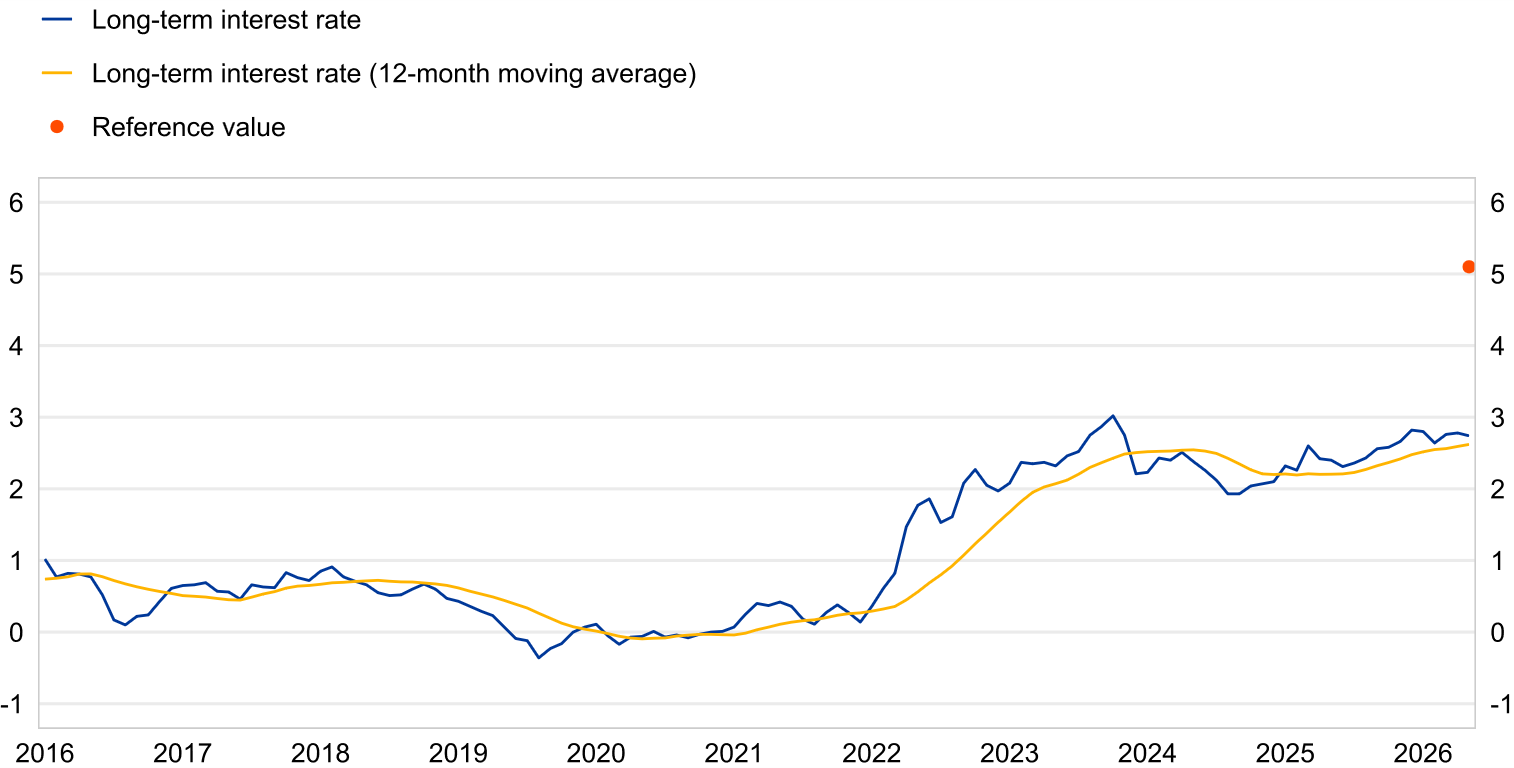
Sources: European System of Central Banks and ECB calculations.
1) The basis of the calculation of the reference value for the period from June 2025 to May 2026 is the unweighted arithmetic average of the interest rate levels in Cyprus, France and Denmark plus 2 percentage points. The reference value is 5.1%.
Chart 5.5.6
Long-term interest rate and HICP inflation differentials vis-à-vis the euro area
(monthly averages in percentage points)

Sources: European System of Central Banks, ECB calculations and European Commission (Eurostat).
Table 5.5.4
Long-term interest rates and indicators of financial development and integration
(as a percentage of GDP, unless otherwise indicated)
2016- |
2016- |
2021- |
2022 |
2023 |
2024 |
2025 |
June 2025 to May 2026 |
Memo item: euro area 2025 |
|
|---|---|---|---|---|---|---|---|---|---|
Long-term interest rates |
|||||||||
Sweden2) |
1.1 |
0.4 |
1.8 |
1.5 |
2.5 |
2.2 |
2.5 |
2.6 |
- |
Euro area3) 4) |
1.5 |
0.7 |
2.2 |
1.9 |
3.1 |
2.9 |
3.1 |
3.2 |
- |
Euro area AAA par curve, ten-year residual maturity2) 4) |
0.9 |
0.1 |
1.7 |
1.2 |
2.5 |
2.4 |
2.7 |
2.8 |
- |
Indicators of financial development and integration |
|||||||||
Debt securities issued by financial corporations5) |
92.1 |
99.0 |
85.3 |
86.1 |
86.7 |
87.1 |
80.0 |
- |
60.3 |
Debt securities issued by non-financial corporations6) |
25.5 |
25.0 |
26.1 |
28.6 |
26.1 |
24.7 |
22.2 |
- |
11.7 |
Stock market capitalisation7) |
159.2 |
142.6 |
175.8 |
150.2 |
163.7 |
164.4 |
174.2 |
- |
73.9 |
MFI credit to non-government residents8) |
134.6 |
136.5 |
132.7 |
139.4 |
132.6 |
126.5 |
125.4 |
- |
95.4 |
Claims of euro area MFIs on resident MFIs9) |
8.9 |
9.0 |
8.8 |
9.8 |
8.7 |
8.3 |
8.4 |
- |
26.0 |
Sources: European System of Central Banks and ECB calculations.
1) Multi-annual averages calculated using the arithmetic mean.
2) Average interest rate.
3) GDP-weighted average of the euro area long-term interest rates for the purpose of assessing convergence.
4) Included for information only.
5) Outstanding amount of debt securities issued by resident MFIs (excluding the national central bank) and other financial corporations.
6) Outstanding amount of debt securities issued by resident non-financial corporations.
7) Outstanding amount of listed shares issued by residents at market values.
8) MFI (excluding national central bank) credit to domestic non-MFI residents other than general government. Credit comprises outstanding amounts of loans and debt securities.
9) Outstanding amount of deposits and debt securities issued by resident MFIs (excluding the national central bank) held by euro area MFIs as a percentage of total liabilities of resident MFIs (excluding the national central bank). Total liabilities exclude capital
and reserves and remaining liabilities.
The examination of the convergence process is highly dependent on the quality and integrity of the underlying statistics. Member States are invited to consider the quality and integrity of their statistics as a matter of priority, to ensure that a proper system of checks and balances is in place when compiling these statistics and to apply high standards with respect to governance and quality in the domain of statistics.
National statistical authorities in each Member State and the EU statistical authority within the European Commission (Eurostat) should enjoy professional independence and ensure that European statistics are impartial and of a high quality. This is in line with the principles laid down in Article 338(2) of the Treaty, the Regulation on European statistics[165] and the European Statistics Code of Practice.[166] Article 2(1) of the Regulation on European statistics states that the development, production and dissemination of European statistics shall be governed by the following statistical principles: (a) professional independence, (b) impartiality, (c) objectivity, (d) reliability, (e) statistical confidentiality, and (f) cost-effectiveness. Pursuant to Article 11 of the Regulation, these statistical principles are elaborated further in the European Statistics Code of Practice.
Against this background, this chapter reviews the quality and integrity of the convergence indicators in terms of the underlying statistics. It provides information on the statistical methodology of the convergence indicators, as well as on the compliance of the underlying statistics with the standards necessary for an appropriate assessment of the convergence process.
6.1 Institutional features relating to the quality of statistics for the assessment of the convergence process
The governance of the European Statistical System (ESS) has progressively improved, in particular with the adoption of the European Statistics Code of Practice in 2005. In the specific context of the EU fiscal surveillance system and of the excessive deficit procedure (EDP), Council Regulation (EU) No 679/2010[167] granted Eurostat new competences for the regular monitoring and verification of public finance data, which it exercises by conducting more in-depth dialogue visits to Member States and by extending such visits to public entities supplying upstream public finance data to the national statistical institutes (NSIs).
Furthermore, the EU’s economic governance framework – initially reinforced by the “six-pack”[168] and “two-pack”[169] legislative packages in 2011 and 2013 – has been substantially enhanced by the economic governance framework reform that entered into force in 2024.[170] This reform replaced the previous preventive arm of the Stability and Growth Pact and amended the corrective arm and national fiscal framework requirements to strengthen the economic governance structure of the euro area and the EU as a whole. The reformed framework continues to rely on the compilation of high-quality statistical information, which needs to be produced under robust quality management.
Moreover, the European Statistics Code of Practice – last revised in 2017 – distinguishes between the principles to be implemented by ESS members and the principles relating to the institutional environment that are to be implemented by Member State governments. It emphasises that the NSIs and Eurostat coordinate all activities involved in the development, production and dissemination of European statistics (produced in accordance with the Regulation on European statistics) at the level of their national statistical systems and the ESS respectively.[171]
Since 2015 the Regulation on European statistics has been amended twice in order to, among other things, clarify that the principle of professional independence of NSIs applies unconditionally.[172] Statistics must indeed be developed, produced and disseminated in an independent manner, free of any pressure from political or interest groups or from EU or national authorities, and existing institutional frameworks must not be allowed to restrict this principle.
Lastly, it is necessary to assure the independence of other statistical authorities responsible for the compilation of European statistics (e.g. ministries of finance). Other statistical authorities’ responsibility for the publication of statistics needs to be clearly identified in order to distinguish statistical releases from political statements. In Poland and Romania, the ministries of finance compile EDP debt data. In Romania, Law No 226/2009 on the organisation and functioning of official statistics (the “Statistical Law”) includes the principle of professional independence and applies to all statistical processes and products. In Poland, although the independence of the compilers at the Ministry of Finance is not guaranteed by law, the monitoring and quality assurance of the EDP data and government finance statistics (GFS) compiled by the Ministry of Finance form part of the coordination role of the NSI. The institutional responsibilities for the compilation of EDP data and GFS in the countries covered in this report are shown in Table 6.1.
Table 6.1
Quality and integrity of convergence statistics
Czech Republic
Institutional features relating to the quality and integrity of the statistics used in assessing the convergence process | |
Legal independence of the national statistical institute |
Under Article 5 of the State Statistical Service Act, statistics are based on objectivity, impartiality and independence. Under Article 3, the Head of the NSI is appointed by the President of the Republic. |
Administrative supervision and budget autonomy |
The NSI is a central statistical agency within the public administration. It has budget autonomy on the basis of an annual amount assigned from the state budget. |
Legal mandate for data collection |
The State Statistical Service Act determines the main principles of data collection. |
Legal provisions regarding statistical confidentiality |
Under Articles 16, 17 and 18 of the State Statistical Service Act, the confidentiality of the statistical data is assured. |
HICP inflation1) | |
Compliance with legal minimum standards |
Eurostat made a compliance monitoring visit in 2019 and published a report in January 2020 confirming that, in general, the methods used for producing the HICP are satisfactory. There were no apparent instances of non-compliance with the HICP methodology. In February 2023 Eurostat reviewed the recommendations implemented by the NSI of the Czech Republic and identified two areas in which the quality of the HICP could be improved further. |
Other issues |
Eurostat considered the representativeness of the HICP in terms of accuracy and reliability to be generally adequate. |
Government finance statistics | |
Data coverage |
Revenue, expenditure, deficit and debt data are provided for the period 2016-25. |
Outstanding statistical issues |
No major outstanding statistical issues identified. Eurostat made an EDP visit to the Czech Republic in 2024 and published the final findings on its website. |
Institution responsible for the compilation of statistics |
The NSI compiles the non-financial and financial accounts of government, as well as government debt. |
Hungary
Institutional features relating to the quality and integrity of the statistics used in assessing the convergence process | |
Legal independence of the national statistical institute |
Under Act CLV of 2016 on Official Statistics, statistics are compiled following the principles of professional independence, impartiality, objectivity, reliability, commitment to quality, confidentiality and cost-effectiveness. The Head of the NSI is appointed by the Prime Minister. The term of office is fixed (seven years; reappointment is possible, only twice). |
Administrative supervision and budget autonomy |
The NSI is a public administration under the immediate supervision of the Government. It has budget autonomy on the basis of an annual amount assigned from the state budget. |
Legal mandate for data collection |
The Act on Official Statistics determines the main principles of data collection. |
Legal provisions regarding statistical confidentiality |
Under Articles 40 to 44 of the Act on Official Statistics, the confidentiality of the statistical data is assured. |
HICP inflation1) | |
Compliance with legal minimum standards |
Eurostat made a compliance monitoring visit in 2025 and published a report in December 2025 confirming that, in general, the methods used for producing the HICP are satisfactory. Several instances of non-compliance with the HICP methodology were identified. These related to the coverage and other quality characteristics of the HICP and its sub-indices, specifically those for rents, energy, telecommunication services, package holidays and insurance, and the price-updating of weights. Notwithstanding these issues, Eurostat assesses the HICP for Hungary to be generally comparable to those for the other EU Member States. |
Other issues |
Eurostat considered the representativeness of the HICP in terms of accuracy and reliability to be generally adequate. |
Government finance statistics | |
Data coverage |
Revenue, expenditure, deficit and debt data are provided for the period 2016-25. |
Outstanding statistical issues |
No major outstanding statistical issues identified. Eurostat made an EDP visit to Hungary in 2025 and will publish the final findings on its website. |
Institution responsible for the compilation of statistics |
The NSI compiles the non-financial accounts of government. The NCB compiles government debt and the financial accounts of government. |
Poland
Institutional features relating to the quality and integrity of the statistics used in assessing the convergence process | |
Legal independence of the national statistical institute |
Under Article 1 of the Law on Official Statistics, statistics are based on reliability, objectivity and professional independence. The Head of the NSI is selected by open competition and appointed by the President of the Council of Ministers who may also remove the person appointed. |
Administrative supervision and budget autonomy |
The NSI is a central agency within the public administration under the supervision of the President of the Council of Ministers. It has budget autonomy on the basis of an annual amount assigned from the state budget. |
Legal mandate for data collection |
The Law on Official Statistics determines the main principles of data collection. |
Legal provisions regarding statistical confidentiality |
Under Articles 10, 11, 12, 38, 39 and 54 of the Law on Official Statistics, the confidentiality of the statistical data is assured. |
HICP inflation1) | |
Compliance with legal minimum standards |
Eurostat made a compliance monitoring visit in 2024. The methods used for producing the HICP are of a good standard and in line with legal requirements. |
Other issues |
In a report issued in 2016, Eurostat made recommendations for further increasing the accuracy and reliability of the HICP. A report issued in 2024 found the HICP for Poland to be comparable with those for the other EU Member States. |
Government finance statistics | |
Data coverage |
Revenue, expenditure, deficit and debt data are provided for the period 2016-25. |
Outstanding statistical issues |
No major outstanding statistical issues identified. Eurostat made an EDP visit to Poland in 2024 and published the final findings on its website. |
Institution responsible for the compilation of statistics |
The NSI compiles the non-financial and financial accounts of government. The Ministry of Finance compiles government debt. |
Romania
Institutional features relating to the quality and integrity of the statistics used in assessing the convergence process | |
Legal independence of the national statistical institute |
The autonomy of official statistics is enshrined in the Statistical Law, through the principles of professional independence, impartiality, objectivity (including professional and ethical standards and transparency), reliability, confidentiality and cost-effectiveness (including proportionality). The President of the NSI is appointed by the Prime Minister. The term of office is fixed (five years; reappointment is possible). |
Administrative supervision and budget autonomy |
Under the Statistical Law, the NSI is a specialised institution, subordinated to the Government. It is financed via the state budget, and it has the authority to manage its allocated budget. |
Legal mandate for data collection |
Under the Statistical Law, the NSI is empowered to collect statistical data in its areas of competence that do not fall under those of Banca Naţională a României. |
Legal provisions regarding statistical confidentiality |
Under the Statistical Law, throughout the entire statistical process, the NSI and the other producers of official statistics have the obligation to adopt and implement all the necessary measures for protecting the confidentiality of individual statistical data, regardless of whether they are obtained directly for statistical purposes or indirectly through administrative or other sources. |
HICP inflation1) | |
Compliance with legal minimum standards |
Eurostat made a compliance monitoring visit in 2018 and published a report in February 2020 confirming that, in general, the methods used for producing the HICP are satisfactory. There were no apparent instances of non-compliance with the HICP methodology. In January 2023 Eurostat reviewed the recommendations implemented by the NSI of Romania and took good note of the progress achieved. |
Other issues |
Eurostat considered the representativeness of the HICP in terms of accuracy and reliability to be generally adequate. |
Government finance statistics | |
Data coverage |
Revenue, expenditure, deficit and debt data are provided for the period 2016-25. |
Outstanding statistical issues |
No major outstanding statistical issues identified. Eurostat made an EDP visit to Romania in 2023 and published the final findings on its website. |
Institution responsible for the compilation of statistics |
The NSI compiles the non-financial accounts of government. The Ministry of Finance compiles government debt. The NCB compiles the financial accounts of government. |
Sweden
Institutional features relating to the quality and integrity of the statistics used in assessing the convergence process | |
Legal independence of the national statistical institute |
Under Section 3 of the Official Statistics Act, statistics are objective and available to the public. The Head of the NSI is appointed by the Government. The term of office is fixed (six years; three-year reappointment possible, only once). |
Administrative supervision and budget autonomy |
The NSI is a central statistics agency, subordinated to, but not part of, the Ministry of Finance. Approximately half of its budget is provided by the Ministry of Finance, while the other half stems from charging government agencies and commercial customers for statistical production and advice. |
Legal mandate for data collection |
The Official Statistics Act determines the main principles of data collection. |
Legal provisions regarding statistical confidentiality |
Under Sections 5 and 6 of the Official Statistics Act, the confidentiality of the statistical data is assured. |
HICP inflation1) | |
Compliance with legal minimum standards |
Eurostat made a compliance monitoring visit in 2011 and published a report in 2013 confirming that, in general, the methods used for producing the HICP are satisfactory. Some instances of non-compliance with the HICP methodology were identified, but these were considered by Eurostat to be limited and unlikely to have a major impact in practice on the annual average rates of change in the HICP. In May 2024 Eurostat underlined that progress with respect to the quality improvement recommended by Eurostat for some products has been rather limited. However, this is not expected to affect annual HICP inflation significantly. |
Other issues |
Eurostat considered the representativeness of the HICP in terms of accuracy and reliability to be generally adequate. |
Government finance statistics | |
Data coverage |
Revenue, expenditure, deficit and debt data are provided for the period 2016-25. |
Outstanding statistical issues |
No major outstanding statistical issues identified. Eurostat made an EDP to visit to Sweden in 2025 and will publish the final findings on its website. |
Institution responsible for the compilation of statistics |
The NSI compiles the non-financial and financial accounts of government, as well as government debt. |
Note: NCB stands for national central bank.
1) See Eurostat’s website for the full reports on the findings and recommendations of the HICP compliance monitoring visits for each country.
6.2 HICP inflation
This section considers the methodology and quality of the statistics underlying the measurement of price developments, specifically the Harmonised Index of Consumer Prices (HICP). The HICP was developed for the purpose of assessing convergence in terms of price stability on a comparable basis. It is published for all EU Member States by Eurostat.[173] The HICP covering the euro area as a whole has been the main measure of price developments for the monetary policy of the ECB since January 1999.
Article 1 of Protocol (No 13) on the convergence criteria (annexed to the Treaty) requires price convergence to be measured by means of the consumer price index (CPI) on a comparable basis, taking into account differences in national definitions. The framework regulation introduced to establish HICPs, Council Regulation (EC) No 2494/95[174], was adopted in October 1995 and subsequently replaced by Regulation (EU) 2016/792[175], which entered into force in June 2016. The HICPs have also been harmonised on the basis of EU Council and European Parliament regulations. They use common standards for the coverage of the items, the territory and the population included (all these elements are major reasons for differences between national CPIs). Common standards have also been established in several other areas, for example the treatment of new goods and services.
The HICPs use annually updated expenditure weights (or, until 2011, with less frequent updates if this did not have a significant effect on the index) and cover all goods and services included in household final monetary consumption expenditure. The latter is derived from the national accounts domestic concept of household final consumption expenditure but excludes owner-occupied housing. The prices observed are the prices households actually pay for goods and services in monetary transactions and thus include all taxes (minus subsidies) on products, e.g. VAT and excise duties. Expenditure on health, education and social services is covered to the extent that it is financed (directly or through private insurance) by households and not reimbursed by the government. The “HICP – administered prices” includes only prices which are directly set or significantly influenced by government, including national regulators. It is based on a common definition and compilation, and is published by Eurostat. In 2026 a reviewed breakdown of HICP sub-indices by consumption purpose was introduced. Pre-2026 data were recalculated according to the new classification, while total inflation rates were kept unchanged.
Eurostat must ensure that the statistical practices used to compile national HICPs comply with HICP methodological requirements and that good practices in the field of consumer price indices are being followed. Eurostat carries out compliance monitoring visits and publishes its findings in information notes made available on its website.
6.3 Government finance statistics
This section describes the methodology and quality of the statistics used to measure fiscal developments. GFS are based mainly on national accounts concepts as defined in the ESA 2010[176] and Commission Regulation (EU) No 220/2014[177]. They refer to the institutional sector “general government” as defined in the ESA 2010. This comprises central government, state government (in Member States with a federal structure), local government and social security funds. It typically does not include public corporations.
The general government deficit (-)/surplus (+) is equal to the ESA 2010 item “net lending (+)/net borrowing (-)”, which in turn is equal to “total revenue” minus “total expenditure”. The primary government deficit/surplus is the government deficit/surplus excluding interest expenditure.
The general government debt is the sum of the outstanding gross liabilities at nominal value (face value) in currency and deposits, debt securities (e.g. government bills, notes and bonds) and loans. It excludes financial derivatives, such as swaps, as well as trade credits and other liabilities not represented by a financial document, such as overpaid tax advances.[178],[179] It also excludes contingent liabilities, such as government guarantees and pension commitments. While government debt is a gross concept in the sense that neither financial nor non-financial assets are deducted from liabilities, it is consolidated within the general government sector and therefore does not include government debt held by other government units. Government deficit and debt ratios are expressed as a percentage of GDP at current market prices.
6.3.1 Data sources
The national central banks (NCBs) provide the ECB with detailed GFS data under the ECB’s GFS Guideline[180]. Although the Guideline is only legally binding for euro area NCBs, non-euro area EU NCBs also transmit GFS data to the ECB by the same deadlines and using the same procedures. The Guideline lays down requirements for the transmission of annual data with detailed breakdowns of annual revenue and expenditure and the deficit-debt adjustment. In addition, it requests figures on general government debt with breakdowns by instrument, by initial and residual maturity, and by holder.
6.3.2 Methodological issues
GFS must comply with the ESA 2010 and reflect decisions and guidelines issued by Eurostat for specific cases involving the general government sector. The borderline classification cases between the financial, non-financial and general government sectors continue to be examined closely by Eurostat and national statistical compilers, and this may lead to further reclassifications and changes in EDP and GFS data.
Sector classification of certain monetary financial institutions (MFIs) differs across statistical frameworks in the Czech Republic and Hungary, creating known and documented discrepancies. In the Czech Republic and Hungary, there are MFIs that are classified in the general government sector for EDP purposes. In the Czech Republic, these MFIs are classified as part of the financial sector in the macroeconomic statistics compiled by the NCB (i.e. financial accounts statistics and balance of payments statistics) and in other ESCB statistics, such as monetary statistics and securities statistics. In Hungary, the MFI concerned is classified as part of the government sector in the macroeconomic statistics compiled by the NCB (i.e. financial accounts statistics and balance of payments statistics) and as part of the financial sector in other ESCB statistics, such as monetary statistics and securities statistics. The resultant discrepancy in sector classification between those statistics and GFS is well documented and has been made known to users.
6.4 Exchange rates
Article 3 of Protocol (No 13) on the convergence criteria defines what is meant by the criterion on participation in the exchange rate mechanism of the European Monetary System. The bilateral exchange rates of the Member States’ currencies vis-à-vis the euro are daily reference rates recorded by the ECB at around 14:10 CET and subsequently published on the ECB’s website at around 16:00 CET. Nominal and real effective exchange rates (EERs) are constructed by applying trade weights (based on a geometric weighting) to the bilateral nominal and real exchange rates of Member States’ currencies vis-à-vis the currencies of 40 trading partners. Both nominal and real EER statistics are published by the ECB.
6.5 Long-term interest rates
Article 4 of Protocol (No 13) on the convergence criteria requires interest rates to be measured on the basis of long-term government bonds or comparable securities, taking into account differences in national definitions. While Article 5 assigns the responsibility for providing the statistical data for the application of the Protocol to the European Commission, the ECB, given its expertise in the area, assists in this process by defining representative long-term interest rates and collecting the data from the NCBs for transmission to the Commission. This is a continuation of the work carried out by the European Monetary Institute as part of the preparations for Stage Three of Economic and Monetary Union in close cooperation with the Commission. The conceptual work resulted in the definition of seven key features to be considered in the calculation of long-term interest rates, as presented in Table 6.2. Long-term interest rates refer to bonds denominated in national currency.
Table 6.2
Statistical framework for defining long-term interest rates for the purpose of assessing convergence
Concept |
Recommendation |
|---|---|
Bond issuer |
The bond should be issued by the central government. |
Maturity |
As close as possible to ten years’ residual maturity. Any replacement of bonds should minimise maturity drift; the structural liquidity of the market must be considered. |
Coupon effects |
No direct adjustment. |
Taxation |
Gross of tax. |
Choice of bonds |
The selected bonds should be sufficiently liquid. This requirement should determine the choice between benchmark or sample approaches, depending on national market conditions. |
Yield formula |
The “redemption yield” formula should be applied. |
Aggregation |
Where there is more than one bond in the sample, a simple average of the yields should be used to produce the representative rate. |
6.6 Other indicators
The last paragraph of Article 140(1) of the Treaty states that, in addition to the four main criteria, the reports of the European Commission and the ECB shall also take account of the results of the integration of markets, the situation and development of the balances of payments on current account and an examination of the development of unit labour costs and other price indices. Whereas, for the four main criteria, Protocol (No 13) stipulates that the Commission will provide the data to be used for the assessment of compliance and describes those statistics in more detail, it makes no reference to the provision of statistics for these other indicators.
With regard to the results of the integration of markets, two sets of indicators are used. These are (i) statistics on financial development and integration referring to the structure of the financial system,[181] and (ii) statistics on financial and non-financial integration with the euro area.[182]
The data covering the structure of the financial system are provided by the NCBs. The indicators concerning the debt securities issued by resident financial corporations (MFIs, excluding the NCB and non-monetary financial corporations) and non-financial corporations are compiled in accordance with the methodology set out in Guideline (EU) 2022/971[183]. The indicator relating to stock market capitalisation refers to listed shares issued by resident corporations following the methodology set out in the same Guideline. The indicators concerning MFI credit to residents and claims of euro area MFIs on resident MFIs are based on available data collected by the ECB as part of the MFI balance sheet statistics collection framework. The data are obtained from the countries under review and, for the latter indicator, also from the euro area countries covered by Regulation (EU) No 2021/379[184]. Historical data are compiled by the relevant NCBs, where appropriate. For the indicators mentioned in this paragraph, the statistical data relating to the euro area cover the countries that had adopted the euro at the time to which the statistics relate.
Balance of payments and international investment position statistics are compiled in accordance with the concepts and definitions laid down in the sixth edition of the International Monetary Fund’s Balance of Payments and International Investment Position Manual (BPM6) and with guidance provided by the ECB in its Guideline on external statistics[185] and by Eurostat.[186] The Convergence Report examines developments in the current account (goods, services, primary income and secondary income) and the capital account. The sum of the balances of these two accounts corresponds to the net lending/net borrowing of the total economy. In addition, developments in the main components of the financial account are presented together with the net international investment position and gross external debt of each country. Exports and imports of goods and services are presented vis-à-vis both the rest of the world and the euro area. Direct and portfolio investment assets in and liabilities to the euro area are also reported. Forecasted data are taken from the European Commission’s economic forecasts.
The Convergence Report also looks at the development of unit labour costs and other price indices. Statistics on unit labour costs (calculated as hourly compensation per employee divided by hourly labour productivity) are derived from data provided under the ESA 2010 transmission programme. With regard to producer price indices, these data refer to domestic sales of total industry excluding construction. The statistics are collected on a harmonised basis under the Regulation on European business statistics[187].
The following country assessments report only on those provisions of national legislation which the ECB considered to be relevant from the perspective of their compatibility with provisions on the independence of NCBs, members of NCBs’ decision-making bodies and Governors in the Treaty (Article 130) and the Statute (Articles 7 and 14.2), provisions on confidentiality (Article 37 of the Statute), prohibitions on monetary financing (Article 123 of the Treaty) and privileged access (Article 124 of the Treaty), and the single spelling of the euro as required by EU law. While, in particular, the independence requirements and the monetary financing prohibition are applicable to all Member States, including those with a derogation since the date of their accession to the European Union, the following country assessments additionally cover the perspective of legal integration of the NCBs into the Eurosystem (in particular as regards Articles 12.1 and 14.3 of the Statute).[188]
7.1 Czech Republic
7.1.1 Compatibility of national legislation
The following legislation forms the legal basis for Česká národní banka and its operations:
- the Czech Constitution,[189]
- the Law on Česká národní banka (hereinafter the “Law on CNB”,[190]
- the Law No 166/1993 Coll. on the Supreme Audit Office (hereinafter the “Law on NKU”).
- In relation to the points identified in the ECB’s Convergence Report of June 2024, the comments made in that report are largely repeated.
7.1.2 Independence of the NCB
With regard to Česká národní banka’s independence, the Law on CNB needs to be adapted as set out below.
7.1.2.1 Functional independence
Article 2(1) of the Law on CNB provides that in addition to the primary objective of price stability, Česká národní banka’s objective is “to ensure financial stability and the safe and sound operation of the financial system in the Czech Republic”. In line with Article 127(1) of the Treaty, the secondary objective of Česká národní banka should be stated to be without prejudice to Česká národní banka’s primary objective of maintaining price stability.
7.1.2.2 Institutional independence
Article 3 of the Law on CNB obliges Česká národní banka to submit a report on monetary development to the Chamber of Deputies at least twice a year for review; the Law on CNB also provides for an optional extraordinary report to be prepared pursuant to a Chamber of Deputies resolution. The Chamber of Deputies has the power to acknowledge the report or ask for a revised report; such a revised report must comply with the Chamber of Deputies’ requirements. These parliamentary powers could potentially breach the prohibition on giving instructions to NCBs pursuant to Article 130 of the Treaty and Article 7 of the Statute.
In addition, Article 47(5) of the Law on CNB requires Česká národní banka to submit a revised report if the Chamber of Deputies rejects its annual financial report. This revised report must comply with the Chamber of Deputies’ requirements. Such parliamentary powers breach the prohibition on approving, annulling or deferring decisions. Article 3 and Article 47(5) of the Law on CNB are therefore incompatible with central bank independence and should be adapted accordingly.
Further, Article 130 of the Treaty and Article 7 of the Statute are partially mirrored in the Law on CNB. Article 9(1) of the Law on CNB expressly prohibits Česká národní banka and its Board from seeking or taking instructions from the President of the Republic, from Parliament, from the Government, from administrative authorities of the Czech Republic, from the bodies, institutions or other entities of the European Union, from governments of the Member States or from any other body, but it does not expressly prohibit the Government from seeking to influence the members of Česká národní banka’s decision-making bodies in situations where this may have an impact on Česká národní banka’s fulfilment of its ESCB-related tasks. In this respect the Law on CNB needs to be adapted to be fully consistent with Article 130 of the Treaty and Article 7 of the Statute.[191]
Pursuant to the Law on NKU, the Supreme Audit Office (NKU) is empowered to audit Česká národní banka’s financial management as regards its operating expenditure and expenditure for the purchase of property. The ECB understands that: (i) the NKU’s auditing powers in relation to Česká národní banka are without prejudice to Article 9 of the Law on CNB, which concerns the general prohibition on Česká národní banka seeking or taking instructions from other entities; and (ii) the NKU has no power to interfere with either the external auditors’ opinion or with Česká národní banka’s ESCB-related tasks. In so far as this understanding is correct, the NKU’s auditing powers vis-à-vis Česká národní banka are not incompatible with central bank independence.
7.1.2.3 Personal independence
The Law on CNB is silent on the right of national courts to review a decision to dismiss any member, other than the Governor, from Česká národní banka’s Board who is involved in the performance of ESCB-related tasks. Even though this right may be available under general law, providing specifically for such a right of review would increase legal certainty.
7.1.3 Monetary financing and privileged access
Under Article 33a of the Law on CNB, Česká národní banka, upon request, may exceptionally provide the Financial Market Guarantee System (FMGS) with short-term credit guaranteed by government bonds or other securities underwritten by the Government and owned by the FMGS, for a maximum of three months, in order to address an urgent situation, where the FMGS does not have sufficient funds to perform its tasks and this situation might jeopardise the stability of the financial market. Even if such funding is discretionary, temporary and in the interests of financial stability,[192] it remains the case that Article 123(1) of the Treaty prohibits any type of credit facility in favour of “bodies governed by public law”. Given the features of the FMGS, the provisions laid down in the Law on CNB are not compatible with the monetary financing prohibition and should be amended accordingly.[193] The FMSG qualifies as a “body governed by public law” within the meaning of Article 123(1) of the Treaty, as has been recently clarified. In particular, the FMGS has all of the following characteristics: (a) it is established for the specific purpose of meeting needs in the general interest, not having an industrial or commercial character; (b) it has legal personality; and (c) it is closely dependent on the public sector entities referred to in Article 123(1) of the Treaty, given that, although only a minority of the members of FMGS’s governing body are representatives of the Ministry of Finance, the Ministry of Finance has in fact the right to appoint and dismiss all the members of the FMGS’s governing body.
7.1.4 Legal integration of the NCB into the Eurosystem
With regard to Česká národní banka’s legal integration into the Eurosystem, the Law on CNB and Law No 2/1969 Coll., establishing ministries and other central administrative bodies of the Czech Republic (hereinafter the “Law on competences”) need to be adapted as set out below.
7.1.4.1 Economic policy objectives
Article 2(1) of the Law on CNB, the last sentence of which provides that without prejudice to its primary objective, Česká národní banka shall support the general economic policies of the Government leading to sustainable economic growth and the general economic policies in the EU with a view to contributing to the achievement of the objectives of the EU, is not fully compatible with Article 127(1) of the Treaty and Article 2 of the Statute. The Law on CNB should make it clear that the objective of financial stability and the objective of supporting the general economic policies of the Government leading to sustainable growth are subordinate not only to the primary objective of price stability as specified in Section 7.1.2.1. but also to the secondary objective of the ESCB.
7.1.4.2 Tasks
Monetary policy
Article 2(2)(a), Article 5(1) and Part Five (namely Articles 23 to 26) of the Law on CNB, which provide for Česká národní banka’s powers in the field of monetary policy and instruments for the implementation thereof, do not recognise the ECB’s powers in this field.
Articles 32 and 33 of the Law on CNB, which empower Česká národní banka to enter into certain financial transactions, also fail to recognise the ECB’s powers in this field.
Official foreign reserve management
Article 35(c) and Article 47a of the Law on CNB, which provide for Česká národní banka’s powers relating to foreign reserve management, do not recognise the ECB’s powers in this field. Article 4(1) of the Law on competences, according to which the Ministry of Finance is the central administrative body for, inter alia, “foreign exchange affairs including the State’s claims and obligations towards foreign entities” does not recognise the ECB’s powers in this field.
Payment systems
Article 2(2)(c) and Articles 38 and 38a of the Law on CNB, which provide for Česká národní banka’s powers relating to the smooth operation of payment systems, do not recognise the ECB’s powers in this field. Article 4(1) of the Law on competences, according to which the Ministry of Finance is the central administrative body for, inter alia, “payments systems”, does not recognise the ECB’s powers in this field.
Issue of banknotes
Article 2(2)(b) of the Law on CNB, which empowers Česká národní banka to issue banknotes and coins, and Part Four of the Law on CNB, namely Articles 12 to 22, which specify Česká národní banka’s powers in this field and the related implementing instruments, do not recognise the Council’s and the ECB’s powers in this field.
7.1.4.3 Financial provisions
Appointment of independent auditors
Article 48(2) of the Law on CNB, which provides that Česká národní banka’s annual financial statements are audited by auditors selected on the basis of an agreement between Česká národní banka’s Board and the Minister for Finance, does not recognise the Council’s and the ECB’s powers under Article 27.1 of the Statute.
Financial reporting
Article 48 of the Law on CNB does not reflect Česká národní banka’s obligation to comply with the Eurosystem’s regime for financial reporting of NCB operations, pursuant to Article 26 of the Statute.
7.1.4.4 Exchange rate policy
Article 35 of the Law on CNB, which authorises Česká národní banka to conduct exchange rate policy, does not recognise the Council’s and the ECB’s powers in this field. Article 4 of the Law on competences also fails to recognise the Council’s and the ECB’s powers in this field.
7.1.4.5 International cooperation
Article 2(3) of the Law on CNB, which empowers Česká národní banka to cooperate and negotiate agreements with the central banks of other countries, international financial institutions and other foreign and international organisations performing similar tasks to those performed by Česká národní banka, does not recognise the ECB’s powers in this field.
7.1.4.6 Miscellaneous
Article 37 of the Law on CNB, which provides for the respective legislative powers of Česká národní banka and the Ministry of Finance in areas relating, inter alia, to currency, the circulation of money, the financial market, the adoption of the euro in the Czech Republic, the payment system, foreign exchange management, and the status, competence, organisation and activities of Česká národní banka, does not recognise the Council’s and the ECB’s powers in this field.
Article 46(3) of the Law on CNB, which sets out the sanctions against third parties which fail to comply with their statistical obligations, does not recognise the Council’s and the ECB’s powers to impose sanctions.
7.1.5 Conclusions
The Law on CNB and the Law on competences do not comply with all the requirements for central bank independence, the monetary financing prohibition and legal integration into the Eurosystem. The Czech Republic is a Member State with a derogation and must therefore comply with all adaptation requirements under Article 131 of the Treaty.
7.2 Hungary
7.2.1 Compatibility of national legislation
The following legislation forms the legal basis for the Magyar Nemzeti Bank and its operations:
- The consolidated version of the Fundamental Law of Hungary,[194]
- Law CXXXIX of 2013 on the Magyar Nemzeti Bank (hereinafter the “Law on the MNB”).[195]
The Law on the MNB has been amended several times since the ECB’s Convergence Report of June 2024. As a result, some additional points are included in this year's assessment. Nevertheless, there have been no major changes in relation to the points identified in that Convergence Report, and those comments are therefore largely repeated in this year's assessment.
7.2.2 Independence of the NCB
With regard to the Magyar Nemzeti Bank’s independence, the Law on the MNB, Law XXVII of 2008[196] and Government Decree 474/2024 (XII. 31.) on the implementation of the law on the resilience of critical entities[197] need to be adapted as set out below.
7.2.2.1 Institutional independence
After introducing significant changes between 2013 and 2015,[198] minor amendments were made to the Law on the MNB. Between 2022 and 2024, the Magyar Nemzeti Bank was entrusted with a number of additional tasks arising from the implementation of EU legislation. In the past two years, the powers of the Magyar Nemzeti Bank have been further extended on the basis of relevant EU legislation,[199] and by national legislation relating to the newly established fundamental right to payment in cash.[200] Additionally, the number of the members of the Monetary Council and of the Executive Board and the deputy governors of the NCB is higher.[201] Given the nature of these changes, it is unlikely that they will have a material impact on the institutional framework and organisational and governance stability of the Magyar Nemzeti Bank.
On 20 December 2024, Law LXXXIV of 2024 on the resilience of critical entities[202] was published in the Hungarian Official Gazette, followed, on 31 December 2024, by an implementing Government decree, Government Decree 474/2024 (XII. 31.) on the implementation of the law on the resilience of critical entities[203]. The Law and its implementing Decree imposed a number of obligations on the Magyar Nemzeti Bank and placed it under the supervision of governmental bodies with substantial powers. For instance, the Magyar Nemzeti Bank was required to build and improve its resilience based on obligations such as the preparation of a resilience plan and a resilience matrix with predetermined content and form requirements and the establishment of a position of an independent critical entity resilience manager with the provision of adequate technical, human and financial resources for their activities. The supervising governmental bodies’ powers included, for example, the power to designate specific Magyar Nemzeti Bank infrastructure as critical infrastructure, to approve or reject the Magyar Nemzeti Bank’s resilience plan and resilience matrix, and to mandate the Magyar Nemzeti Bank to conduct resilience exercises and stress tests. The Magyar Nemzeti Bank was also subject to inspections during which the supervising governmental bodies monitored all Magyar Nemzeti Bank actions and inaction related to its resilience. Finally, if the Magyar Nemzeti Bank or the critical entity resilience manager failed to comply with their legal obligations, the supervising governmental bodies would impose a time limit for the Magyar Nemzeti Bank to remedy the failure and could impose an administrative fine on the Magyar Nemzeti Bank. These obligations and supervisory powers significantly affected the Magyar Nemzeti Bank’s preparedness and fundamentally restricted the autonomy of the Magyar Nemzeti Bank’s decision-making bodies to make decisions concerning the Magyar Nemzeti Bank’s resilience.[204]
Law LXXXIV of 2024 on the resilience of critical entities was amended by Law LXXI of 2025 on the amendment of laws supporting the efficiency of law enforcement[205], effective from 1 January 2026. The amendments to Law LXXXIV of 2024 on the resilience of critical entities exempt the Magyar Nemzeti Bank from the supervisory powers of the governmental bodies insofar as the Magyar Nemzeti Bank is acting as an organisation providing the essential services defined in rows 72 and 75 of the table in Annex 1 to Law LXXXIV of 2024 on the resilience of critical entities.[206] Government Decree 474/2024 (XII. 31.) on the implementation of the law on the resilience of critical entities was also amended by the same law, but the scope of the tasks in the exercise of which the Magyar Nemzeti Bank can be designated as a critical entity differs under the Law and its implementing Decree. This may potentially affect the independence of the Magyar Nemzeti Bank, as the limitations of the supervisory powers of governmental bodies in relation to the Magyar Nemzeti Bank only apply insofar as the Magyar Nemzeti Bank is acting as an organisation providing essential services as defined in rows 72 and 75 of the table in Annex 1 to Law LXXXIV of 2024 on the resilience of critical entities. Therefore, Government Decree 474/2024 (XII. 31.) on the implementation of the law on the resilience of critical entities needs to be adapted in this regard.
7.2.2.2 Personal independence
Law XXVII of 2008 specifies the wording of the oath that the members of the Monetary Council – including the Governor – are required to take.[207] Pursuant to Article 9(7), in conjunction with Articles 10(3) and 11(2) of the Law on the MNB, the Governor and the Deputy Governors of the Magyar Nemzeti Bank must take an oath before Hungary’s President, while other members of the Monetary Council take an oath before the Parliament. Law XXVII of 2008 specifies the wording of the oath to be taken by public officials appointed by the Parliament.[208] Therefore, it is not clear whether the Governor and Deputy Governors take the same oath as the other members of the Monetary Council.
The Magyar Nemzeti Bank’s Governor acts in a dual capacity as a member of both the Magyar Nemzeti Bank’s Monetary Council and the ECB decision-making bodies. The wording of the oath should take into account and reflect the status, obligations and duties of the Governor as a member of the ECB’s decision-making bodies. Furthermore, the other members of the Monetary Council are also involved in the performance of ESCB-related tasks. The oath taken should not hinder the Governor, Deputy Governors and other members of the Monetary Council from performing ESCB-related tasks. Law XXVII of 2008 and Articles 9(7), 10(3) and 11(2) of the Law on the MNB need to be adapted in this regard.[209]
In addition, in accordance with Article 152(2) of the Law on the MNB, by way of exception from the general rule laid down in Article 152(1), all employees of the Magyar Nemzeti Bank, including the members of the Monetary Council, may: (1) hold membership of any kind in some but not all of the entities[210] subject to the Magyar Nemzeti Bank’s supervisory powers, which fall under the scope of the laws enumerated in Article 39 of the Law on the MNB;[211] (2) have an employment relationship or any other work-related relationship, including by being executive officer or a supervisory board member, in a financial institution in which the Magyar Nemzeti Bank holds shares; and (3) be a supervisory board member of a non-profit business association the purpose of which is the resolution of entities subject to Article 39. In addition, pursuant to Article 153(1) of the Law on the MNB, employees of the Magyar Nemzeti Bank, including the members of the Monetary Council, performing the Magyar Nemzeti Bank’s basic tasks can maintain an employment relationship, including by being an executive officer or a supervisory board member, with financial institutions in which the Magyar Nemzeti Bank holds shares. Furthermore, pursuant to Article 153(6) of the Law on the MNB,[212] by way of exception from Article 152, Article 153(1) to (5) and Articles 154 to 156 of the Law on the MNB, the members of the Monetary Council may, without being subject to a formal disclosure requirement (unless it amounts to an employment relationship), be an executive officer or a member of a supervisory board of a business association under the majority ownership of the Magyar Nemzeti Bank, as well as a member of the management, board of trustees or supervisory board of a foundation established by the Magyar Nemzeti Bank. On the basis that it gives rise to potential conflicts of interest, the exception provided for in Article 152(2) - in conjunction with Article 153(1) - and Article 153(6) of the Law on the MNB should be removed in relation to the entities subject to the Magyar Nemzeti Bank’s supervisory powers that fall under the scope of the laws enumerated in Article 39 of the Law on the MNB, in order to safeguard the personal independence of the members of the Monetary Council. Furthermore, in relation to entities that are not subject to the Magyar Nemzeti Bank’s supervisory powers and do not fall under the scope of the laws enumerated in Article 39 of the Law on the MNB, it should be clarified that the memberships or relationships specified in the abovementioned provisions of the Law on the MNB are not permitted if they give rise to a conflict of interest.
In addition, Article 153(4) of the Law on the MNB stipulates that all employees of the Magyar Nemzeti Bank, including the members of the Monetary Council, must notify the Magyar Nemzeti Bank when acquiring financial instruments subject to the Law CXXXVIII of 2007 on Investment Service Providers and Commodity Traders and the Rules of their Services except for state bonds and securities issued by open-ended public investment funds. The notification must be made within three working days of acquiring the instruments. In order to avoid any potential conflict of interest, however, this notification obligation should cover all instruments including state bonds and securities issued by open-ended public investment funds.
In addition, Article 156(7) of the Law on the MNB in conjunction with Article 152(1), sets out post-employment conflict of interest rules for the members of the Monetary Council. It provides the members of the Monetary Council with an exemption from the cooling-off period of six months with regard to any membership or shareholder relationship, employment relationship or work-related contractual relationship, executive officer relationship or supervisory board membership with any of the entities subject to the Magyar Nemzeti Bank’s supervisory powers, which fall under the scope of the laws enumerated in Article 39 of the Law on the MNB and in which the Hungarian State or the Magyar Nemzeti Bank has a majority stake.[213] Providing for such an exemption may give rise to potential conflicts of interest for the members of the Monetary Council. In order to safeguard those members' personal independence, the exemption from the post-employment restrictions provided for in Article 156(7) of the Law on the MNB should be removed as regards the entities subject to the Magyar Nemzeti Bank’s supervisory powers and should be amended to clarify that such membership is not permitted if it gives rise to a conflict of interest as regards the other entities covered by Article 156(7) of the Law on the MNB.
Article 157 of the Law on the MNB defines the rules that members of the Monetary Council must abide by when submitting their declarations of wealth. The Governor and the Deputy Governors must also follow these rules, by reference to the application of the provisions laid down in Law XXXVI of 2012 on the Parliament governing the declaration of wealth of members of the Parliament and related proceedings. Pursuant to Article 90(3) of Law XXXVI of 2012, which applies to the members of the Monetary Council by virtue of Article 157(1) and Article183/L of the Law on the MNB, in the case of non-compliance with the obligation to submit a declaration of wealth, the members of the Monetary Council will be prohibited from carrying out their duties and, as a consequence, they will not be entitled to receive their remuneration for the period of non-compliance. The sanction provided for in Article 90(3) of Law XXXVI of 2012 in effect allows the members of the Monetary Council to be temporarily removed from office for grounds other than those pursuant to Article 14.2 of the Statute. The provisions of Article 157(2) of the Law on the MNB should be adapted[214] so that the members of the Monetary Council may not be dismissed for reasons other than those laid down in Article 14.2 of the Statute.[215]
7.2.2.3 Financial independence
In the past two years, the Magyar Nemzeti Bank’s recapitalisation and reimbursement regime was replaced twice. First, Article 166(3) of the Law on the MNB was amended to provide that if the amount of equity fell below the subscribed capital at the end of the year under review, the difference would be reimbursed from the central budget directly to the retained earnings over a period of five years, with equal instalments being paid every year, within 30 days of the shareholder’s receipt of the notification of the report for the year under review.[216] Additionally, if the amount of the equity exceeded the subscribed capital, all outstanding repayment obligations would cease. If, within the five-year period, the central budget incurred a new reimbursement obligation, Article 166(3) of the Law on the MNB would apply to the fulfilment of this obligation if the central budget ensured that the Magyar Nemzeti Bank's equity did not remain below the level of subscribed capital for a longer period.[217]
As a result of the second amendment, Article 166(3) of the Law on the MNB currently provides that if the equity of the Magyar Nemzeti Bank is below the subscribed capital for a prolonged period of time, it must be ensured, by direct reimbursement to the retained earnings provided from the central budget, that the amount of the Magyar Nemzeti Bank’s equity should be at least at the level of the subscribed capital within a reasonable period of time, in order to comply with the principle of financial independence. In addition, the Executive Board of the Magyar Nemzeti Bank must approve a year-by-year forecast of the preliminary level of the equity at the end of the previous year and its expected development and send the report to the shareholder and the Fiscal Council by 30 April.[218] The State authorities seem to have a wide margin of discretion to determine when the Magyar Nemzeti Bank’s equity would be restored up to the level of the Magyar Nemzeti Bank’s subscribed capital, which, as such, is not inconsistent with the Treaty and the Statute of the ESCB.[219]
The Magyar Nemzeti Bank’s dividend payment regime was also modified in the past two years.[220] Article 166(1) of the Law on the MNB currently provides that if the amount of the Magyar Nemzeti Bank’s equity exceeds its subscribed capital at the end of the year under review, the Magyar Nemzeti Bank will pay 50% of its profit for the year under review as a dividend (automatic dividend payment). Article 166(1a) of the Law on the MNB stipulates that the Magyar Nemzeti Bank will pay dividends, based on a decision of its Executive Board, from the positive amount of its retained earnings supplemented by the loss or 50% of its profit from the year under review, up to the amount of the equity exceeding the subscribed capital (discretionary dividend payment). According to Article 166(1b) of the Law on the MNB, the dividend payment is due within 30 days of the Magyar Nemzeti Bank sending the notification of the report for the year under review to the shareholders. The ECB is of the view that the Law on the MNB may prescribe how its profits are to be allocated. Profits may be distributed to the State budget only after any accumulated losses from previous years have been covered and financial provisions deemed necessary to safeguard the real value of the Magyar Nemzeti Bank’s capital and assets have been created. The Magyar Nemzeti Bank is best placed to assess independently what level of reserves is necessary to enable it to perform its tasks, and such a decision should not be the subject of a third party’s decision.[221]
Article 183 of the Law on the MNB, read in conjunction with Article 176, provided that on 1 October 2013 all employees of the HFSA would be employees of the Magyar Nemzeti Bank and that the Magyar Nemzeti Bank was to bear the financial obligations arising from any employment relations which HSFA staff transferred to the Magyar Nemzeti Bank may have had with the HFSA in the past. This provision alone, taken together with the mass redundancy scheme provided for under Article 183(10) of the Law on the MNB and the aim of eliminating positions not essential for the discharge of duties in order to optimise staff management, is incompatible with the Magyar Nemzeti Bank’s financial independence and more specifically its autonomy in staff matters. It impeded the Magyar Nemzeti Bank’s ability to decide on employing and retaining necessary and qualified staff for the Magyar Nemzeti Bank. See, also, the following Section regarding compatibility with the prohibition on monetary financing.[222]
7.2.3 Monetary financing and privileged access
Article 36 of the Law on the MNB provides that if circumstances arise which jeopardise the financial system’s stability due to a credit institution’s operations, the Magyar Nemzeti Bank may extend an emergency loan to such credit institution subject to observing the prohibition on monetary financing in Article 146 of the Law on the MNB. However, it would be useful to specify that such loans are granted independently and at the Magyar Nemzeti Bank’s full discretion, which may make such extensions conditional if necessary and against adequate collateral, thus introducing an additional safeguard which should minimise the possibility of the Magyar Nemzeti Bank suffering any loss.
Article 37 of the Law on the MNB provides that on request, the Magyar Nemzeti Bank at its full discretion may provide a loan to the National Deposit Insurance Fund, subject to the prohibition on monetary financing in Article 146 of the Law on the MNB, in urgent and exceptional cases threatening the stability of the financial system as a whole and the smooth completion of cash transactions, the term of which loan may not be longer than three months. Law LXXXV of 2015 extended the scope of Article 37 in order to enable such emergency short-term loan facilities to be provided to the Hungarian Investor Protection Fund, under the same conditions as to the National Deposit Insurance Fund. This provision is compatible with the monetary financing prohibition. As also already clarified in ECB opinions,[223] it may be useful to specify that such loans are extended against adequate collateral, thus introducing an additional safeguard which should minimise the possibility of the Magyar Nemzeti Bank suffering any loss.
The integration of the HFSA into the Magyar Nemzeti Bank took place on 1 October 2013. Based on Articles 176 to 181 of the Law on the MNB, all of the HFSA’s assets were transferred to the Magyar Nemzeti Bank. The Magyar Nemzeti Bank also became a general legal successor to all obligations of the HFSA including, inter alia, its contractual relationships, pending procurement procedures, out-of-court redress procedures, tax-related administrative procedures as well as any other type of legal procedure (including pending administrative legal procedures). As a consequence, any payment obligation from a legal relationship or a requirement to pay compensation following any judgment handed down by a Hungarian court granting compensation to an individual or entity challenging a prior decision of the HFSA is to be borne by the Magyar Nemzeti Bank.
Although Article 177(6) of the Law on the MNB provides for compensation by the State to the Magyar Nemzeti Bank for all expenses resulting from the above-mentioned obligations that would exceed the assets taken over from the HFSA, the Law on the MNB does not specifically lay down the procedure and deadlines applicable to financing by the State and reimbursement of the Magyar Nemzeti Bank. This can only be considered to be an ex-post financing scheme. The provisions applying to the assignment of the obligations of the HFSA to the Magyar Nemzeti Bank were not accompanied by measures that would fully insulate the Magyar Nemzeti Bank from all financial obligations resulting from any activities and contractual relationships of the HFSA originating prior to the transfer of tasks, and the provisions of the Law on the MNB introduced a time gap between the costs arising and the Hungarian State reimbursing the Magyar Nemzeti Bank, should the expenses incurred at the Magyar Nemzeti Bank exceed the value of assets taken over from the HFSA. As mentioned in previous Convergence Reports, such a scenario would constitute a breach of the prohibition on monetary financing laid down in Article 123 of the Treaty as well as of the principle of financial independence under Article 130. Hence the Magyar Nemzeti Bank must be insulated from all financial obligations resulting from the prior activities or legal relationships of the HFSA.
Article 183 of the Law on the MNB read in conjunction with Article 176 of the Law on the MNB provides that the Magyar Nemzeti Bank bears the financial obligations arising from the employment relationships which HFSA staff transferred to the Magyar Nemzeti Bank may have had with the HFSA in the past. In order to comply with Article 123 of the Treaty, the Magyar Nemzeti Bank should be insulated from all obligations arising out of employment relationships between any new Magyar Nemzeti Bank staff member and the HFSA, in the light of the mass redundancy scheme provided for under Article 183(10) of the Law on the MNB[224].
7.2.4 Single spelling of the euro
In several Hungarian legal acts[225] the name of the single currency is spelled in a way ("euró"), which is inconsistent with EU law. Under the Treaties a single spelling of the word “euro” in the nominative singular case is required in all EU and national legislative provisions, taking into account the existence of different alphabets. The Hungarian legal acts in question should therefore be amended accordingly.[226]
The ECB expects that the correct spelling of the word “euro” will be applied in Hungarian legal acts and the euro changeover law. Only when all national legal acts use the correct spelling of the word “euro” will Hungary comply with the Treaties.
7.2.5 Legal integration of the NCB into the Eurosystem
With regard to the Magyar Nemzeti Bank’s legal integration into the Eurosystem, the Law on the MNB needs to be adapted as set out below.
7.2.5.1 Economic policy objectives
Article 3(2) of the Law on the MNB provides that the Magyar Nemzeti Bank supports, without prejudice to the primary objective of price stability, the maintenance of the stability of the financial intermediary system, the enhancement of its resilience, its sustainable contribution to economic growth and the Government’s general economic policies and environmental sustainability policy. This provision is incompatible with Article 127(1) of the Treaty and Article 2 of the Statute as it does not reflect the secondary objective of supporting the general economic policies in the EU.
7.2.5.2 Tasks
Monetary policy
Article 41 of the Fundamental Law of Hungary and Article 1(2) and Articles 4, 9, 16 to 22, 159 and 171 of the Law on the MNB establishing the Magyar Nemzeti Bank’s powers in the field of monetary policy and instruments for the implementation thereof do not recognise the ECB’s powers in this field.
Collection of statistics
Although Article 4(6) of the Law on the MNB refers to the Magyar Nemzeti Bank’s obligation to transfer specific statistical data to the ECB in accordance with Article 5 of the Statute, Articles 1(2) and 171(1) and Articles 9, 12, 30 and 160 of the Law on the MNB establishing the Magyar Nemzeti Bank’s powers relating to the collection of statistics do not recognise the ECB’s powers in this field.
Official foreign reserve management
Article 1(2), Article 4(3), (4) and (12), Article 9 and Article 159(2) of the Law on the MNB, which provide for the Magyar Nemzeti Bank’s powers in the field of foreign reserve management, do not recognise the ECB’s powers in this field.
Payment systems
Article 1(2), Article 4(5) and (12), Articles 9, 13, 27 and 28, and Article 171 (3) of the Law on the MNB establishing the Magyar Nemzeti Bank’s powers with regard to the promotion of the smooth operation of payment systems do not recognise the ECB’s powers in this field.
Issue of banknotes
Article K of the Fundamental Law and Article 1(2), Article 4(2) and (12), Articles 9, 12, 23 to 26 and Articles 171(1) and 172(2) of the Law on the MNB establishing the Magyar Nemzeti Bank’s exclusive right to issue banknotes and coins do not recognise the Council’s and the ECB’s powers in this field.
7.2.5.3 Financial provisions
Appointment of independent auditors
Article 144 of the Law on the MNB providing that the President of the State Audit Office must be consulted before the Magyar Nemzeti Bank’s auditor is elected or their dismissal is proposed, Article 6(1) of the Law on the MNB, which provides for the shareholder’s power to appoint and dismiss the auditor, and Article 15 of the Law on the MNB do not recognise the Council’s and the ECB’s powers under Article 27.1 of the Statute.
Financial reporting
Article 12(4)(b) and Article 147 of the Law on the MNB and Law C of 2000,[227] in conjunction with Government Decree 221/2000,[228] do not reflect the Magyar Nemzeti Bank’s obligation to comply with the Eurosystem’s regime for financial reporting of NCB operations, pursuant to Article 26 of the Statute.
7.2.5.4 Exchange rate policy
Article 1(2), 4(4) and (12), Articles 9 and 22 of the Law on the MNB lay down the Government’s and the Magyar Nemzeti Bank’s respective powers in the area of exchange rate policy. These provisions do not recognise the Council’s and the ECB’s powers in this field.
7.2.5.5 International cooperation
Article 1(2), 135(5) of the Law on the MNB providing that, upon authorisation by the Government, the Magyar Nemzeti Bank may undertake tasks arising at international financial organisations, unless otherwise provided for by a legislative act, fails to recognise the ECB’s powers as far as issues under Article 6 of the Statute are concerned.
7.2.5.6 Miscellaneous
Articles 75 and 76 of the Law on the MNB do not recognise the ECB’s powers to impose sanctions.
With regard to Article 132 of the Law on the MNB, which entitles the Magyar Nemzeti Bank to be consulted on draft national legislation related to its tasks, it is noted that consulting the Magyar Nemzeti Bank does not obviate the need to consult the ECB under Articles 127(4) and 282(5) of the Treaty.
As set out in Section 7.4.2, Article 9(7) of the Law on the MNB requires the members of the Monetary Council to make an oath in accordance with the wording specified in Article 1 of Law XXVII of 2008. Article 9(7) of the Law on the MNB needs to be adapted to comply with Article 14.3 of the Statute.[229]
7.2.6 Conclusions
The Fundamental Law of Hungary, the Law on the MNB, Law XXVII of 2008, and Government Decree 474/2024 (XII. 31.) on the implementation of the law on the resilience of critical entities do not comply with all the requirements for central bank independence, the prohibition on monetary financing, and legal integration into the Eurosystem. Other Hungarian legal acts do not comply with the requirements for the single spelling of the euro. Hungary is a Member State with a derogation and must therefore comply with all adaptation requirements under Article 131 of the Treaty.
7.3 Poland
7.3.1 Compatibility of national legislation
The following legislation forms the legal basis for Narodowy Bank Polski and its operations:
- the Polish Constitution,[230]
- the Law on Narodowy Bank Polski (hereinafter the “Law on NBP”),[231]
- the Law on the Bank Guarantee Fund, deposit guarantee system and compulsory restructuring (hereinafter the “Law on the Fund”),[232]
- the Law on banking (hereinafter the “Law on banking”),[233]
- the Law on settlement finality in the payment and settlement systems and on the supervision of such systems.[234]
No major new legislation has been enacted in relation to the points identified in the ECB’s Convergence Report of June 2024, and those comments are therefore largely repeated in this year’s assessment.
7.3.2 Independence of the NCB
With regard to Narodowy Bank Polski’s independence, the Polish Constitution, the Law on NBP and the Law on the State Tribunal[235] need to be adapted in the respects set out below. Currently, the Polish Constitution specifies that Narodowy Bank Polski “shall have the exclusive right to issue money and to formulate and implement monetary policy”.[236] The Law on NBP states that “the primary objective of the activity of Narodowy Bank Polski shall be to maintain price stability, while supporting the economic policies of the Government insofar as this does not constrain the pursuit of the primary objective of Narodowy Bank Polski”.[237] The ECB understands that these provisions necessarily imply that Narodowy Bank Polski carries out its tasks and pursues its objectives independently of any other authority. Accordingly, the well-established case-law of the Constitutional Tribunal derives the principle of the independence of Narodowy Bank Polski from a functional interpretation of the content of Article 227 of the Polish Constitution[238].
7.3.2.1 Institutional independence
Article 11(3) of the Law on NBP, which provides that Narodowy Bank Polski’s Governor represents Poland’s interests within international banking institutions and, unless the Council of Ministers decides otherwise, within international financial institutions, needs to be adapted to comply with Article 130 of the Treaty and Article 7 of the Statute.
Article 23(1)(2) of the Law on NBP, which obliges Narodowy Bank Polski’s Governor to forward draft monetary policy guidelines to the Council of Ministers and the Minister for Finance, needs to be adapted to comply with Article 130 of the Treaty and Article 7 of the Statute.
The Supreme Audit Office (NIK), a constitutional body, has wide powers under Article 203(1) of the Polish Constitution to control the activities of, among others, all public administrative authorities and Narodowy Bank Polski as regards their legality, economic prudence, efficiency and diligence. The scope of the NIK’s control should be clearly defined, should be without prejudice to the activities of Narodowy Bank Polski’s independent external auditors,[239] should comply with the prohibition on giving instructions to an NCB and its decision-making bodies and should not interfere with the NCB’s ESCB-related tasks. In particular, it should be ensured that when auditing Narodowy Bank Polski, the application by the NIK of the “efficiency criterion” does not extend to an evaluation of Narodowy Bank Polski’s activities related to its primary objective of price stability.[240] Article 203(1) of the Polish Constitution needs to be adapted to comply with Article 130 of the Treaty and Article 7 of the Statute.
7.3.2.2 Personal independence
Article 9(5) of the Law on NBP regulates the dismissal of Narodowy Bank Polski’s Governor by the Sejm (lower house of Parliament) upon request of the President of the Republic of Poland, if he or she has:
- been unable to fulfil his or her duties due to prolonged illness,
- been convicted of a criminal offence under a final court sentence,
- submitted an untruthful disclosure declaration, confirmed by a final court judgment,[241]
- been prohibited by the State Tribunal from occupying executive positions or holding posts of particular responsibility in state bodies.[242]
Moreover, under Article 25(3) in conjunction with Article 3 and Article 1(1)(3) of the Law on the State Tribunal, Narodowy Bank Polski’s Governor may also be relieved from office[243] if he or she violates the Constitution or a law.[244]
The ECB understands that the grounds listed above in principle do not constitute new grounds for dismissal of Narodowy Bank Polski’s Governor in addition to those contained in Article 14.2 of the Statute. However, Article 25(3) in conjunction with Article 3 and Article 1(1)(3) of the Law on the State Tribunal could be understood as extending the scope of serious misconduct beyond Article 14.2 of the Statute to mere violations of the law. For the sake of legal clarity, the potential inconsistency resulting from these provisions with the grounds of dismissal contained in Article 14.2 of the Statute should be removed.[245] Until then, these provisions should be interpreted in line with Article 14.2 of the Statute.
With regard to security of tenure and grounds for dismissal of other members of Narodowy Bank Polski’s decision-making bodies involved in the performance of ESCB-related tasks (i.e. the members of the Management Board, and in particular the First Deputy Governor, and the members of the Monetary Policy Council), Article 13(5) and Article 17(2b), second sentence, of the Law on NBP provide the following grounds for dismissal:
- an illness which permanently prevents them from performing their responsibilities,
- a conviction for a criminal offence under a final court sentence,
- submission of an untruthful lustration declaration, and this has been confirmed by a final court judgment,[246]
- non-suspension of membership of a political party or trade union.
The grounds listed above and Article 14(3) of the Law on NBP, which reaffirms the possibility of dismissal of a member of the Monetary Policy Council of Narodowy Bank Polski for a conviction for a criminal offence, therefore need to be interpreted in line with Article 130 of the Treaty.[247]
The Governor of Narodowy Bank Polski acts in dual capacity as a member of Narodowy Bank Polski’s decision-making bodies and of the relevant decision-making bodies of the ECB. Article 9(3) of the Law on NBP, which specifies the wording of the oath sworn by Narodowy Bank Polski’s Governor, needs to be adapted to reflect the status and the obligations and duties of the Governor of Narodowy Bank Polski as member of the relevant decision-making bodies of the ECB.
The Law on NBP is silent on the right of national courts to review a decision to dismiss any member of the NCB’s decision-making bodies who is involved in the performance of ESCB-related tasks. Even though this right may be available under general Polish law for any member of the NCB’s decision-making bodies other than the Governor (whose dismissal falls within the jurisdiction of the Court of Justice of the European Union), providing specifically for such a right of review would increase legal certainty.
7.3.2.3 Financial independence
In March 2019 the Law amending the Law on prohibitions regarding conducting of business activities by public officials and the Law on NBP[248] entered into force. According to Article 66(3) of the amended Law on NBP, the upper salary limit (salary cap) for all employees (excluding members of the Management Board of Narodowy Bank Polski) is set at 60% of the salary of the Governor of Narodowy Bank Polski (the salary of the Governor is determined on the basis of other provisions which have not been amended). However, amendments included in any legislative proposal that lead to reductions in remuneration are not compatible with the principle of financial independence if the ability of the relevant national central bank to employ and retain staff to perform independently the tasks conferred on it by the Treaty and the Statute is affected. Any adopted legislative solution should provide for a cooperation mechanism with Narodowy Bank Polski, to ascertain if it considers that an exception to a cap on remuneration is required. Such an exception should be decided upon in close and effective cooperation with Narodowy Bank Polski, taking due account of its views, to ensure its ongoing ability to independently carry out its tasks.[249] As such close and effective cooperation with Narodowy Bank Polski is not provided for in the present legal framework regarding the salary cap, the legislation does not satisfy the requirements of Article 130 of the Treaty and Article 7 of the Statute.
7.3.3 Confidentiality
Article 23(7) of the Law on NBP specifies instances in which data collected from individual financial institutions, as well as statistical surveys, studies and assessments enabling identification of individual entities, are subject to disclosure by Narodowy Bank Polski to external parties. One such instance covers disclosure to “unspecified recipients”, under “separate applicable provisions”.[250] Such disclosure may potentially affect data protected under the ESCB’s confidentiality regime and therefore the Law on NBP should be adapted to fully comply with Article 37 of the Statute.[251]
In addition, since NIK has wide powers under Article 203(1) of the Polish Constitution to control the activities of Narodowy Bank Polski, as mentioned in Section 7.3.2.1, NIK also has wide access to Narodowy Bank Polski’s confidential information and documents. However, pursuant to Article 37 of the Statute in conjunction with Article 130 of the Treaty, NIK's access to Narodowy Bank Polski’s confidential information and documents must be limited to that necessary for the performance of NIK's statutory tasks. Such access must also be without prejudice both to the ESCB’s independence and to its confidentiality regime, to which the members of the NCBs’ decision-making bodies and staff are subject. In addition, the relevant Polish legislation should be amended to stipulate that NIK shall safeguard the confidentiality of information and documents disclosed by Narodowy Bank Polski to an extent corresponding to that applied by Narodowy Bank Polski.
7.3.4 Monetary financing and privileged access
Article 42(1) in conjunction with Article 3(2)(5) of the Law on NBP provides for Narodowy Bank Polski’s powers to grant refinancing credit to banks satisfying specified conditions.[252] In addition, Article 42(3) of the Law on NBP allows Narodowy Bank Polski to grant refinancing credit for the purpose of implementing a bank recovery plan, which is initiated in the event of a bank infringing, or being likely to infringe, certain requirements relating to, among other things, own funds and liquidity ratio.[253] Granting of refinancing credit is in all cases subject to the general rules of the Law on banking, with the modifications resulting from the Law on NBP.[254] Safeguards currently contained in such rules aiming at ensuring timely repayment of the credit do not fully exclude an interpretation that would allow an extension of refinancing credit to a bank undergoing recovery proceedings which then becomes insolvent.[255] More explicit safeguards in relation to all financial institutions receiving liquidity support from Narodowy Bank Polski are needed to avoid incompatibility with the monetary financing prohibition under Article 123 of the Treaty.[256] The Law on NBP should be adapted to make clear that such liquidity support is only temporary and it may not be extended to insolvent financial institutions.
Article 43 of the Law on NBP in conjunction with Articles 270 and 306 of the Law on the Fund provides for Narodowy Bank Polski’s powers to grant, at its discretion, short-term credit to the Bank Guarantee Fund (hereinafter the “Fund”) related to the financing of its deposit guarantee function, if a threat to financial stability arises and in view of its urgent needs. Given the current features of the Fund, the provisions laid down in the Law on NBP and the Law on the Fund regarding the possibility of NBP granting loans to the Fund are not compatible with the monetary financing prohibition and should be amended accordingly. The Fund qualifies as a “body governed by public law” within the meaning of Article 123(1) of the Treaty. In particular, the Fund has all of the following characteristics: (a) it has been established for the purpose of meeting needs in the general interest – especially tasks related to financial stability, administering the deposit guarantee scheme and resolution; (b) it has legal personality; and (c) it is closely dependent on public sector entities referred to in Article 123(1) of the Treaty, as the majority of the members of the Fund’s Council, which acts as the Fund’s administrative board, are appointed by the Minister competent for financial institutions and the Chairman of the Financial Supervisory Authority.[257] Additionally, the Fund is included in the catalogue of entities that are part of the public sector for the purposes of the Law of 27 August 2009 on public finance.[258]
Article 220(2) of the Polish Constitution provides that “the budget shall not provide for covering a budget deficit by way of contracting credit obligations to the State’s central bank”. While this provision prohibits the State from financing its budgetary deficit via Narodowy Bank Polski, the ECB understands that it does not constitute an implementation of Article 123 of the Treaty prohibiting monetary financing, and its aim and function are therefore not identical to those of the said Treaty prohibition. Article 123 of the Treaty, supplemented by Council Regulation (EC) No 3603/93, is directly applicable, so it may not be reproduced or transposed into national legislation.
7.3.5 Legal integration of the NCB into the Eurosystem
With regard to Narodowy Bank Polski’s legal integration into the Eurosystem, the Polish Constitution and the Law on NBP need to be adapted in the respects set out below.
7.3.5.1 Economic policy objectives
Article 3(1) of the Law on NBP provides that Narodowy Bank Polski’s primary objective is to maintain price stability, while supporting the economic policies of the Government, insofar as this does not constrain the pursuit of its primary objective. This provision is incompatible with Article 127(1) of the Treaty and Article 2 of the Statute, as it does not reflect the ESCB’s secondary objective of supporting the general economic policies in the Union.
7.3.5.2 Tasks
Monetary policy
Article 227(1) and (6) of the Constitution and Article 3(2)(5), Articles 12, 23 and 38 to 50a and 53 of the Law on NBP, which provide for Narodowy Bank Polski’s powers with regard to monetary policy, do not recognise the ECB’s powers in this field.
Collection of statistics
Article 3(2)(7) and Article 23 of the Law on NBP, which provides for Narodowy Bank Polski’s powers relating to the collection of statistics, do not recognise the ECB’s powers in this field.
Official foreign reserve management
Article 3(2)(2) and Article 52 of the Law on NBP, which provide for Narodowy Bank Polski’s powers in the field of foreign exchange management, do not recognise the ECB’s powers in this field.
Payment systems
Article 3(2)(1) of the Law on NBP, which provides for Narodowy Bank Polski’s powers in organising monetary settlements, does not recognise the ECB’s powers in this field.
Issue of banknotes
Article 227(1) of the Constitution and Article 4 and Articles 31 to 37 of the Law on NBP, which provide for Narodowy Bank Polski’s exclusive powers to issue and withdraw banknotes and coins having the status of legal tender, do not recognise the Council’s and the ECB’s powers in this field.
7.3.5.3 Financial provisions
Appointment of independent auditors
Article 69(1) of the Law on NBP, which provides for the auditing of Narodowy Bank Polski, does not recognise the Council’s and the ECB’s powers under Article 27.1 of the Statute. The powers of the NIK to control the activities of Narodowy Bank Polski should be clearly defined by legislation and should be without prejudice to the activities of Narodowy Bank Polski’s independent external auditors, as laid down in Article 27.1 of the Statute.
7.3.5.4 Exchange rate policy
Articles 3(2)(3) and 17(4)(2) and Article 24 of the Law on NBP, which provide for Narodowy Bank Polski’s power to implement the exchange rate policy set in agreement with the Council of Ministers, do not recognise the Council’s and the ECB’s powers in this field.
7.3.5.5 International cooperation
Articles 5(1) and 11(3) of the Law on NBP, which provide for Narodowy Bank Polski’s right to participate in international financial and banking institutions, do not recognise the ECB’s powers in this field.
7.3.5.6 Miscellaneous
Article 9(3) of the Law on NBP, which specifies the wording of the oath sworn by Narodowy Bank Polski’s Governor, needs to be adapted to comply with Article 14.3 of the Statute.
With regard to Article 21(4) of the Law on NBP, which provides for Narodowy Bank Polski’s rights to present its opinion on draft legislation concerning the activity of banks and having significance to the banking system, it is noted that consulting Narodowy Bank Polski does not obviate the need to consult the ECB under Articles 127(4) and 282(5) of the Treaty.
7.3.6 Conclusions
The Polish Constitution, the Law on NBP and the Law on the State Tribunal do not comply with all the requirements of central bank independence, confidentiality, the monetary financing prohibition and legal integration into the Eurosystem. Poland is a Member State with a derogation and must therefore comply with all adaptation requirements under Article 131 of the Treaty.[259]
7.4 Romania
7.4.1 Compatibility of national legislation
The following legislation forms the legal basis for Banca Naţională a României and its operations:
- Law No 312/2004 on the Statute of Banca Naţională a României (hereinafter the “Law on BNR”).[260]
There have been no changes in relation to the points identified in the ECB’s Convergence Report of June 2024 concerning the Law on BNR, and therefore those comments are largely repeated in this year’s assessment.
7.4.2 Independence of the NCB
With regard to Banca Naţională a României’s independence, the Law on BNR and other legislation needs to be adapted in the respects set out below.
7.4.2.1 Institutional independence
Article 3 of the Law on BNR does not expressly prohibit the Government from seeking to influence the members of Banca Naţională a României’s decision-making bodies in situations where this may have an impact on Banca Naţională a României’s fulfilment of its ESCB-related tasks. In this respect the Law on BNR needs to be adapted to be fully consistent with Article 130 of the Treaty and Article 7 of the Statute.[261]
7.4.2.2 Personal independence
Article 33(7) of the Law on BNR provides that no member of the Board of Banca Naţională a României may be recalled from office for reasons other than or following a procedure other than those provided for in Article 33(6) of the Law on BNR. Article 33(6) of the Law on BNR contains grounds for dismissal which are compatible with those laid down in Article 14.2 of the Statute. Law 161/2003 on certain measures for transparency in the exercise of public dignities, public functions and business relationships and for the prevention and sanctioning of corruption,[262] and Law 176/2010 on the integrity in the exercise of public functions and dignities,[263] define the conflicts of interest and incompatibilities applicable to the Governor and the other members of the Board of Banca Naţională a României and require them to report on their interests and wealth. The ECB understands that the sanctions provided for in these Laws for the breach of such obligations as well as the automatic resignation mechanism in cases of incompatibility[264] do not constitute new grounds for dismissal of the Governor or other members of the Board of Banca Naţională a României in addition to those contained in Article 33 of the Law on BNR.
7.4.2.3 Financial independence
Article 43 of the Law on BNR provides that each month, Banca Naţională a României must transfer to the State budget an 80% share of the net revenues left after deducting expenses relating to the financial year, including provisions for credit risk, and any losses relating to previous financial years that remain uncovered. This arrangement may in certain circumstances amount to an intra-year credit, which in turn may undermine the financial independence of Banca Naţională a României. Article 43(3) of the Law on BNR also provides that Banca Naţională a României sets up provisions for credit risk in accordance with its rules, after having consulted the Ministry of Public Finance. The ECB notes that NCBs must be free to independently create financial provisions to safeguard the real value of their capital and assets.
Article 43 of the Law on BNR should therefore be adapted to ensure that such arrangement does not undermine the ability of Banca Naţională a României to carry out its ESCB tasks in an independent manner.
Pursuant to Articles 21 and 23 of Law 94/1992 on the organisation and functioning of the Court of Auditors,[265] the Court of Auditors is empowered to control the establishment, management and use of the public sector’s financial resources, including Banca Naţională a României’s financial resources, and to audit the management of the funds of Banca Naţională a României. The scope of audit by the Court of Auditors is further defined in Article 47(2) of the Law on BNR, which provides that commercial operations performed by Banca Naţională a României, as shown in the revenue and expenditure budget and in the annual financial statements, shall be subject to auditing by the Court of Auditors. As the provisions of Law 94/1992 on the organisation and functioning of the Court of Auditors expressly apply to Banca Naţională a României, in the interests of legal certainty it should be clarified in Romanian legislation that the scope of audit by the Court of Auditors is provided by Article 47(2) of the Law on BNR and is therefore limited to commercial operations performed by Banca Naţională a României.[266]
7.4.3 Confidentiality
Pursuant to Article 52(2) of the Law on BNR, the Governor may release confidential information on the four grounds listed. Under Article 37 of the Statute, professional secrecy is an ESCB-wide matter. Therefore, the ECB assumes that such release is without prejudice to the confidentiality obligations towards the ECB and the ESCB.
7.4.4 Monetary financing and privileged access
Articles 6(1) and 29(1) of the Law on BNR expressly prohibit direct purchase on the primary market by Banca Naţională a României of debt instruments issued by the State, central and local public authorities, autonomous public service undertakings, national societies, national companies and other majority State-owned companies. Such prohibition has been extended by Article 6(2) to other bodies governed by public law and public undertakings in Member States. Furthermore, under Article 7(2) of the Law on BNR, Banca Naţională a României is prohibited from granting overdraft facilities or any other type of credit facility to the State, central and local public authorities, autonomous public service undertakings, national societies, national companies and other majority State-owned companies. Article 7(4) extends this prohibition to other bodies governed by public law and public undertakings in Member States. The range of public sector entities referred to in these provisions needs to be extended to be fully consistent with Article 123 of the Treaty and aligned with the definitions contained in Regulation (EC) No 3603/93[267].
Pursuant to Article 7(3) of the Law on BNR, majority State-owned credit institutions are exempted from the prohibition on granting overdraft facilities and any other type of credit facility in Article 7(2) and benefit from loans granted by Banca Naţională a României in the same way as any other credit institution eligible under Banca Naţională a României’s regulations. Article 7(3) of the Law on BNR should be adapted to be fully consistent with the wording of Article 123(2) of the Treaty, which only exempts publicly owned credit institutions “in the context of the supply of reserves by central banks”.[268]
Article 26 of the Law on BNR provides that, to carry out its task of ensuring financial stability, in exceptional cases and only on a case-by-case basis, Banca Naţională a României may grant to credit institutions loans which are unsecured or secured by assets other than assets eligible to collateralise the monetary or foreign exchange policy operations of Banca Naţională a României. Article 26 does not contain sufficient safeguards to prevent such lending from potentially breaching the monetary financing prohibition contained in Article 123 of the Treaty, especially given the risk that such lending could result in the provision of solvency support to a credit institution experiencing financial difficulties, and should be adapted accordingly.
Article 43 of the Law on BNR provides that Banca Naţională a României must transfer to the State budget an 80% share of the net revenues left after deducting expenses relating to the financial year, including provisions for credit risk, and losses related to the previous financial years that remained uncovered. The 80% of the net revenues is transferred monthly before the 25th day of the following month, based on a special statement. The adjustments relating to the financial year are performed by the deadline for submission of the annual balance sheet, based on a rectifying special statement. This provision is constructed in a way which does not rule out the possibility of an intra-year anticipated profit distribution in circumstances where Banca Naţională a României accumulates profits during the first half of the year but suffers consecutive losses during the second half of the year. Although the State is under an obligation to make adjustments after the closure of the financial year and would therefore have to return any excessive distributions to Banca Naţională a României, this would only happen after the deadline for submission of the annual balance sheet and may therefore be viewed as amounting to an intra-year credit to the State. Article 43 should be adapted to ensure that such an intra-year credit is not possible to rule out the possibility of breaching the monetary financing prohibition in Article 123 of the Treaty.
7.4.5 Legal integration of the NCB into the Eurosystem
With regard to Banca Naţională a României’s legal integration into the Eurosystem, the Law on BNR and the minimum reserves regime[269] need to be adapted in the respects set out below.
7.4.5.1 Economic policy objectives
Article 2(3) of the Law on BNR provides that, without prejudice to the primary objective of price stability, Banca Naţională a României must support the State’s general economic policy. This provision is incompatible with Article 127(1) of the Treaty, as it does not reflect the ESCB’s secondary objective of supporting the general economic policies in the Union.
7.4.5.2 Tasks
Monetary policy
Article 2(2)(a), Article 5, Articles 6(3) and 7(1), Articles 8, 19 and 20 and Article 33(1)(a) of the Law on BNR, which provide for the powers of Banca Naţională a României in the field of monetary policy and instruments for the implementation thereof, do not recognise the ECB’s powers in this field.
Collection of statistics
Article 49 of the Law on BNR, which provides for the powers of Banca Naţională a României relating to the collection of statistics, does not recognise the ECB’s powers in this field.
Official foreign reserve management
Articles 2(2)(e) and 9(2)(c) and Articles 30 and 31 of the Law on BNR, which provide for the powers of Banca Naţională a României relating to foreign reserve management, do not recognise the ECB’s powers in this field.
Payment systems
Article 2(2)(b), Article 22 and Article 33(1)(b) of the Law on BNR, which provide for the role of Banca Naţională a României in relation to the smooth operation of payment systems, do not recognise the ECB’s powers in this field.
Issue of banknotes
Article 2(2)(c) and Articles 12 to 18 of the Law on BNR, which provide for Banca Naţională a României’s role in issuing banknotes and coins, do not recognise the Council’s and the ECB’s powers in this field.
7.4.5.3 Financial provisions
Appointment of independent auditors
Article 36(1) of the Law on BNR, which provides that the annual financial statements of Banca Naţională a României are audited by financial auditors that are legal entities authorised by the Financial Auditors Chamber in Romania and selected by the Board of Banca Naţională a României through a tender procedure, does not recognise the ECB’s and the Council’s powers under Article 27.1 of the Statute.
Financial reporting
Article 37(3) of the Law on BNR, which provides that Banca Naţională a României establishes the templates for the annual financial statements after having consulted the Ministry of Public Finance, and Article 40 of the Law on BNR, which provides that Banca Naţională a României adopts its own regulations on organising and conducting its accounting, in compliance with the legislation in force and having regard to the advisory opinion of the Ministry of Public Finance, and that Banca Naţională a României registers its economic and financial operations in compliance with its own chart of accounts, also having regard to the advisory opinion of the Ministry of Public Finance, do not reflect Banca Naţională a României’s obligation to comply with the Eurosystem’s regime for financial reporting of NCB operations, pursuant to Article 26 of the Statute.
7.4.5.4 Exchange rate policy
Article 2(2)(a) and (d), Article 9 and Article 33(1)(a) of the Law on BNR, which empower Banca Naţională a României to conduct exchange rate policy, do not recognise the Council’s and the ECB’s powers in this field.
Articles 10 and 11 of the Law on BNR, which allow Banca Naţională a României to draw up regulations on monitoring and controlling foreign currency transactions in Romania and to authorise foreign currency capital operations, transactions on foreign currency markets and other specific operations, do not recognise the Council’s and the ECB’s powers in this field.
7.4.5.5 Minimum reserves regime
The national minimum reserves regime will need to be aligned with the Eurosystem framework.[270]
7.4.6 Miscellaneous
With regard to Article 3(2) of the Law on BNR, which entitles Banca Naţională a României to be consulted on draft national legislation, consulting Banca Naţională a României does not obviate the need to consult the ECB under Articles 127(4) and 282(5) of the Treaty.
Article 57 of the Law on BNR does not recognise the ECB’s powers to impose sanctions.
Article 4(5) of the Law on BNR entitles Banca Naţională a României to conclude short-term credit arrangements and to perform other financial and banking operations with other entities, including central banks, and provides that such arrangements are possible only if the credit is repaid within one year. The ECB notes that such a limitation is not foreseen in Article 23 of the Statute.
7.4.7 Conclusions
The Law on BNR does not comply with all the requirements for central bank independence, the monetary financing prohibition and legal integration into the Eurosystem. Romania is a Member State with a derogation and must therefore comply with all adaptation requirements under Article 131 of the Treaty.
7.5 Sweden
7.5.1 Compatibility of national legislation
The following legislation forms the main legal basis for Sveriges Riksbank and its operations:
- the Instrument of Government,[271] which forms part of the Swedish Constitution,
- the Law on Sveriges Riksbank,[272]
- the Law on exchange rate policy.[273]
- No major new legislation has been enacted, nor have any major amendments been made to the current legislation, in relation to the points identified in the ECB’s Convergence Report of 2024, and those comments are therefore largely repeated in this year’s assessment.
7.5.2 Independence of the NCB
With regard to Sveriges Riksbank’s independence, the Instrument of Government and the Law on Sveriges Riksbank need to be adapted in the respects set out below.
7.5.2.1 Institutional independence
Article 13 of Chapter 9 of the Instrument of Government states that Sveriges Riksbank is an authority under the Swedish Parliament and that Sveriges Riksbank is responsible for formulating and implementing monetary policy, implementing currency interventions, holding and managing a foreign currency reserve, promoting a well-functioning payment system and carrying out other basic tasks pursuant to special legislation. Article 15 of Chapter 9 of the Instrument of Government states that no public authority may determine how Sveriges Riksbank is to decide in matters for which it is responsible under Article 13 and that Sveriges Riksbank may not request or receive instructions from anyone within these areas of responsibility. The Law on Sveriges Riksbank contains a distinction between Sveriges Riksbank’s monetary policy objectives, tasks and powers in Chapter 2, and its financial stability objectives, tasks and powers in Chapter 3. A narrow conceptualisation of monetary policy and a broad conceptualisation of financial stability, combined with the prohibition on Sveriges Riksbank seeking and taking instructions pursuant to the Instrument of Government applying only in the area of monetary policy, would not provide the legally required compatibility with the Treaties and the Statute of the ESCB.[274]
Article 3 of Chapter 2 of the Law on Sveriges Riksbank states that Sveriges Riksbank shall, with the approval of the Swedish Parliament, decide on the specification of the price stability objective. The rights of third parties to approve, suspend, annul and defer an NCB’s decisions are contrary to NCBs’ institutional independence and incompatible with the Treaty and the Statute of the ESCB as far as ESCB-related tasks are concerned. The Swedish Parliament’s right to approve or reject Sveriges Riksbank’s decisions on the design of the price stability objective is therefore inconsistent with Article 130 of the Treaty.[275]
Article 1(3) of Chapter 6 of the Law on Sveriges Riksbank states that Sveriges Riksbank in its international activities shall be guided by the overall positions of the Swedish Government and the Swedish Parliament in various policy areas. This could entail a risk of the Swedish Parliament influencing Sveriges Riksbank in a way that is not compatible with Article 130 of the Treaty. Therefore, it should be clarified that the provision is without prejudice to Sveriges Riksbank’s independence under the Treaty.[276]
7.5.2.2 Financial independence
Article 3 of Chapter 10 of the Law on Sveriges Riksbank provides that Sveriges Riksbank may only restore its foreign reserves for financial stability purposes. These constraints on Sveriges Riksbank’s ability to increase its foreign reserves whenever necessary in pursuance of its independently formulated monetary, foreign exchange and liquidity policies clearly encroach on Sveriges Riksbank’s independence under the Treaty and Statute of the ESCB in the performance of its basic monetary, foreign exchange and liquidity policies, jeopardising its capacity to achieve its Treaty-based primary objective of maintaining price stability.
7.5.2.3 Monetary financing prohibition
Article 6(2) of Chapter 1 of the Law on Sveriges Riksbank partially reproduces Article 123 of the Treaty, which is supplemented by Regulation (EC) No 3603/93. Article 123 of the Treaty and Regulation (EC) No 3603/93 are directly applicable in the legal order of the Member State. There is a discrepancy between the wording of Article 123(2) of the Treaty and the relevant provisions of the Law on Sveriges Riksbank. The exemption from the monetary financing prohibition for publicly owned credit institutions set out in Article 123(2) of the Treaty is stated to apply only “in the context of the supply of reserves by central banks”. Even though this wording is absent from the Law on Sveriges Riksbank, the preparatory work of the Law states that the exemption corresponds to Article 123(2) of the Treaty. Nevertheless, in the event of a conflict between these provisions, the directly applicable Union provisions would prevail.[277] The ECB notes, however, that the reproduction of relevant provisions of Union law directly applicable in the legal order of the Member State is to be avoided[278].
Article 6(1) of Chapter 1 of the Law on Sveriges Riksbank provides that Sveriges Riksbank may not provide credits to or acquire debt instruments directly from the State, municipalities, regions or associations of municipalities, or legal persons over which the State, regions, municipalities or associations of municipalities, individually or jointly, exercise direct or indirect legal control, or institutions, bodies or offices within the European Union that are not central banks. However, this provision does not cover the public sector, including public undertakings of other Member States, and, therefore, needs to be adapted to be consistent with Article 123 of the Treaty.[279]
7.5.3 Legal integration of the NCB into the Eurosystem
With regard to Sveriges Riksbank’s legal integration into the Eurosystem, the Law on Sveriges Riksbank, the Constitution and the Law on exchange rate policy need to be adapted in the respects set out below.
7.5.3.1 Economic policy objectives
Article 1 of Chapter 2 of the Law on Sveriges Riksbank provides that Sveriges Riksbank’s overriding objective is to maintain permanently low and stable inflation (the price stability objective) and that without neglecting the price stability objective, the Riksbank shall contribute to the balanced development of production and employment, considering the real economy. However, the ECB notes that Article 1 is more limited than the objective of supporting the general economic policies in the Union as set out in Article 127(1) of the Treaty.
7.5.3.2 Tasks
Monetary policy
Article 13 of Chapter 9 of the Instrument of Government, which establishes Sveriges Riksbank’s powers in the field of monetary policy, does not recognise the ECB’s powers in this field.
Articles 4, 5 and 6 of Chapter 2 of the Law on Sveriges Riksbank, which provide for Sveriges Riksbank’s powers in the field of monetary policy, do not recognise the ECB’s powers in this field.
Article 5 of Chapter 2 of the Law on Sveriges Riksbank states that Sveriges Riksbank may only purchase and sell financial instruments other than Swedish sovereign debt instruments when there are exceptional grounds. This restriction on Sveriges Riksbank’s ability to purchase and sell financial instruments other than Swedish sovereign debt instruments constitutes a constraint in the context of Article 18 of the Statute of the ESCB, which allows the NCBs to buy and sell outright or under repurchase agreements and by lending or borrowing all manner of claims and marketable instruments, including instruments issued by sovereign and private issuers alike.[280]
Article 6 of Chapter 2 of the Law on Sveriges Riksbank, concerning Sveriges Riksbank’s ability to require that a certain proportion of a financial company’s investments or obligations should be equivalent to the company’s deposits at Sveriges Riksbank (reserve requirement) and the payment of a financial penalty to the Swedish Government in the event of a breach of this requirement, do not recognise the ECB’s powers in this field.
Collection of statistics
Article 11 of Chapter 1 of the Law on Sveriges Riksbank, which establishes Sveriges Riksbank’s powers relating to the collection of statistics, does not recognise the ECB’s powers in this field.[281]
Official foreign reserve management
Chapter 10 of the Law on Sveriges Riksbank, and Article 13 of Chapter 9 of the Instrument of Government, which provide for Sveriges Riksbank’s powers in the field of foreign reserve management, do not recognise the ECB’s powers in this field.
Payment systems
Article 13 of Chapter 9 of the Instrument of Government and Articles 1 to 5 and 8 of Chapter 3 of the Law on Sveriges Riksbank, which establish Sveriges Riksbank’s powers with regard to the smooth operation of payment systems, do not recognise the ECB’s powers in this field.
Issue of banknotes
Article 14 of Chapter 9 of the Instrument of Government and Chapter 4 of the Law on Sveriges Riksbank, which lay down Sveriges Riksbank’s exclusive right to issue banknotes and coins, do not recognise the Council’s and the ECB’s powers in this field.
7.5.3.3 Financial provisions
Appointment of independent auditors
The Law on Sveriges Riksbank does not recognise the Council’s and the ECB’s powers under Article 27.1 of the Statute.
7.5.3.4 Exchange rate policy
Article 12 of Chapter 9 of the Instrument of Government and Chapter 10 of the Law on Sveriges Riksbank, together with the Law on exchange rate policy, lay down the powers of the Swedish Government and Sveriges Riksbank in the area of exchange rate policy. These provisions do not recognise the Council’s and the ECB’s powers in this field.
7.5.3.5 International cooperation
Pursuant to Article 1 of Chapter 6 in the Law on Sveriges Riksbank, Sveriges Riksbank may serve as a liaison body in relation to international financial institutions of which Sweden is a member. This provision does not recognise the ECB’s powers in this field.
7.5.3.6 Miscellaneous
With regard to Article 5(2) of Chapter 7 of the Law on Sveriges Riksbank, which provides for the General Council’s right to submit consultation opinions on behalf of Sveriges Riksbank within its area of competence, it is noted that consulting Sveriges Riksbank does not obviate the need to consult the ECB under Articles 127(4) and 282(5) of the Treaty.
As specified in Chapter 2.2.4, the primacy of Union law and rules adopted thereunder also means that national laws on access by third parties to documents may not lead to infringements of the ESCB’s confidentiality regime. The ECB understands that the Public Access to Information and Secrecy Act [282] and any other relevant Swedish legislation will permit Sveriges Riksbank to apply it in a manner that ensures compliance with the ESCB’s confidentiality regime.
7.5.4 Conclusions
The Law on Sveriges Riksbank, the Instrument of Government, and the Law on exchange rate policy do not comply with all the requirements for central bank independence, the monetary financing prohibition and legal integration into the Eurosystem. Sweden is a Member State with a derogation and must therefore comply with all adaptation requirements under Article 131 of the Treaty. Pursuant to the Treaty, Sweden has been under the obligation to adopt national legislation with a view to integration into the Eurosystem since 1 June 1998.[283]
Acknowledgements
This Convergence Report was coordinated and prepared by the ECB’s Directorate General Economics and has benefited from input, comments and suggestions from other business areas across the ECB, in particular the Directorates General Legal Services, Monetary Policy and Statistics. Comments from the EU national central banks and, in particular, the participants of the Editorial Group for the June 2026 Convergence Report are gratefully acknowledged.The Convergence Report was endorsed by the ECB’s General Council on 19 June 2026.The economic parts were prepared by Ursel Baumann, Martin Bijsterbosch, Alexandra Olivia Coldea, Matteo Falagiarda, Michael Fidora, Christine Gartner, Nadine Leiner-Killinger, Christiane Nickel, Steffen Osterloh, Philipp Rother, Gábor Vincze, Giovanni Vitale and Caroline Willeke.With additional contributions from Ginevra Aguiari, Miguel Ampudia, Ana Bairrao, Klára Bakk Simon, Nicolai Benalal, Othman Bouabdallah, Francesco Chiacchio, Livia Chitu, Roberta De Stefani, Virginia Di Nino, Martin Eiglsperger, Patrick Grussenmeyer, Stephan Haroutunian, Jürgen Herr, Stanimira Kosekova, Dimitrios Laskos, Elena Lourenço, Christophe Madaschi, Silvia Márquez Thibaut, Antonio Moreno, Ralica Müller, Carolin Nerlich, Jerzy Niemczyk, Hans Olsson, Elvira Rosati and Martina Viggiano.The legal parts were prepared by Axel-Johannes Korb, Christian Kroppenstedt and Chiara Zilioli.With additional contributions from David Baez Seara, Alina Grosu, Karen Kaiser, Justyna Kurzela, Simona Lambrinoc, Sarah Levy, Fabian von Lindeiner, Margot Littlefair and Marta Szablewska.
© European Central Bank, 2026
Postal address 60640 Frankfurt am Main, Germany
Telephone +49 69 1344 0
Website www.ecb.europa.eu
All rights reserved. Reproduction for educational and non-commercial purposes is permitted provided that the source is acknowledged.
For specific terminology please refer to the ECB glossary (available in English only).
PDF ISBN 978-92-899-7867-5, ISSN 1725-9525, doi:10.2866/3023899, QB-01-26-131-EN-N
HTML ISBN 978-92-899-7866-8, ISSN 1725-9525, doi:10.2866/8702474, QB-01-26-131-EN-Q
Conventions used in the tables
“-” data do not exist/data are not applicable
“.” data are not yet available
Legal Disclaimer:
EIN Presswire provides this news content "as is" without warranty of any kind. We do not accept any responsibility or liability for the accuracy, content, images, videos, licenses, completeness, legality, or reliability of the information contained in this article. If you have any complaints or copyright issues related to this article, kindly contact the author above.
